- WHALING (or WHALER’S) FLAGS/PENNANTS
- In US usage, now obsolete, those flags or pennants flown by vessels engaged in the commercial pursuit of whales (see also ‘house flag 1)’).
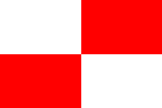
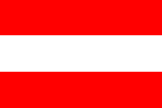
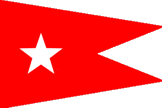
US
Whaling Flags/Pennants, 19th C (fotw)
- WHEATSHEAF
- In heraldry see ‘garbe’.
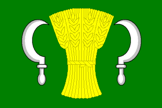
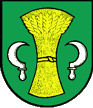
Flag
and Arms of Horní Bludovice, Czechia (fotw)
- WHEEL CROSS
- See ‘sun cross’ (also ‘celtic cross’).
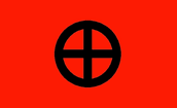
Flag of the Nordiska Rikspartiet, Sweden (fotw)
- WHEEL OF ST. CATHERINE
- See ‘St. Catherine's Wheel’.
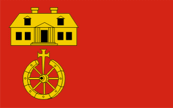
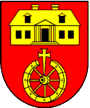
Flag and Arms of Nozdrzec, Poland (fotw)
- WHEFT
- See ‘waft’.
- WHIP PENNANT
- 1) See ‘masthead pennant 2)’.
- 2) See ‘wimpel’.

Whip/Masthead Pennant of Chile (fotw)
- WHIPTAIL
- In United States naval usage, a colloquial term for the commission pennant – see
‘masthead pennant 1)’.
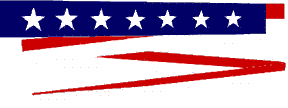
Commission Pennant, US (Sea Flags)
- WHITE ENSIGN
- 1) In British maritime usage the ensign now worn by all vessels of the Royal Navy,
over naval establishments, and by the Royal Yacht Squadron – but see 2) below
(also
‘blue ensign 1)’
‘naval ensign’ under ‘ensign’, ‘red ensign
1)’
and ‘St George’s ensign’).
2) In English then British RN usage, now obsolete (and largely – but not exclusively -
dependent upon the rank of the admiral in command), the second senior of three alternative
ensigns carried (undefaced) by a warship until 1864 – see
‘blue ensign 2)’,
‘red ensign 2)’, ‘yellow admiral’
and the notes below.
3) Generically, any canton flag (either plain or defaced) with a white field – particularly (but not exclusively)
if flown at sea – a British-style ensign (see also
‘blue ensign 3)’,
‘canton flag 1)’,
‘deface’ and
‘red ensign 3)’).

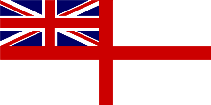
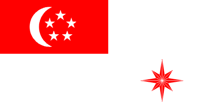
White Ensign c1630 – 1702, England (fotw);
White Ensign, UK (fotw);
War Ensign, Singapore (fotw).
Notes
a) With regard to 1), the term may also be applied to any British ensign with a white field.
b) Regarding 2), before 1864 an Admiral’s seniority was outwardly displayed by the colour
of his command flag and by the ensigns flown by any ships under his command - the junior colour being blue,
the next white and the senior red - however, in 1864 this colour system was abolished, and thereafter all
flag officers flew a white command flag from the appropriate masthead where applicable, and all Royal Naval
ships the white ensign (see also‘distinction of colour’
and ‘flag of command 1)’).
c) In addition the ensigns worn within a fleet could be arbitrarily changed (if the tactical situation
required it) by order of the Flag Officer in overall command of that fleet irrespective of the grade
held by any of his subordinate admirals.
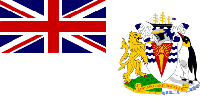
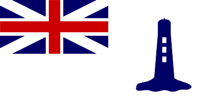
Flag of The British Antarctic Territories (fotw);
Commissioner's flag, Commissioners of Northern Lighthouses, UK (fotw)
- WHITE FLAG
- See ‘flag of truce’ (also
‘dinner flag’).

- WIDTH
- 1) That dimension of a flag which is measured vertically from its upper to
its lower edge - the height (see also ‘Appendix I’,
‘fly’, ‘hoist’ and
‘length’).
- 2) The narrower or shorter dimension of a stripe or band within a flag - howsoever
orientated (see also ‘stripe’).
- 3) The vertical height of an emblem, arms, shield, charge or badge when it appears on a flag –
but see the note below, ‘height’ and
‘width across’ (also
‘badge’,
‘charge’,
‘emblem’
'establishment of arms' and
‘shield’).

Please note that definition 3) is given with regard to the consistent
use of proportions when describing a flag and its charges, however, it is suggested that when
giving the actual dimensions of any such charge the word ‘height’
should be used for its vertical measurement and the phrase ‘width across’
for its horizontal size (see also ‘dimensions’ and
‘proportions’).
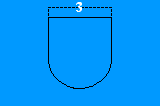
- WIDTH ACROSS
- The horizontal measurement of an emblem, shield, charge or badge when detailing the dimensions –
but see ‘width 3)’ (also ‘dimensions’,
‘height’ and ‘proportions’).
- WIGWAG (or WIG-WAG)
- In largely US usage, a system of signalling, now obsolete, in which a single flag was waved according
to an established code, and based upon the direction of the arches made by the flag (see also
‘Morse code signalling with flags’
and ‘semaphore’).
![[wigwag flag]](../images/v/vxt-d1125.gif)
Vessel Flag of the Army Signal Corps, US (showing a pair of Wig-Wag Flags)
- WIMPEL
- 1) A usually streamer-like pennant in national/livery colours and/or a
sometimes simplified charge, that is flown in place of a national or other
flag to avoid the appearance of an empty flag pole - especially popular in
Northern Europe and Scandinavia but increasingly used in the UK – a vlaggenstok
wimpel, national pennant/wimpel or flagpole pennant – but see 2) below and
‘provincial wimpel’ (also
‘charge’,
‘flüger’
‘livery colours’,
‘national colours 2)’,
‘national flag’ and
‘flag pole’).
2) In largely Dutch usage as above, but also sometimes flown (on the same flagpole) in
addition to the national flag to express loyalty to a particular municipality/region, or to the
House of Orange – for example, a long orange streamer is often flown with the Dreikleur if a
member of the Royal Family is present (see also ‘dreikleur’).
![[wimple - Denmark]](../images/v/vxt-d355.gif)
![[wimple - Sweden]](../images/v/vxt-d355a.gif)
The Wimpel/National Pennant of Denmark (fotw); The Wimpel/National
Pennant of Sweden (CS)
Please note that this term (or slight variations thereof) means pennant
or streamer in several European languages,
but has been adopted into English language vexillology in this context – and with the meaning given above - only.
In Danish and Swedish it is a VIMPEL, in Finnish viiri.
- WIND (WINDSURF or WINDSURFING) DANGER FLAG (or PENNANT)
- See ‘beach flag’.
![[Windsurf danger flag]](../images/v/vxt-d426a.gif)
![[Wind danger flag]](../images/v/vxt-d426b.gif)
Windsurfing Danger Flag and
Wind Danger Pennant, France (fotw)
- WIND VANE
- See ‘vane 3)’.
- WINDMILL
- A building or device for the harnessing of the wind to create power for the grinding of cereals or for other purposes (see also
‘scoop wheel’ and ‘waterwheel’).
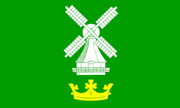
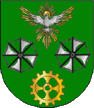
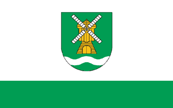
Flag of Eddelak, Germany (fotw);
Arms of Monsanto, Portugal (fotw);
Flag of Ostaszewo, Poland (fotw)
- WINDSOCK (or WINDCONE)
- 1) A flag-shaped like a sleeve, attached at the open end to a ring and pole,
and partially closed at the other – characteristic of traditional societies and
modern Japan (see also ‘draco’,
‘dragon flag’ and
‘ring’).
- 2) As above and generally brightly coloured, but usually fully open at the
fly end, tapered and used at airports (largely) to indicate wind direction.
- WING(S)
- In heraldry see ‘vol’ and ‘volant’.
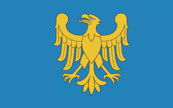
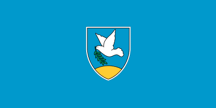
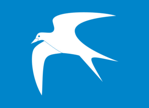
State Flag of Śląskie, Poland (fotw);
Flag of Izola, Slovenia (fotw);
Flag of Tvedestrand, Norway (fotw)
- WINGLESS DRAGON
- In Oriental (particularly but not exclusively Chinese) usage, a mythological creature which was (and is) symbolic of
– amongst other things – wisdom, power and strength – see ‘imperial dragon flag’ (also ‘dragon’)
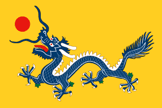
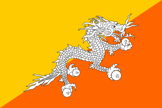
State Flag/Naval Ensign c1895, China (fotw);
National Flag of Bhutan (fotw)
Please note that the concept of a wingless dragon was not entirely unknown in pre-heraldic Europe – see ‘draco’ and ‘dragon flag 1)’.
- WING MARKING(S)
- 1) The term that should be used to describe a fuselage marking when it is displayed
upon the wing (or wings) of a military aircraft - see ‘fuselage marking’
(also ‘aircraft marking(s)’, ‘roundel 1)’
and ‘fin flash’ .
2) See ‘roundel 1)’.

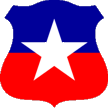
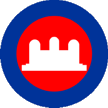
Wing Markings: The Netherlands,
Chile and Cambodia (fotw)
- WOLFTEETH (WOLF-TEETH or WOLF’S TEETH)
- 1) On flags, in largely (but not exclusively) Hungarian and other central/eastern European
usage, a band of inward pointing, connected triangles either curved, wavy or straight-sided and
forming a border on one, two, three or four sides of a flag – shark’s teeth, a triangle or triangular border or a border of triangles
or zigzag border (see also
'border',
'flammulets' and
‘serrated’).
- 2) In European heraldry, a charge formed by a series of generally curved triangles issuing
from the edges of a shield or banner of arms.
- 3) The term may also be applied where the fly edge of a flag is saw-toothed as illustrated below.
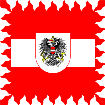
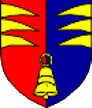
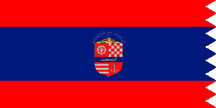
Government Official Afloat, Austria (fotw); Coat of arms (Westkingdom);
The Flag of District XIII Budapest, Hungary (fotw)
Please note with regard to 1) that the term wolfteeth (or
its alternatives) should only apply to
a border where the triangular charges face inward as shown above, and that when those
charges face both inward and outward the correct term is ‘flammulets’.
- WOLF-TRAP (or WOLF IRON or WOLF HOOK)
- In continental European (particularly German) heraldry the variously detailed representation of a device
for snaring animals of that name – a charge, as far as can be discovered, unknown in English heraldry – but see the note below..
![[wolftrap]](../images/v/vxt-d4893.gif)
![[wolftrap]](../images/v/vxt-d3527.gif)
![[wolftrap]](../images/v/vxt-d3911.gif)
Flag of Dinklage, Germany (fotw);
Flag of Wiefelstede, Germany (fotw);
Flag of Vechta, Germany (fotw)
Please note that these charges (in general) depict only parts of the device in question,
and that there seems to be very little (if any) difference in appearance between those traps
intended to catch animals and those designed to snare humans, with the original German
blazon not drawing a distinction between the two (as that on the flag shown below).
![[wolftrap]](../images/v/vxt-d4089.gif)
Flag of Erwitte, Germany (fotw)
- WORSHIP PENNANT
- See ‘church pennant’ and its following note.
![[Church pennant - Jewish worship pennant US]](../images/v/vxt-d083b.gif)
Jewish Worship Pennant, US (fotw)
- WREATH
- 1) On flags, two semi-circular crossed branches of varying types of intertwined
or plain foliage with or without flowers, that are often tied with a ribbon at their
crossing point and generally split at the top but see ‘garland 2)’
(also ‘crossed branches 1)’,
‘garland 1)’ and
‘panicles’).
- 2) In heraldry, a twisted band usually in the livery colours of a shield, generally
placed on top of the helmet and below the crest in a full set of armorial bearings
– a torse (see also ‘Appendix IV’,
‘armorial bearings’,
‘coat of arms’,
'crest 1)',
‘helm’, ‘livery colours 1),
‘military crest’
and ‘shield’).
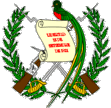

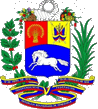
National Arms of Guatemala, Dominican Republic and
Venezuela (fotw)
Please note that a circlet composed of foliage is
called a chaplet, garland or orle in heraldry - see ‘garland 1)’
(also
‘civic crown 2)’ and
‘crown triumphal’).
- WREATH OF IMMORTELLES
- The silver replica of a laurel garland – or crown triumphal - placed at the
head of the colour pike or staff of certain British and Canadian regiments in
commemoration of particular distinction in action (see also
‘colour 2)’,
'colours 2)',
‘crown triumphal’,
‘garland’,
‘pike’ and
‘staff 2)’.
- WYN
- The exact details are conjectural, but considered to be have been either an alternative
term, now obsolete, for a lance pennon or vane (see also
‘pennon 2)’ and ‘vane 1)’).
- WYVERN
- In heraldry see ‘dragon’ and its following note.
![[Church pennant - Jewish worship pennant US]](../images/v/vxt-d4158.gif)
Flag of Tr้gor, France (fotw)

