- VAILING
- When the finial on the staff of military colour or parade flag is allowed
to touch – or nearly touch - the ground whilst being lowered in salute - but
see 'trailing 1)' (also
‘dipping 1)’).
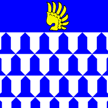
- VAIR (VAIRE or VAIRY)
- The heraldic term for a fur (reputedly that of a squirrel), which is usually (but not
invariably) shown as a series of blue inverted shield or bell-like shapes on a white or
silver field (see also ‘ermine’, ‘furs’ in
‘appendix III:’ and ‘potent’).

Municipal flag of
Awans, Belgium (fotw);
Prahins, Switzerland (fotw)
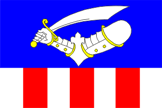
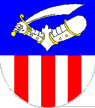
- VAMBRACED
- The heraldic term used when an arm only is shown clad in armour - but see
‘harnysed’
(also ‘armoured’ and
‘embowed’).

Municipal flag of
Běhařov , Czech Rep. (fotw);
Northern Karelia (fotw)
- VANE
- 1) The term for a short, triangular pennant now obsolete, sometimes
stiffened with a frame (often plain red) and formerly flown from the mastheads
of sailing merchant vessels in place of a masthead pennant, or sometimes to
identify individual ships when travelling in convoy (see also
‘frame 2)’,
‘masthead’ and
‘masthead pennant 1)’).
- 2) See ‘distinguishing vane’.
- 3) A length of bunting (or other light material) extended on a wooden stock and fixed
in the shrouds of a yacht or small sailing vessel to indicate wind direction – a wind vane.
- 4) A small metal flag-like object; generally set on a rod on the top of a
building – a weather vane.
- 5) A pre-heraldic vexilloid in the form of a decorative metal plaque mounted
onboard ship by the Vikings (see also ‘pre-heraldic’
and ‘vexilloid’).
Please note, it has been suggested that the word
“vane” was a southern English dialect corruption of the Medieval term “fane” –
see ‘fane 1))’.
Also please note that the term vane (or van) in heraldry can also refer to a
‘winnowing basket’ or scruttle/shruttle/fruttle/fan.

see supplemental note
- VANNALUM
- A medieval term, now obsolete, for a small flag or vane - see
‘vane 1)’.
- VANNERIA
- A medieval term, now obsolete, for a banner – see
‘banner’.
- VARIANT
- 1) A flag that shows comparatively minor differences (either official or unofficial)
from some standard model, and one example would be the variously difference standards of
the British Royal Family (see also
‘difference 1’) and
‘cadency, mark of’).
- 2) A term that may be applied when describing a flag which differs from others of the
same basic design, but for which no official specifications are known (see also
‘de facto’,
‘de jure’ and following notes).
- 3) See ‘archivexillum’.
Standard of HM The Queen & that of HRH The Princess Royal, UK (Graham Bartram)

Variants of the National Flag of Niger (Graham Bartram and fotw)
- VENETIAN ENTASIS TAPER
- A distinctive design invented in Venice that gives an aesthetically pleasing,
convex
taper to a tall flagpole, and now one of the most common form used - but see
‘cone tapered’ (also
‘flag pole’).
- VENN
- A term (sometimes further divided into Venn A and Venn B) employed for the detailed classification of
17th Century English military colours, with particular regard to their use within a regiment (see also
‘colour 2)’,
‘colours 2)’ and
‘stand of colours 1)’).
Please note that the above system of classification only applies
to English colours, and is taken from those illustrated by Captain Thomas Venn
in his book Military Observations (or the Tacticke Put Into Practice) of 1672.
Please note also however, that there were a number of variations not originally covered
by this classification, and that further, more comprehensive
methods have been recently proposed.
- VERGETTE
- See ‘paly’ in Appendix VI.
- VERT
- A heraldic term for the colour green (see also ‘Appendix III’
and ‘rule of tincture’).
- VERTICAL MERIDIAN (or MEDIAN)
- See ‘meridian’.
- VERTICAL BICOLOUR
- See ‘bicolour 1)’ (also ‘bicolour 2)’).
National Flag of Algeria (fotw)
- VERTICAL MULTI-STRIPE
- See ‘multi-stripe 3)’.
Flag of Duchcov, Czech Republic (fotw)
- VERTICAL TRIBAND
- See ‘triband 1)’ and ‘triband 2)’.
National flag of Barbados (fotw)
- VERTICAL TRICOLOUR
- See ‘tricolour 1)’ and ‘tricolour 2)’.
National flag of Andorra (fotw)
- VERTICALLY HOISTED FLAG
- In German speaking, Central European and some other usage, a term that may be
applied to any long, vertically orientated flag, but which (unlike a banner or hanging
flag as defined herein) is hoisted along its upright (rather than topmost) edge
- a flapping flag
(see also ‘banner 2)’,
‘hanging flag’,
‘hoisted flag’ and
‘outrigger flag’).
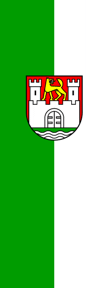
Vertically Hoisted Flag of Sankt Wolfgang, Germany (fotw)
Please note that this term has been introduced by the
Editors as no existing established term could be found, however, in German language
vexillology the terms hochflagge, hochformatflagge, hochformatfahne, knatterflagge
or knatterfahne (or their plurals flaggen and fahnen) are variously used.
- VESSEL FLAG (or PENNANT)
- In US army usage, now increasingly obsolete, a term for the special flag or pennant of
an army unit, or of a type of command, flown by that unit or commander only when operating
aboard a vessel – but see ‘boat flag 2)’ and note below.
From left: Army Ordinance Corps, US; Army Mine Planters, US;
Army Quartermasters Corps, US Flag and Pennant (fotw)
Please note that as far as is known the vessel flag of the US army transportation corps
is still in current use, and that the vessel flag of the US corps of engineers is now also
authorized to be flown on land at their facilities which are not located on Army installations.

From left: Army Transportation Corps, US; Army Corps of Engineers, US (fotw)
- VESTED
- The heraldic term that is properly employed to describe the vestments of a
bishop, archbishop or prince of the Church, but which is sometimes used for the
habit of a monk or friar – but see
‘habited’ (also
‘adorned 2)’ and
‘clad’).

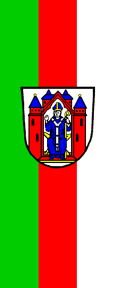
Arms and Flag of Brod Moravice, Croatia (fotw)
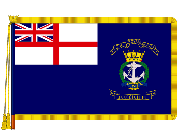
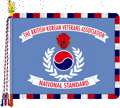
- VETERAN’S FLAG
- The flag of an organization representing the veterans of a particular, service,
war, campaign, or unit. The flags of veteran’s organizations are often mounted,
trimmed and treated like a military colour (see also
‘parade flag 2)’ and
‘colour 2)’).
Flag of the Royal British Legion, UK (Graham Bartram); Flag of The Royal Naval Association, UK
- VEXIFERRET
- A colloquial term for one who undertakes an assiduous search for (sometimes obscure)
flag information (see also ‘vexiferreting’ below and
‘vexillologist’).
- VEXIFERRETING
- A colloquial term for the assiduous search for (sometimes obscure) flag information (see also
‘vexiferret’ above and ‘vexillologist’).
- VEXILLARIUS
- 1) See 'vexillifer'.
- 2) A member of a Roman military unit (vexillatio) detached from the main force under a vexillum –
but see ‘vexillation’ (also ‘vexillifer’ and
‘vexillum’).
- VEXILLARY
- 1) (adj) Of or pertaining to flags (see also ‘vexillology’).
- 2) See ‘vexillifer’.
- VEXILLATION
- Any detachment of soldiers serving under a vexillum - but see ‘vexillarius 2)’ (also
‘banderium’,
‘vexillifer’ and ‘vexillum’).
Please note this term is taken directly from the Latin vexillatio being a
detachment of soldiers as described above.
- VEXILLATOR
- A 19th Century term, now obsolete, for the standard bearer in a medieval mystery
play.
- VEXILLATRY (or VEXILLOLATRY)
- The treatment of a flag as a fetish or religious object.
- VEXILLIFER
- The bearer of the vexillum (see also ‘vexillarius 2)’,
‘vexillation’ and ‘vexillum’.
- VEXILLOBIBLIOPHILE
- A person who loves and/or collects flag books (but see also
‘vexillophile’ below).
- VEXILLOGRAPHER
- A designer of flags, or the creator of a flag design.
- VEXILLOGRAPHY
- The designing of flags, or the creation of a flag design.
- VEXILLOHOBBYIST
- A collector of flags and/or artefacts concerning flags – but see ‘vexillophile’.
- VEXILLOID
- 1) A rigid emblem (such as a carved animal or similar) mounted on a pole,
which fulfils the function of a flag but which is not a flag, and characteristic
(but not exclusively so) of traditional societies – not to be confused with a
tufa (see also ‘tugh’ and
‘tufa’).
- 2) As above, but the forerunner of the flag as in the Nome standards of ancient
Egypt, the Semeia of classical Greece or in the Eagles of a Roman legion (see
also ‘eagle 2)’,
‘Semeion’ and
‘standard 5)’).
- 3) See ‘standard 6)’.
- VEXILLOPHILATELIST
- A student and/or collector of flag related postage stamps and/or of related
information.
- VEXILLOPHILE
- A collector of flags and/or of information regarding flags - a flag enthusiast
but see ‘vexillohobbyist’
(also ‘vexillobibliophile’).
- VEXILLOLOGIST
- A student of vexillology (see also ‘vexillology’).
- VEXILLOLOGY
- The scholarly or scientific study of the history, symbolism and/or usage of
flags.
Please note, the term was coined by Dr. Whitney
Smith of the Flag Research Center (Massachusetts, USA) and based on the Latin
vexillum (see also ‘vexillologist’ and
‘vexillum’).
- VEXILLONAIRE
- A person who is active in flag design or usage, or is engaged in promoting a specific agenda and/or
point of view with regard to flags.
- VEXILLOPHILY
- The collection of flags and/or of information regarding flags (see
‘vexillophile’ above).
- VEXILLUM
- An ancient Roman standard consisting of an often decorated (usually) red or purple
cloth hung from a cross bar. It is considered to be the first true flag in Western
culture, and from which the term vexillology is derived (see also
‘vexillarius’, ‘vexillifer’, 'vexillation' and
‘vexillology’).
![[Roman vexillum]](../images/v/vxt-d345.gif)
Vexillum of the 13th Legion (Eugene Ipavec)
Please note however, that whilst frequently described as a cavalry standard (which it was),
the vexillum also had a number of other military uses.
- VEXILLUM REGALE
- A medieval term, now obsolete, for the royal standard – see
‘royal standard 1)’.
Please note that it is unclear whether the medieval
chroniclers were referring to a banner of the royal arms as is common today, or
to a standard of the heraldic pattern known to have been used by many English
kings in the medieval period (see also ‘standard 4)’).
- VEXILLI ERECTIO
- A medieval term, now obsolete, for the fixing of banners or standards to the walls
of a fortress (see also ‘banner 1)’ and
'standard 4)).
- VILLENÉ
- See ‘priapic in its virility’.
- VIRILED
- See ‘priapic in its virility’.
- VISUAL CENTRE (or CENTER)
- The term used when a charge is not set in the exact geometric centre of a flag, section of flag
or of the panel it occupies, or on a vertical or horizontal meridian of that flag, section or panel,
but is placed as to appear so centred to the observer – but see note below (also
‘centred’,
‘meridian’,
‘optical proportions’ and
‘panel’).
Civil Ensign of Japan 1870 – 1999 (CS); Flag of Manitoba, Canada (CS); Flag of Horní Radechová, Poland (fotw)
Please note that the examples given above show the pre-1999 merchant flag
of Japan with its disc set slightly towards the hoist, the arms on the flag of Manitoba placed a little
below the horizontal meridian and the flag of Horní Radechová with a charge set on the vertical meridian
but below the horizontal.
- VLAGGENSTOK WIMPEL
- See ‘wimpel 1)’ and ‘wimpel 2)’.
- VOIDED
- A basically heraldic term that is applicable to any ordinary (or other charge) when
the middle is removed so that the field of a shield or banner of arms may be seen through it
(see also ‘charge 2)’,
‘cross-voided’ in ‘appendix VIII’,
‘mascle’,
‘ordinary’ and ‘pierced 2)’).
Please note that in vexillology a voided cross such as shown above may, for example
(and with equal accuracy) be described as “a red cross, fimbriated yellow on a red field”
or similar.
- VOIDED CROSS
- See ‘cross-voided’ in ‘appendix VIII’.
- VOIDED LOZENGE
- See ‘mascle’.

Flag of Daillens, Switzerland (fotw)
- VOL
- The French heraldic term for a pair of wings conjoined at the base and placed with the tips upwards,
but sometimes used when only a single wing is shown or differently orientated – but see ‘volant’ below
(also ‘conjoined 1)’,
plus ‘rising’ and ‘displayed’ in ‘appendix V’).
- VOLANT
- The heraldic term for wings, and sometimes (but not invariably) used to signify that those wings are extended in a horizontal
position as if in flight – but see note below (also ‘vol’ above,
plus ‘rising’ and ‘displayed’ in ‘appendix V’).
Please note that these two terms (vol and volant)
can have a rather complex use, and we suggest that a suitable glossary or
dictionary of heraldry be consulted for further details.