
This page is part of © FOTW Flags Of The World website
Dictionary of Vexillology: B (Base – Bayeux Tapestry)
Last modified: 2026-07-18 by martin karner
Keywords: vexillological terms |
Links: FOTW homepage |
search |
disclaimer and copyright |
write us |
mirrors
On this page:
BASE
1) In heraldry a term for the lower section of a shield or banner
of arms, which heraldic use frequently suggests should occupy roughly one-third of the total depth of
that shield or flag – a Champagne (see also
banner 1),
coat of arms,
field, pointed).
2) In vexillology an alternative name for the bottom edge of a flag.

BASE FLAG
In US Air Force usage, a post flag (see also
post flag 1)).
BASIC HERALDIC COLOURS
See enamels (also tinctures).
![[colour example]](../images/v/vxt-d555d.gif)
![[colour example]](../images/v/vxt-d555b.gif)
![[colour example]](../images/v/vxt-d555i.gif)
![[colour example]](../images/v/vxt-d555f.gif)
![[colour example]](../images/v/vxt-d555g.gif)
Gules, Azure, Vert, Purpure and Sable
BASILISK
In heraldry see dragon
and its following note.

Flag of Kazan, Tatarstan (Russia)
BATHING FLAG (or PENNANT)
See beach flag.


Safe Bathing, Bathing with Caution and No Bathing Flags, Spain
BATON
1) A symbol of the highest military rank (a field marshal or five-star-general etc.),
and usually displayed on their rank flags and insignia.
2) In traditional heraldry it is considered a diminutive (although usually couped)
of a bend or bend sinister.
3) In modern heraldry the term is often used to describe an undecorated walking staff, a rod or
similar – but see baton fleury
(also pilgrim's staff).


Flag of Chancelaria, Portugal;
Flag of a Field Marshal, India;
Flag of Vilar de Peregrinos, Portugal
BATON FLEURY
A heraldically derived term that covers a short shaft topped by a
fleur-de-lis – staff(s) or sceptre fleury –
see baton 3),
fleury (also sceptre).

Flag of Brislach, Switzerland
BATON SINISTER
In heraldry see baton(s) 2),
plus bend sinister and its following note.

Arms of the Duke of Richmond 1519–1536 illegitimate son of King Henry VIII, England
(Wikimedia)
BATTALION RING
A term for a metal band sometimes placed on the staff of a military or national
colour (usually below the lower edge of the flag), and showing the battalion and
regiment to which it belonged – a ring (see also
battle honour,
colour 2),
staff 2)).
Please note that as far as can be determined, this
was a custom formerly in the US Army (but still in use in the US Marine Corps)
and also in some European forces.
see supplemental note
BATTLE BANNER
A generic term for those flags having heraldic (or armorial) symbolism that were carried
into battle during the medieval period (see also banner 1),
banneret 2),
battle standard,
livery colours,
lance pennon 1),
pennoncelle,
pennoncier,
standard 3)).
![[battle banner]](../images/v/vxt-d1088.gif)
![[battle banner]](../images/v/vx-gb_rich3.jpg)
Lance Pennon of Sir Robert Knolles. Knight Banneret c1360; England;
Heraldic Standard of King Richard III 1483–1485, England
BATTLE COLOR (or COLOUR)
In US usage, the organizational colour of a combatant Marine Corps unit or
of the Corps as a whole when carried by dismounted troops (see also
branch of service flag).

Battle Colour of the
Marine Corps,
US (seaflags.us)
BATTLE EFFICIENCY PENNANT
In US naval usage, a triangular pennant that is flown (from the foremast) to indicate that
the vessel has achieved superior performance in an operational environment – an
E pennant or
meatball (see also award flag).


Battle Efficiency and Special Battle Efficiency Pennants,
USN
BATTLE ENSIGN(S)
In RN/USN usage and in some others, one or more large naval ensigns
flown from the yardarms of a warship prior to commencing – and
during – a surface engagement at sea (see also garrison flag).

Warship of the USN flying a Battle Ensign (Wikipedia)
Notes
a) A warship raises additional large-sized
ensigns prior to an engagement at sea for added identification and in case one
or more are shot away – see strike.
b) Dominion/Commonwealth navies (such as those of Australia and Canada) which formerly
fought under the British white ensign are known to have (sometimes) flown their respective national
flags as an additional battle ensign.
BATTLE FLAG
1) A flag (either official or unofficial) that is specifically intended for
use in battle – either to avoid confusion with the flag of an enemy or to convey
a patriotic sentiment – and used in addition to or instead of military colours
(see also colour 2),
colours 2),
southern cross 2),
stainless banner).
2) In US naval usage, an unofficial flag, sometimes marked with stars to
recall the number of times a particular vessel has been in combat, and flown from the
yardarm when entering or leaving port, completing underway refuelling,
parting company with other ships, or similar occasions – a house flag or unrep flag.
3) In US naval usage now obsolete, an unofficial flag which, defaced
by a number of varying symbols, was used by submarines to signify that the boat flying it had
successfully engaged an enemy – but see jolly roger 2).
4) In some Central and East European usage (e.g. the Romanian Drapel de lupta literally meaning
battle flag) – an alternative term for an army flag or a military colour – but see
colour 2) (also war flag 2)).


Battle Flag of USS Jack 1944, US (seaflags.us);
Battle Flag of the Army of Northern Virginia, CSA 1861–1865;
Battle/House Flag of USS Harry S Truman, US (seaflags.us)
Please note with regard to 2), that these flags
have no standard pattern, official existence or meaning, but are designed and
used by individual ship’s companies to express pride in their vessels, that their
use has become traditional in the US Navy, that US and that other naval forces
have official naval code signals to order and conduct operations such as underway
replenishment (with these unofficial flags being hoisted in addition).
BATTLE HONOUR (or HONOR)
A mark of distinction, usually including the name of a battle or campaign,
added to a regimental or other unit colour to show that unit’s military
service (see also
battalion ring,
colour 2),
ferrule,
staff 2),
streamer 1),
streamer retaining ring,
and compare with augmentation of honour).


Regimental Colour 28th Regiment of Foot c1880, UK;
Queen's Colour and Regimental Colour,
1st Battalion The Gloucestershire Regiment, UK
Notes:
a) Battle honours may take the form of an inscription within a ribbon scroll applied to the field of the
colour (as on the illustrations above), or a metal band (or bands) around the staff, or a metal clip
attached to a streamer, or to the streamer itself – a battle streamer or honorary distinction.
b) The ships of many navies show
their battle honours on a carved board or similar on ceremonial occasions, or
when the ship is open to visitors rather than on a unit flag.
BATTLE STANDARD
A term, now obsolete, for the Scottish heraldic standard
as carried in battle, and there are indications that it was the smallest of three sizes (see
also pageant standard,
pinsel,
great standard).
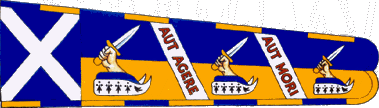
Standard of the Laird of Clan Barclay (The Flag Center)
BATTLE STREAMER
See battle honour.
![[battle streamer]](../images/v/vx-battlestreamer.jpg)
Battle Streamer Awarded for the Liberation and Defence of Kuwait 17 January – 11 April 1991, US
(nmaahc.si.edu)
BATTLED (or BATTELLY)
Alternative heraldic terms to embattled.
075.gif)

Arms and Flag of Miren, Slovenia
BATTLEMENTS (or BATTLEMENTED)
In heraldry see embattled and the note below.

Flag of Harburg district, Germany
Please note that a castle's battlements are composed of the upright merlins, with the embrasures
between them traditionally termed either crenels or crenelles.
BAUCANS (or BAUCCEDILLIAN)
Alternative 13th century terms, now obsolete, for the plain red streamer flown from a
ship’s masthead (in northern European waters) to signify that ‘no quarter would
be given’, and the size according to record was 30 yards (24.45 m) long by 2 yards
(1.82 m) wide (see also
flag of defiance and
streamer 2)).
![[Baucens]](../images/v/vxt-d036.gif)
Notes:
a) This flag first appears in records
of the 1290s, and is considered to have been a direct ancestor of the later flag
of defiance.
b) "No quarter would be given" indicates that surrender would
not be accepted and all prisoners killed.
BAUCEANT (BAUCEANS, BAUCENT or BEUCENNUS)
Alternative medieval terms for the black and white banner of the
Knights Templar – the bauceans, bauceant, beucennus or balzaus
(see also balcanifer and
rounded cross).
![[Bauceant]](../images/v/vx-rel-baux.gif)
![[Bauceant]](../images/v/vx-rel-bauc.gif)
![[Bauceant Battle Flag]](../images/v/vx-rel-temp1.gif)
Bauceant Flags
BAYEUX TAPESTRY
An 11th century wall hanging that records the Norman invasion of English in 1066, and considered to
be a primary source of pre-heraldic symbolism (see also
pallia,
raven flag).
![[Bayeux tapestry]](../images/v/vx-bayeuxtap.jpg)
![[Bayeux tapestry]](../images/v/vx-fr_bayt1.gif)
Fragment of the Tapestry (Wikipedia);
One interpretation of the Pallia given to William of
Normandy in 1066 as shown in that Tapestry
Introduction |
Table of Contents |
Index of Terms | Previous Page |
Next Page
