- CLAD
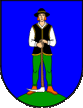
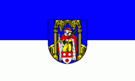
- A term sometimes used in continental heraldry in place of its English
heraldic equivalents of habited, habillé or vested – see
‘habited’ and
‘vested’).
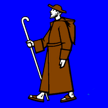
Flag of Münchwilen, Switzerland (fotw);
Arms of Delnice, Croatia (fotw);
Flag of Könnern, Germany (fotw)
- CLAD IN ARMOUR
- 1) In vexillology see 'armoured 1)'
2) In heraldry see
‘harnysed’.
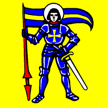
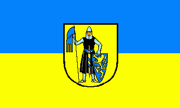
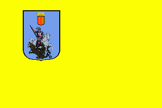
Flag of Alvaneu, Switzerland (fotw);
Flag of Laucha upon Unstrut, Germany (fotw);
Flag of Es Castell, Spain (fotw)
- CLAN STANDARD
- A term sometimes (inaccurately) used to describe the heraldic standard of a
Scottish Laird or clan chief – see
‘battle standard’,
‘pageant standard’,
‘great standard’ and
‘standard 4)’
(also ‘pinsel’).
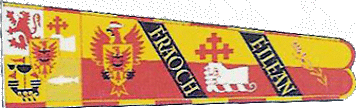
Standard of the Laird of Clan McDonald of McDonald (The Flag Center)
- CLASP
- See ‘bar 3)’.
- CLASS FLAG
- In British RAF usage, the alternative name for a rank flag – see
‘rank flag 1)’
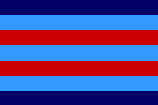
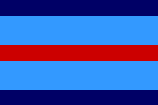
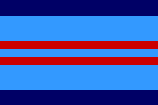
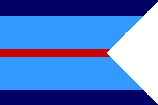
RAF - Air Chief Marshal, Air Marshal. Air Vice-Marshall, Air Commodore (fotw)
- CLAWED
- In heraldry see ‘armed 2’.
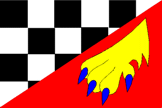
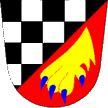
Flag and Arms of Bezverov, Czechia (fotw)
- CLEAN MARINA FLAG (or PENNANT)
- In US usage the flag (or pennant) flown by those marine facilities that have reached an acceptable standard under various state sponsored programs - see ‘blue flag’ (also ‘pumpout flag’).



Clean Marina Flags: South Carolina,
Virginia, and
Washington
(fotw)
- CLEAT
- A metal fitting with two arms, which is attached to the lower part of a flagpole
or mast for securing the halyard (see also
‘belaying pin’,
‘flag pole’ and
‘halyard’).
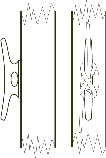
Željko Heimer
- CLEW(S)
- A term for the lower fly corner or both lower corners of a flag – particularly
(but not exclusively) a religious/processional banner or similar – to which a line
or lines are attached so as to prevent unwanted movement - particularly in windy
conditions (see also ‘banner 3)’ and
‘outrigger pole’)
- CLIP
- See ‘Inglefield clip’
- CLIP AND GROMMET
- An efficient method of hoisting a flag much favoured in the US, whereby clips attached to
the halyard are slipped into grommets on the flag – see
‘grommet 1)’ and
‘Inglefield clip’ (also
‘appendix I’ and
‘running eye and toggle’).
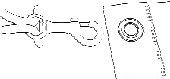
Željko Heimer
- CLOSED SLEEVE
- A technical term for the sleeve of a flag (usually a parade flag) which is closed at its upper end
so that the staff (when inserted) does not project above the top of that flag (see also
‘sleeve 2)’,
‘staff 2)’ and
‘parade flag’).
- CLOSE UP (or CLOSED UP)
- (adj) The naval term for when a flag or pennant is hoisted right up to the truck
(see also also ‘code pennant’,
‘dip, at the’ and
‘truck’).
- CLOTHED
- In heraldry see ‘clad’,
‘habited’ and
‘vested’).
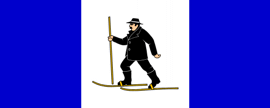
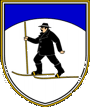
Flag and Arms of Bloke, Slovenia (fotw))
- CLOVEN BULLNOSE
- See ‘double tailed descate’.
![[cloven bullnose example]](../images/v/vxt-d1188.gif)
- CLOVEN DESCATE
- See ‘descate’.
![[cloven descate example]](../images/v/vxt-d1189.gif)
Guidon of the Metropolitan Police Mounted Branch, UK (fotw)
- CLOVERLEAF
- In heraldry see ‘trefoil’.
![[cloverleaf example]](../images/v/vxt-d3865.gif)
![[cloverleaf example]](../images/v/vxt-d3865a.gif)
Flag and Arms of
Tzum, The Netherlands (fotw)
- CLOVERSTEM(S) (or CLOVER STEM)
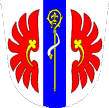
- The term – and a direct translation of kleestengeln or kleestengel – for a charge largely
(but not exclusively) used on heraldic birds (especially eagles in European heraldry) which
may be described as a crescent-like shape (usually but not invariably) ornamented with
trefoil/clover leaf elements either at one or both ends and/or in the middle, and sometimes
visible only on the wings – kleestengeln or kleestengel (see also
‘crescent 2)’ and
‘trefoil’).
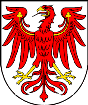
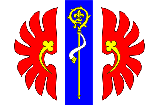
Arms of Brandenburg, Germany (fotw);
Flag and Arms of Brodeslavy, Czechia (fotw)
- CLUB PENNANT
- A small triangular flag designed to be hung vertically usually charged with
the emblem and livery colours of a sporting club – a vertical pennant (see also
‘livery colours’,
’pennant 2’ and
‘souvenir flags’).
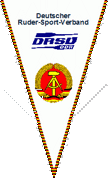
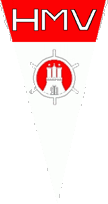
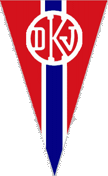
Pennants of the Deutscher Ruder Sport Verband, the
Hamburger Motorboot Verband
and the Deutscher Kanuverband, Germany (fotw)
- CMYK
- The Initials for Cyan, Yellow, Magenta and Black, being the four primary shades
used in the print process to create any colour, and an abbreviation for the four-colour
printing system (see also ‘cable number’,
‘British colour code’,
‘Pantone Matching System’ and
‘International Colour Code’).
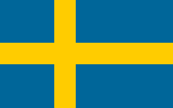
CMYK for the National Flag of Sweden - Blue: 10% Yellow, 50% Magenta and 100% Cyan, Yellow: 100% Yellow and 20% Magenta
- COACHWHIP PENNANT
- See ‘masthead pennant 2)’ and
‘whip pennant 2)’).
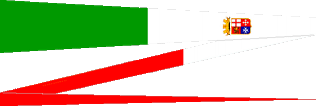
Coachwhip/Masthead Pennant, Italy (fotw)
- COAT
- A heraldic term that refers to each individual section or quartering on a
shield or banner of arms – see 'coat of arms 2)' (also 'banner of arms',
'impaled',
'quartering' and
'shield 2)’).
- COAT OF ARMS (or COA)
- 1) On flags and generically, the heraldic insignia of an individual or family,
or of a corporate institution such as a nation, province or municipality, or of
a commercial enterprise. In general terms the coat of arms can contain all the
elements that make up a full set of armorial bearings - but see 2) below (also
‘lesser arms’,
‘middle arms’ and
‘state arms 1)’
under ‘arms’).
- 2) In heraldry, as above but the term only refers to the shield from a full
set of armorial bearings – an escutcheon (see also
‘armorial bearings’,
'banner of arms', and
‘shield’).
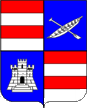
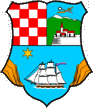
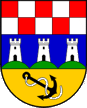
Coats of Arms of Dubrovnik-Neretva,
Primorje-Gorski Kotar and Bakar,
Croatia (fotw)
Notes
a) A full set of armorial bearings
can include (for example) shield, supporters, helmet, torse, crest, mantling,
compartment, motto, collar etc., and whilst many of the terms used are illustrated
in Appendix IV and/or briefly defined herein, it is
suggested that a suitable glossary or heraldic dictionary be consulted for full details.
b) The emblems of some countries
such as those of Mexico or Italy – whilst conforming to the definition of that
term as detailed herein – are officially described as “coats of arms” (see also
‘emblem, national’).
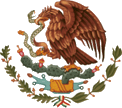
National Coat of Arms/Emblem of Mexico (fotw)
- COCKADE
- 1) A rosette or bow, generally in national or livery colours, and sometimes
used to decorate a staff below the finial (see also ‘cravat 1)’,
‘finial’,
‘livery colours’
and ‘staff’).
- 2) A rosette or bow formerly worn by both military personnel and civilians
(largely on the hat or shako) to indicate patriotic or political loyalties and
still sometimes seen.
- 3) See ‘roundel 1)’.
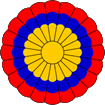
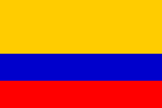
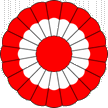
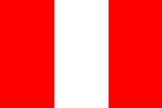
The National cockades and flags of Colombia and
Peru (fotw)
Please note that the cockade was the precursor of many national flags (those of Argentina and France being two examples).
- COCKATRICE (or COCATRICE)
- In heraldry see ‘dragon’
and its following note.
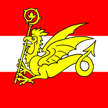
Flag of Porrentruy, Switzerland (fotw)
- CODE PENNANT
- A tapered, square-ended pennant (or trapezoid) used in the International
Code of Signal Flags to indicate a decimal point, but more importantly that a
message has been seen by the intended recipient when hoisted at the dip, and/or
that it has been received and understood when closed up – the answering pennant
(see also ‘close up’,
‘dip, at the’,
‘International Code of Signal Flags’,
‘pendant coupee’ and
‘signal flag’ and
‘trapezoid 2)’).
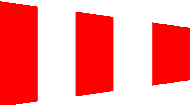
Code pennant (fotw)
Please note that this pennant is also included in the NATO Code of Signals, but (as
opposed to the meanings given above) is raised at the start of a signal hoist to
indicate that any following message must be read using the International Code.
- COG
- 1) See ‘cog-wheel’.
2) A type of single-masted, medieval trading vessel (usually shown with fore and aft
castles as equipped for war) – but see ‘ancient ship’
‘nef’ and the note below.
![[Kostrena]](../images/v/vxt-d2684.gif)
![[Kostrena]](../images/v/vxt-d2684a.gif)
![[cog]](../images/v/vxt-d4900.gif)
Flag and Arms of Kostrena, Croatia (fotw);
Flag of Wittmund, Germany (fotw)
Please note with regard to 2) that the terms “cog“ and “nef” both refer to a single-masted
vessel and are generally considered interchangeable, however, strictly speaking the earlier cog was
most often
steered by a long oar, whereas the later nef invariably had a stern mounted rudder.
- COG-WHEEL (COG WHEEL or COGWHEEL)
- A toothed wheel used in mechanical engineering to transmit power, and
usually symbolic of industry or industrial workers – a toothed or gear-wheel - but see ‘waterwheel’.
![[cog-wheel]](../images/v/vxt-d4544.gif)
![[cog wheel]](../images/v/vxt-d192b.gif)
![[cog wheel]](../images/v/vxt-d4545.gif)
Flag of Grevesmühlen, Germany (fotw); Flag of Le Sentier,
Switzerland (fotw); Flag of the Labour Party, Turkey (fotw)
- COGNISANCE
- 1) In flags a medieval term, now obsolete, for a lance pennon - see
‘lance pennon 1)’.
- 2) In heraldry as above but the term can include everything by which an
armigerous person is known (see also
‘armigerous’).
