
This page is part of © FOTW Flags Of The World website
Dictionary of Vexillology: H (Head - Historical Flag)
Last modified: 2022-08-27 by rob raeside
Keywords: vexillological terms |
Links: FOTW homepage |
search |
disclaimer and copyright |
write us |
mirrors
On this page:
HEAD
See ‘hoist 1)’ (also
‘heading’ and
‘masthead’).
HEAD, FLAGSTAFF
The topmost point of a flagstaff from which a flag can be flown, and which lies below the cap or finial
- see ‘finial’.
HEADING (or HEADER)
A piece of heavy material, usually canvas or double-ply bunting, along the
hoist edge of a flag, into which a rope is sewn as the hoistline, or into
which grommets are inserted to facilitate the hoisting of a flag - a hoist strip (see also
‘sleeve 2)’, ‘hoistline’, ‘grommet 1)’ and ‘hoist 1)’).

Please note that the increasingly (but by no means entirely) obsolete practice of fixing a flag to
its pole or staff by a series of attached loops is almost certainly based on the earlier use of ties –
see ‘loops’ (also ‘ring 4)’ and ‘ties’).
HEADQUARTERS FLAG
1) See ‘camp flag’.
2) In US military, naval and some other usage, the rank flag of a commanding officer when flown
from their headquarters ashore – a designating (of headquarters) flag (see also
‘rank flag 1)’ and
‘flag of command’).
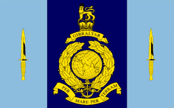
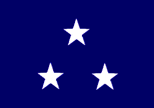
Headquarters/Camp Flag, Royal Marine Commandos, UK (fotw);
Rank/Headquarters Flag, Vice Admiral USN (fotw)
HEADSTICK
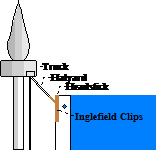
In largely naval usage a short piece of wood sewn into the top of a flag’s heading to allow the Inglefield
clip to be attached about five cm from the top, thus permitting the flag to be
hoisted right up to the truck, while enabling the top hoist corner of the flag to
remain straight and upright – but see ‘frame 2)’
(also ‘Appendix I’,
‘Inglefield clip’ and
‘truck’).
HEAD OF STATE'S COLOUR (or COLOR)
That flag presented to a military formation by a country’s ruler – see ‘colour 2)’ and ‘colours 2)’.
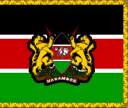
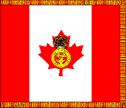
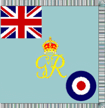
Presidential Colour of Kenya (fotw); Queen’s Colour of
Princess Patricia's Canadian Light Infantry (fotw); King’s Colour
RAF 1947 – 1952, UK (fotw)
HEAD OF STATE'S STANDARD (or FLAG)
A Royal, Imperial or Presidential standard (or flag) – see
‘royal standard 1)’,
‘imperial standard 1)’ and
‘presidential standard’.
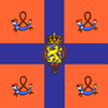
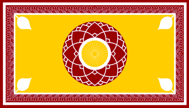
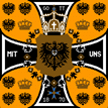
Royal Standard of The Netherlands (fotw);
Presidential Flag 1994 – 2005 of Sri Lanka; Imperial Standard of
Germany 1871 – 1918 (fotw)
HEART-SHAPED SHIELD
1) See ‘Renaissance shield’.
2) See ‘triangular heart-shaped shield’.
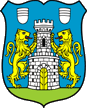
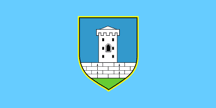
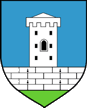
Arms of Ilok, Croatia (fotw); Flag and Arms of
Tinjan, Croatia (fotw)
Please note that several of the terms describing a specific type of shield are still in the process
of standardization, and that no consistent approach has thus far been identified.
HEART SHIELD
The term, and a translation of the German herzschild, sometimes used in heraldic blazoning instead of the correct (English) term inescutcheon – see ‘inescutcheon’.
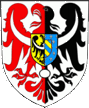
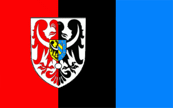
Arms and Flag of Kamienna Gσra, Poland (fotw)
HEIGHT
1) The vertical measurement of an emblem, shield, charge or badge when detailing the dimensions
- but see ‘width 3)’ (also
‘dimensions’ and
‘width across’)
2) see ‘width 1)’

HELM (or HELMET)
The metal headpiece from a suit of armour usually ensigned above the shield in a coat
of arms or set of armorial bearings, but sometimes seen as a separate charge – a helmet or casque (see also
‘Appendix IV’,
‘armorial bearings’,
‘coat of arms’,
‘crest 1)’,
‘ensigned’,
‘shield’ and
‘wreath 2)’).
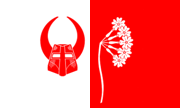
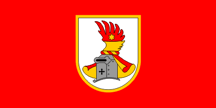
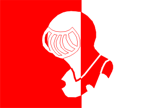
Flag of Rantzau, Germany (fotw);
Flag of Josipdol, Croatia (fotw);
Flag of Helmond, The Netherlands (fotw)
Please note that in English heraldry the style and positioning of a helm varies according to the rank of the bearer, and it is suggested that a suitable glossary or dictionary of heraldry be consulted for full details.
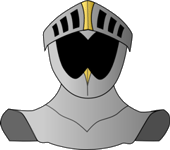
Helmet of a Knight in English Heraldry (Wikipedia)
HERALDICALLY BASED FLAG
See ‘armorial banner 2)’ and ‘livery colours’.
![[Heraldically based]](../images/v/vxt-d2886.gif)
![[Heraldically based]](../images/v/vxt-d2886a.gif)
![[Heraldically based]](../images/v/vxt-d2887.gif)
![[Heraldically based]](../images/v/vxt-d2887a.gif)
Flag and Arms of Lanškroun, Czechia (fotw); Flag and Arms of
Galanta, Slovakia (fotw)
HERALDIC BANNER
A banner of arms - see ‘banner of arms’
(also ‘armorial banner 2)’).
![[Banner of Drahelčice]](../images/v/vxt-d3832.gif)
![[Arms of Drahelčice]](../images/v/vxt-d3832a.gif)
Heraldic Banner and Arms of Drahelčice, Czechia (fotw)
HERALDIC BADGE
See ‘badge in heraldry’ under ‘badge’.
![[heraldic badge]](../images/v/vxt-d2237.gif)
Badge of the Royal House of Tudor 1486 – 1603, England (Wikipedia)
HERALDIC BEASTS
The animals, birds, fish and mythological creatures used as supporters and/or charges in a
set of armorial bearings, or on a banner of arms or a flag - but see note below (also
‘armorial bearings’,
‘banner of arms’,
‘dragon’,
‘griffin’,
‘mermaid’,
‘phoenix’,
‘sea-lion’ and
‘supporters’).
![[heraldic beast]](../images/v/vxt-d4563.gif)
![[heraldic beast]](../images/v/vxt-d4779.gif)
![[heraldic beast]](../images/v/vxt-d2175.gif)
Flag of Varaždinske Toplice, Croatia (fotw);
Flag of the Governor General of Canada;
Flag of Udbina, Croatia (fotw)
Please note that the basic attitudes of heraldic beasts are listed/briefly described herein, and may be found at
‘couchant’,
‘erect’,
‘forcene’,
‘guardant’,
‘haurient’,
‘naiant’,
‘passant’,
‘rampant’,
‘regardant’,
‘salient’,
‘segreant’ and
‘urinant’.
HERALDIC COLOURS
See ‘tinctures’.





HERALDIC FOUNTAIN
See ‘fountain 1)’.
![[heraldic fountain]](../images/v/vxt-d3083a.gif)
![[heraldic fountain]](../images/v/vxt-d3083.gif)
Arms and Flag of Sanguinheira, Portugal (fotw)
HERALDIC LILY
See ‘fleur-de-lis’.
![[heraldic lily]](../images/v/vxt-d4780a.gif)
![[heraldic lily]](../images/v/vxt-d4780.gif)
Arms and Flag of Domaniewice, Poland (fotw )
HERALDIC STANDARD
1) In English usage, a flag of heraldic design, long and tapering, possibly with a rounded or double-rounded
(lanceolate or double-tailed descate) fly carrying the owner’s badge and motto (sometimes also a national symbol or
personal arms), and bordered in his livery colours. Originally used as an identifying symbol by medieval noblemen,
and still occasionally flown by those entitled to it (see also
‘badge in heraldry’,
‘banner of arms’, ‘double-tailed descate’,
‘lance pennon 1)’,
‘lanceolate’ and
‘motto’).
2) The headquarters flag of a Scottish nobleman or clan chief (and a standard
as defined above), it is
between 3.5 and 7.5m long (dependent upon rank) and tapers from 120 cm to 80 cm. The hoist carries either the
national flag or owner’s arms, whilst the tail is in the main livery colours and has the motto (usually on diagonal
bands) separated by the owner’s crest and other badges. The tail is generally split into two rounded
(double-tailed descate) ends (except for those chiefs who do not hold a title of nobility, baronetcy or knighthood
whose standards have a simple rounded or lanceolate end), and the whole is
edged or fringed with alternating livery colours (see also ‘battle standard’,
‘double-tailed descate’,
‘great standard’,
‘lanceolate’, and
‘pageant standard’).
![[Heraldic standard example]](../images/v/vxt-d169.gif)
![[Heraldic standard example]](../images/v/vxt-d2691.gif)
Heraldic standard of the Master Gunner St James’
Park UK (Graham Bartram); Heraldic Standard of
King Henry VI c1450, England (fotw)
Notes
a) With regard to 1), in English heraldry the entitlement to a heraldic standard is consequent upon the
granting or possession of a badge, but is not dependent upon rank (see also ‘badge in heraldry’).
b) Regarding 2) in Scottish heraldry the entitlement to a standard (and to heraldic flags other
than a banner of arms) is consequent upon a separate grant by the Lord Lyon King of Arms (see also
‘pinsel’ and
‘guidon 3)’).
HERALDRY
The science concerned with the designing, interpretation, recording and blazoning of
those armorial bearings and/or heraldic insignia that pertain to an individual, an
institution or to a corporate entity (see also
‘anti-heraldry’,
‘armorial bearings’,
‘blazon’,
‘coat of arms 2)’,
‘insignia’
and ‘pre-heraldic’).
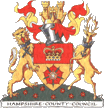
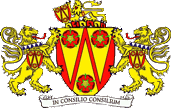
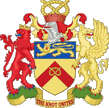
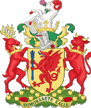
Armorial Bearings for the counties of Hampshire,
Lancashire; Staffordshire and
Somerset, UK (fotw)
HERZSCHILD
The German term for an inescutcheon - see ‘inescutcheon’.
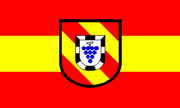
Flag of Ippesheim, Germany (fotw)
HIGH COMMISSIONER’S FLAG
In British and US usage, now obsolete, see ‘colonial flags/ensigns’.
![[High Commissioner's flag]](../images/v/vxt-d3031.gif)
![[High Commissioner's flag]](../images/v/vxt-d3033.gif)
Flag of the Western Pacific High Commissioner
1905 –1976, UK (fotw); Flag of the
Philippines High Commissioner 1935 - 1946, US (fotw)
Please note that in UK usage the title is not obsolete, but that its role has changed, and no longer (as far as is known) carries the entitlement to a special flag – see ‘diplomatic flags’.
HILTED (HILTED AND POMMELED or HILT)
The alternative heraldic terms used when the grip, pommel and cross/hand guard of a sword or dagger are of a different
tincture to its blade – but see note below and ‘hafted’ (also
‘barbed’,
‘garnished’,
‘pommeled’,
‘shafted’ and
‘tincture’).
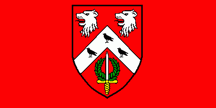
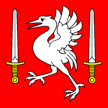
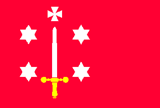
Flag of St. Anne's College, Oxford University, UK (fotw);
Flag of Villars-sous-Mont, Switzerland (fotw);
Flag of Haarlem, The Netherlands (fotw)
Please note that heraldic writers will sometimes blazon the hilt and the pommel
(of a sword or dagger) separately when describing the charges on a coat of arms – hilted and pommeled.
HINOMARU (or HI-NO-MARU)
Literally “sun-disk” and the civil ensign/national flag of Japan
since 1870 – the hi-no-maru or nisshoki (see also
‘daimyo flags’
‘disc’,
and ‘mon’).
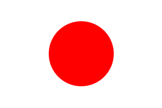
National Flag of Japan (fotw)
Please note that, whilst acting in that role for many years, the Hinomaru/nisshoki was only formally adopted as the National Flag in 1999.
HIS MAJESTY’S JACK
In English RN usage now obsolete, an official term for the 1606 pattern union flag when
flown as a naval jack, and in use from c1640 – c1690 – the king’s jack or the jack – but see
‘British flag’ (also
‘interlaced’,
‘naval jack’ under ‘jack’,
‘James Union’ and
‘union jack 2)’).
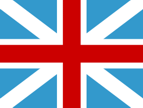
Union Flag 1601 - 1801, England/UK (fotw)
HISSFLAGGE (or HISSFAHNE)
See ‘hoisted flag’.
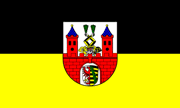
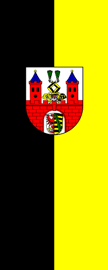
Hissflagge and Banner of Bernburg, Germany (fotw)
HISTORIC FLAG
1) A historical flag of special significance.
2) In Canadian sailing club usage the official title for those defaced ensigns
granted to local yacht clubs by the British Admiralty (for use as an ensign)
before 1964, but now flown as a club flag (see also ‘blue ensign 1)’ with its following note and
‘historical flag’).
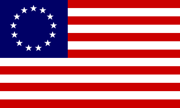
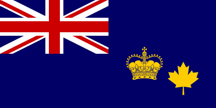
National Flag of the US 1777-1795 (fotw): Defaced Ensign/Historic Flag of the
Royal Hamilton Yacht Club, Canada (fotw)
HISTORICAL FLAG
A flag that has been in use in the past, but has now been superseded by another -
but see
‘historic flag’) (also ‘reconstruction’).
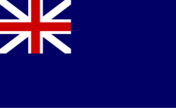
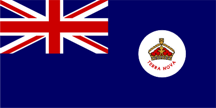
Blue Ensign, UK, 1707-1801 (fotw); Defaced Blue Ensign of
Newfoundland 1870-1904 (fotw)
Introduction | Table of Contents
| Index of Terms | Previous Page | Next Page
