- HOCHFLAGGE (HOCHFORMATFLAGGE or HOCHFORMATFAHNE)
- See vertically hoisted flag 1) and its following
note.

Hochflagge/Vertically Hoisted Flag of
Sankt Wolfgang, Germany
- HOIST
- 1) That edge or section of a flag, which lies next to the flagpole, mast or
staff – the distance line (see also
Appendix I,
fly, heading,
obverse,
reverse).
- 2) See signal hoist.
- 3) (v) The act of raising a flag.
- 4) The width of a flag.
- HOIST-CHEVRON
- See chevron 1).
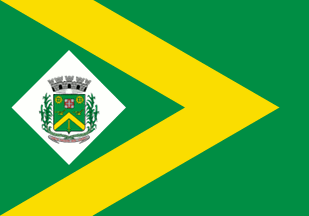
Flag of Santa Bárbara d'Oeste, Brazil
- HOIST-DIAGONAL
- A direct translation of the Dutch term hijsdiagonaal – but see
bend,
per bend,
descending diagonal 2).
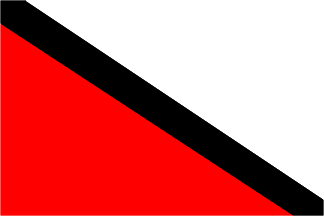
Flag of Klášterská Lhota, Czechia
- HOIST-TRIANGLE (or HOISTTRIANGLE)
- The term – and a direct translation of the Dutch hijsdriehoek – sometimes used to
describe a triangular charge based on the hoist – a simple triangle, or (inaccurately) a simple
pile/triangle throughout – but see pile 1) and
triangle 1)
(also equilateral triangle).
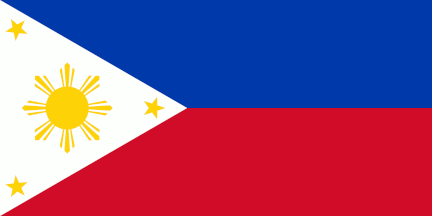
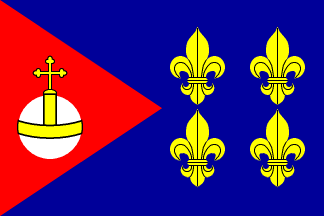
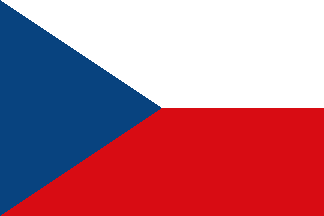
National Flag of the Philippines;
Flag of Benafer, Spain;
National Flag of the Czechia
- HOIST FLAG (or BURGEE)
- 1) See hoist 3).
2) In UK usage, that flag (or burgee) that must be flown by ordinary members of the Royal Yachting
Association – see yachting crown and its following note.
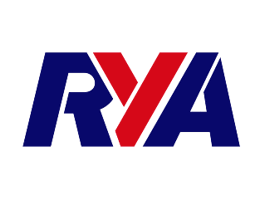
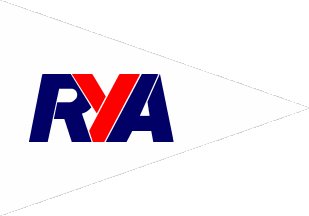
Ordinary member’s House Flag and Burgee of the
Royal Yachting Association, UK
- HOIST OF FLAGS
- See signal hoist (also
international code of signal flags and
signal flag).
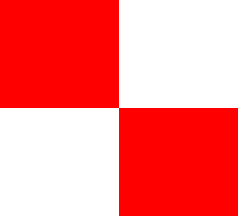

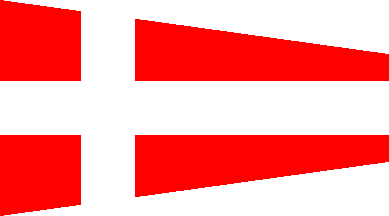
US4 (Uniform-Sierra-4)
in the International Code of Signals or “Nothing Can be Done
Until The Weather Moderates”
- HOIST STRIP
- See heading.

- HOISTED (or HOISTING) FLAG
- Those terms – and translations of the German “hissflagge” or “hissfahne”
used in German language vexillology – to describe a conventional flag (that is a flag generally
longer than it is wide) which is hoisted on a flagpole in the normal way – but
see the note below (also banner 2),
cross bar,
flag 1),
gonfalon 1),
hanging flag,
outrigger flag,
vertically hoisted flag 1)).
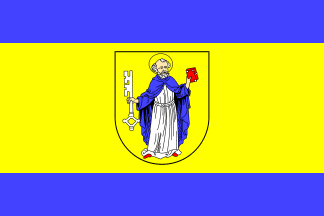
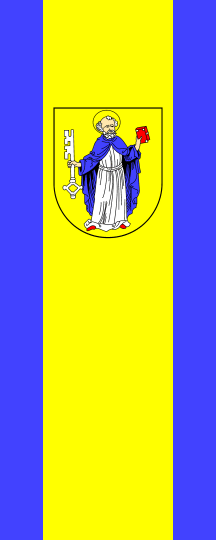
Hoisted Flag and Banner of Albisheim, Germany
Please note that this term is only employed when such a flag is presented (either visually or in
discussion) with another – such as a banner, gonfalon or hanging flag – that is designed to be
hung from a cross bar or is otherwise vertically orientated.
- HOISTLINE (or HOIST LINE)
- A piece of rope sewn into the heading of a flag to which the toggle
(at the top of the heading) and becket
(or eye splice) in the other end below the flag, or
Inglefield clips (at both ends) are attached and by means of
which the flag is bent on (or attached) to the
halyard (see also Appendix I).
Please note that the hoistline is described as a distance line in US military specifications.
- HOLIDAY COLOURS (or COLORS)
- In US naval usage, a larger than usual set of colours flown by a vessel or shore installation on
holidays and other special occasions (see also
ceremonial ensign,
garrison flag,
sunday ensign).
- HOLY LAMB (or HOLY LAMB OF GOD)
- See agnus dei.
prest.gif)
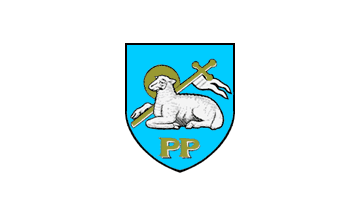
Arms and Former Flag of Preston, UK
- HOLY SPIRIT'S CROWN
- See crown of the holy spirit.
.gif)
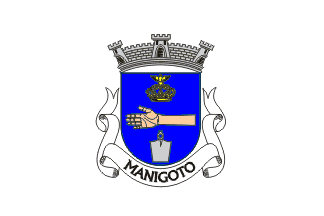
Flag and Arms of Manigoto, Portugal
- HOMEWARD BOUND PENNANT
- In USN usage and in some others the term for a
paying off pennant.
- HONORARY DISTINCTION(S)
- A collective term for any addition (or additions) to a flag, colour or
arms that is
(or are) granted in recognition of an act (or acts) of courage – see
augmentation of honour
and battle honour.
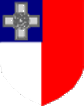
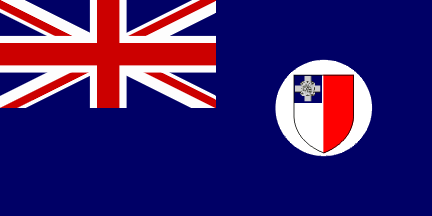
Arms and Government Ensign of Malta 1943–64
- HONOUR (or HONOR) BANNER
- The term – and a direct translation of the German Ehrenbanner – for those flags
(usually decorated with a fringe) that were awarded to various non-military organizations for excellent
performance by the former GDR and possibly other Communist bloc countries – but see
award flag
(also banner 3),
touring flag).
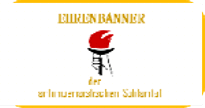
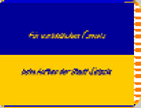
Honour Banner for Anti-Imperialist Solidarity, GDR (Eugene Ipavec);
Honour Banner for Efforts in Developing the Town of Leipzig, GDR (Eugene Ipavec)
- HONOUR (or HONOR) ENSIGN
- See ensign of honour.
![[ensign of honor]](../images/v/vx-yu~1937h.gif)
Ensign of Honour, Yugoslavia 1937–41
- HONOUR (or HONOR) FLAG
- 1) The flag, now obsolete, that was selected to represent those nations which were working
towards world peace prior to the foundation of the United Nations Organization, and in
official/semi-official use (particularly, but not exclusively, in the USA) from 1943 to c1948 –
the four freedoms flag.
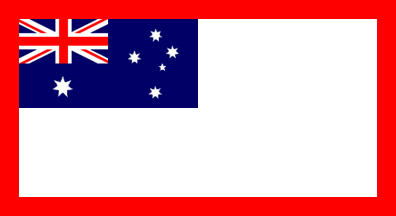
- 2) The flag that was presented to those towns and districts in Australia, as well as that presented
by other similar schemes in (for example) the US and Canada, who subscribed
twice their quota of funds to the Commonwealth Government's Seventh War Loan in 1918.
- 3) One of the flags presented in 1832 by the government of Belgium to honour those
municipalities who had made a significant contribution towards the independence of that cuntry.
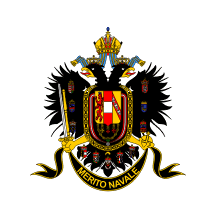
- 4) See flag of honour.
![[Honor flag - proposed UN flag]](../images/v/vx-uno_hon1.gif)
The Honour Flag, Australia 1918;
Flag of Honour, Austria-Hungary 1850–1918;
The Honour Flag
Please note with regard to 1) that the red bars – optionally blue or green and
possibly yellow – were said to represent the four freedoms (freedom of speech and expression,
freedom of every person to worship God in his own way, freedom from want and freedom from fear)
for which the Second World War was being fought, and that the alternative name of four freedoms
flag was in occasional use until 1945.
- HONOUR (or HONOR) JACK
- See jack of honour.
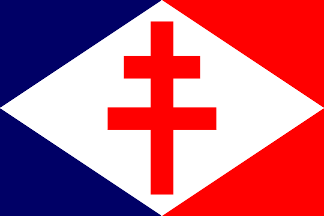
Honour Jack/Jack of Honour (Forces Navales Françaises Libres), France
- HONOUR (or HONOR) POINT
- 1) On flags, the term for the position where the colour or charge with the greatest or highest
symbolism is placed, almost always the upper hoist canton – point of honour, sometimes called the
place of honour – but see the notes below (also
canton 1),
quarter 1),
union).
- 2) In heraldry, a point on the shield slightly above the exact
centre – the fesse or fess-point.
1)
![[honour point]](../images/v/vx-mm-73.gif)
![[honour point]](../images/v/vx-ch-sz.gif)
![[honour point]](../images/v/vx-br-ba.gif)
![[honour point]](../images/v/vx-cn.gif)
National Flag of Myanmar 1974–2010;
Flag of Schwyz, Switzerland;
Flag of Bahia, Brazil; National Flag of PR of China
2)
![[honour point]](../images/v/vx-d1382.gif)
Notes:
a) With regard to 1), not to be confused with the position of honour.
b) Also regarding 1), evidence suggests this basically heraldic term has Continental European origins.
- HONOUR (or HONOR) POSITION
- See position of honour.
- HONOURABLE (or HONORABLE) ORDINARIES
- In heraldry see ordinary.
![[chief example]](../images/v/vx-d578.gif)
![[cross example]](../images/v/vx-d1115a.gif)
![[pale example]](../images/v/vx-d1115b.gif)
![[saltire example]](../images/v/vx-d1115c.gif)
![[fess example]](../images/v/vx-d1115d.gif)
![[pile example]](../images/v/vx-d1115e.gif)
![[chevron example]](../images/v/vx-d1115f.gif)
![[quarter example]](../images/v/vx-d1115g.gif)
![[bend example]](../images/v/vx-d1115h.gif)
Examples: Chief; Cross; Pale; Saltire; Fess; Pile; Chevron; Quarter; Bend