This page is part of © FOTW Flags Of The World website

Dictionary of Vexillology: T (Triangle - Triskelion)

Last modified: 2013-05-15 by rob raeside
Keywords: vexillological terms |
Links: FOTW homepage | search | disclaimer and copyright | write us | mirrors


On this page:


TRIANGLE
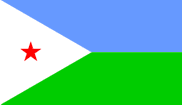
A usually horizontal charge whose apex lies along the meridian, and which may extend up to or slightly exceeding one-half the length of a flag, but whose base generally (but not exclusively) occupies the full width of the hoist – a simple or hoist-triangle. When the base is on the fly it may be called a reversed or fly-triangle, when parallel to the lower edge of a flag it may be called an ‘upright triangle’ or a cone, and when parallel to the upper edge an inverted triangle, however, but in these latter two cases the base generally occupies only a proportion of a flag or panel’s length  (see also ‘chevron 1)’ and ‘meridian’).

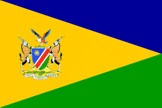
Kájov, Czech Republic  Kájov, Czech Republic  Bahia, Brazil  St Lucia  Gay flag
National flag of Djibouti (fotw), Flag of Kαjov, Czech Republic (fotw); Flag of Bahia, Brazil (fotw); National Flag of St Lucia; A Gay Triangle Flag (fotw)

Please note, however, that a triangle whose apex and base touch opposite edges of the flag should be considered a pile (see ‘pile’).

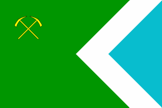
Železniki
Flag of Železniki, Slovenia (fotw)


TRIANGLE THROUGHOUT
See ‘pile 1)’ (also ‘throughout’).

Natalia
Flag of Natalia 1838 – 1843 (fotw)


TRIANGULAR (or TRIANGLE) BORDER
See ‘wolfteeth 1)’.

[Hungary president]
Presidential Standard of Hungary (Zoltan Horvath)


TRIANGULAR-ENDED
A term used to describe the fly of a flag or bottom edge of a gonfalon when it is in the form of a straight-sided triangle (see also ‘gonfalon 1)’ and ‘triangular-ended tails’ below).

[gonfalon showing triangular-ended] [gonfalon showing triangular-ended]
Gonfalon of Bošnjaci, Croatia (Željko Heimer); Gonfalon of Bibinje, Croatia (fotw)


TRIANGULAR-ENDED (or TRIANGULARLY ENDING) TAILS (or TONGUES)
A term used to describe the fly of a flag or bottom edge of a gonfalon that is cut into two or more straight-sided tails or tongues with triangular ends (see also ‘gonfalon 1)’, ‘square-tailed’ ‘tongue(s)’ and and ‘triangular-ended’ above).

[Triband example]  [Triband example]
Gonfalon of Lobor, Croatia (Željko Heimer); Gonfalon of Andrijaševci, Croatia (fotw)


TRIANGULAR PANEL
1) The term that may be used to describe a right-angle triangle that usually occupies the full width of a flag, but which has two sides running parallel to and/or along the edges of that flag.
2) The term may also be used to describe those panels that appear and the hoist and at the fly of a diagonal tricolour, of a diagonally divided bi-colour, or of a flag having an ascending or descending diagonal – that is a bend or bend sinister - see ‘bend’ and ‘bend sinister’.
3) See ‘cantonal triangle’.

[Triangular panel - Bosnia] [Triangular panel - Sarajevo] [Triangular panel - Berezne]
National Flag of Bosnia and Herzegovina (fotw); Flag of Sarajevo – Centar, Bosnia and Herzegovina (fotw); Flag of Berezne, Ukraine (fotw)

Please note that this term has been introduced by the Editors as no suitable established alternative could be found.


TRIANGULAR SWALLOWTAIL
See ‘broad pennant’.

Please note that this term may also be applied to the flag of the state of Ohio, to some yacht club burgees and to certain (appropriately shaped) naval pennants – see ‘broad command pennant’, ‘burgee 1)’, ‘burgee 2)’ and ‘burgee command pennant’.

[Ohio]
Flag of the State of Ohio, US (fotw)


TRIANGULAR-TONGUED (or TAILED)
The term for that variation of a swallow- tail, swallow-tail and tongue or a triple tailed flag whose tongues or tails form a triangle of the same layout as illustrated below (see also ‘swallowtail’, ‘swallowtail and tongue’, ‘tongue(s)’, ‘triangular tails’ and ‘triple-tailed 2)’.

[Triangular-tongued]
Unit Colour 67th Military Police Battalion, Croatia (Željko Heimer)

Please note that this term has been introduced by the Editors as no suitable established term could be found.


TRIARCHED TRIANGULAR SHIELD
The term used in some systems of continental heraldry to describe a shield the edges of which are formed by three (usually regular) convex arcs (see also ‘gothic shield’ with its following note, ‘rectangular shield’, ‘semicircular shield’, ‘shield 2)’ and ‘Spanish-style shield’).

[triarched triangular shield example] [triarched triangular shield example]
Arms and flag of Tešanj, Bosnia and Herzegovina (fotw)


TRIBAL FLAG
The sub-national flag of any group which shares an ethnic origin, but which is not internationally recognized as independent – but see ‘national flag 2)’ and ‘political flag 1)’ (also ‘sub-national flag’).

[tribal flags illustration]
From left: Navaho Nation, US (fotw); Arapaho Nation, US (fotw); Chickasaw Nation, US (fotw)

Please note that a tribal flag may also be a political flag under certain circumstances, and that some tribal flags may be considered as national flags dependent upon the legal status and/or ambitions of the tribal group concerned.

[tribal flags which serve as political or national flags]
From left: The Kurds, Iraq (fotw); The Aboriginals, A National Flag of Australia Under The Law (CS)


TRIBAND (or TRI-BAND)
1) A flag of three (usually) parallel stripes or bands but using only two colours. These stripes may be disposed vertically, horizontally or diagonally, be of equal or unequal width and be either defaced or plain – a three-striped flag or tiercι (see also ‘bar’, ‘deface’, ‘fess’, ‘pale’, ‘plain 2)’, ‘stripe’, ‘striped’, ‘tiercι’, ‘tricolour’, ‘unequal triband’ and ‘width 2)’).
2) An undefaced flag with three equal parallel stripes or bands using two colours whether disposed vertically or horizontally – a simple triband (see also ‘undefaced’).
3) Informally, any flag of three parallel stripes or bands in either two colours or three. These stripes may be disposed vertically, horizontally or diagonally, be of equal or unequal width and be either defaced or plain – but see notes below.

[Triband example] [Triband example] [Triband example] [Triband example]
Civil Flag/Ensign of Guatemala (fotw); National Flag of Argentina (fotw); Flag of Carpena, Brazil (fotw); Flag of Cruzaltense, Brazil (fotw)

Notes:
a)
With regard to 1) and 2), the Editors have drawn a distinction between flags with three parallel stripes and three colours and those having three parallel stripes and only two colours, with the definitions for tricolour and triband having been carefully drawn up using all available sources, however, please see further note below.
b) With regard to 3) it should be further noted that this definition includes not only all flags detailed in 1) and 2) above, but also those described under ‘tricolour’, and it is strongly suggested that these entries be consulted before usage.
c) With regard to diagonal tribands, the orientation of its central stripe can be critical to this definition – if the charge in question runs directly into the corners then it can be considered as a flag bearing a diagonal stripe (as per the example illustrated below), if however, the central stripe has its entire width along either the top and bottom edges and/or along the hoist and fly then the term “diagonal triband” may be used in description – see ‘north-south diagonal 1)’ and its references.

[diagonal stripe example]
Flag of Araruna, Brazil (fotw)


TRIBAR (or TRI-BAR)
A term sometimes applied to a flag of three stripes in two colours – but see ‘triband’ and the note below.

Please note however, before using this term it is suggested that the entry on ‘bar’ and/or a suitable glossary or heraldic dictionary be consulted.


TRICOLORE, LA
The national flag of Italy, see ‘tricolour 2)’.

[La Tricolore]
National flag of Italy


TRICOLORE, LE
The national flag of France, see ‘tricolour 2)’.

[Tricolor example]
National flag of France


TRICOLOUR, TRI-COLOUR or TRI-COLOR)
1) A flag of three (usually) parallel stripes or bands in three different colours. These stripes may be disposed vertically, horizontally or diagonally, be of equal or unequal width and be either defaced or plain – a three-striped flag or tiercé (see also ‘deface’, ‘plain 2)’, ‘stripe’, ‘striped’, ‘tiercι’, ‘triband’, ‘unequal triband’ and ‘width 2)’).
2) An undefaced flag with three equal parallel stripes or bands of different colours whether disposed vertically or horizontally – a simple tricolour – for example: the national flag of France - le tricolore, the national flag of Italy - la tricolore or that of the Netherlands - the driekleur - but see the second note below (also ‘undefaced’ and ‘princeflag’).

[Tricolor example] [Tricolor example] [Tricolor example] [Tricolor example] [Tricolor example]
National Flag of France (CS); National Flag of the Netherlands; National Flag of St Vincent (fotw); National Flag of the Congo (fotw); National Flag of Ecuador (fotw).

Notes:
a)
The definition of tricolour (as given herein) is restricted to flags of three colours disposed in three parallel stripes, and that flags that do not fall into this category are defined elsewhere. The Editors have also drawn a distinction between flags with three parallel stripes and three colours, and those consisting of three parallel stripes but only two colours, with the definitions for tricolour and triband having been carefully drawn up using all available sources, however this distinction is not always observed (see also ‘triband 3)’).
b) With regard to 2), many national flags, in addition to the three examples given above, are referred to as a “tricolour” in their respective languages, for example the five striped flag of Thailand – the Trairanga. .
c) With regard to diagonal tricolours, the orientation of its central stripe can be critical to this definition – if the charge in question runs directly into the corners then it can be considered a flag bearing a diagonal stripe (as per the example illustrated below), if however, the central stripe has its entire width along either the top and bottom edges and/or along the hoist and fly then the term "diagonal tricolour" may be used in description – see ‘north-south diagonal 1)’ and its references.

[diagonal stripe example]
Flag of Roraima, Brazil (fotw)


TRICOLOUR PENDANT (or PENNANT)
See ‘common pendant’.

Man o'War pendant
The Tricolour/Common Pendant, England then UK 1661 – c1850 (fotw)


TRIMMED
See ‘garnished’.

[Kinrooi, Belgium]
Flag of Kinrooi Belgium (fotw)


TRINACRIA
See ‘triskelion’.

trinacria example
Flag of Eagum, Netherlands (fotw)


TRINITARIAN CROSS
A term that is used to describe the (layered) cross of the Catholic Order of the Holy Trinity in which a blue horizontal arm is overlaid by a red vertical. (see also 'layered cross' and 'layered saltire').

Trinitarian Cross
The Order of the Holy Trinity (Wiki)


TRINITY EYE
See ‘Eye of God’.

[Radzymin, Poland] [Radzymin, Poland]
Flag and Arms of Radzymin Poland (fotw)


TRIPARTITE (TRIPARTED or TRIPLE-PARTED)
The term for a charge, particularly (but not exclusively) a cross or saltire, that is divided longitudinally into three parts in three different colours, as in the flag of Dominica – triparted or triple-parted (see also ‘cross 3)’, ‘layered cross’ and ‘layered saltire’).

[Dominica - Tripartite example] [Guatavita Colombia] [Grathem, Netherlands
From left: National Flag of Dominica (fotw); Flag of Guatavita, Colombia (fotw); Flag of Grathem, The Netherlands (fotw)


TRIPLE-ARMED (or TRIPLE) CROSS
1) See ‘papal cross’
2) See ‘orthodox cross’.

[example] [example] S


TRIPLE-MOUNT
See ‘coupeau’ (also ‘mount’).

[triple mount example]
Flag of Savski Venac, Serbia (fotw)


TRIPLE-FIMBRIATED
See ‘cotticed 1)’ and following note (also ‘fimbriated’).

[triple fimbriated example] [triple fimbriated example]


TRIPLE-PRINCE
The term for a 17th Century Dutch naval flag of usually (but not invariably) nine even, horizontal stripes in the Dutch national colours repeated – but see ‘double-prince’ (also ‘dreikleur’ and ‘princeflag’)

triple prince eleven stripe triple prince
From left: Triple Prince c1660 (fotw); With Eleven Stripes c1660 (fotw)

Please note however, whilst all available evidence suggests that red, white and blue were employed, orange instead of red may have been used at an earlier stage.


TRIPLE-SWALLOW-TAIL(ED)
A term sometimes mistakenly used in place of swallowtail and tongue or triple-tailed – see ‘swallow-tail and tongue’ and ‘triple-tailed 2)’.

TRIPLE-TAILED (or TONGUED)
1) See ‘swallow-tail and tongue’.
2) A term that should be used when a flag has three tails or tongues whose width and lengths are of equal size (see also ‘length 2)’, ‘tongues’, ‘triangular-tongued’ and ‘width 2)’).

[Triple-tailed example]
Naval Ensign of Estonia (fotw)


TRIPLE-TAILED DESCATE
(adj) A term used to describe a fly that is cut into three tails with rounded ends (see also ‘double-tailed descate’, ‘fly’, ‘gonfanon’, ‘guidon 2)’, ‘standard 4)’, ‘swallowtail’, ‘swallowtail and tongue’ and 'tongue(s)).

[Triple-tailed descate example]


TRIPPANT
See ‘appendix V’.

[Lengnau]
Flag of Lengnau, Switaerland (fotw)


TRISKELION (TRISKELE)
An originally mystical sign of ancient origin that consists of three symbols emanating from a central point, and of which the three-legged symbols on the flags of the Islands of Man and Sicily (for example) are almost certainly an adaptation - a trinacria or triskele

[Triskelion example] [Triskelion example] [Triskelion example] [Triskelion example]
From left; Flag of the Isle of Man, UK (fotw); Flag of Sicily (fotw); Symbol from Celtic Art (Wikipedia); Flag of Ust-Ord Buratia, Russia (fotw)


Introduction | Table of Contents | Index of Terms | Previous Page | Next Page