
Last modified: 2019-04-24 by rob raeside
Keywords: vexillological terms |
Links: FOTW homepage |
search |
disclaimer and copyright |
write us |
mirrors
On this page:
The following terms may be encountered when referring to a cross in a flag, or banner of arms, or heraldic flag of some other description.
The heraldic term for a cross that does not usually extend to the edges of a shield, flag, canton or panel, but whose ends are formed by three discs – a trefoil or treflee cross (see also ‘cross 2)’, ‘disc’ and ‘trefoil’).
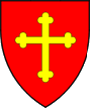
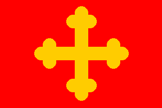
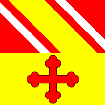
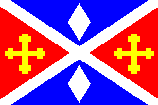
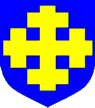
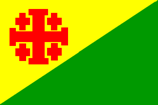
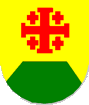
The heraldic term for a cross which may or may not extend to the edges of a shield, flag, canton or panel, but which has four further crosses (or other charges) arranged around it – a cross cantoned (see also ‘canton 3)’, ‘cantoned 1)’, ‘cross 1)’, ‘cross pattée’ and ‘cross potent’)
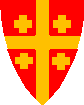
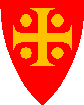
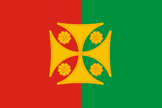
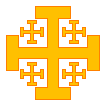
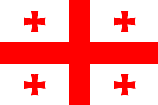
From left: Crosses-Cantonée examples; Flag of
Tianeti, Georgia (fotw); The Kingdom of Jerusalem c1200 (CS); National Flag of
Georgia (fotw)
Please note as may be seen in the illustrations above, various types of cross can be used to make up a cross cantonée, and that a Jerusalem Cross (constructed of a cross-potent and four Greek crosses or of five crosses-potent) is one specific type.
The heraldic term for a cross that does not generally extend to the edges of a shield, flag, panel or flag, but whose arms are in the form of (usually irregular) lozenges or fusils – a cross-lozengy or cross-fusilly (see also ‘cross 2)’, ‘fusil’ and ‘lozenge’).

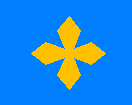
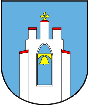
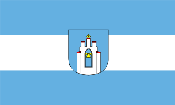
from left: Examples (2); Arms and Flag of Mogilany, Poland (Jarig Bakker)
The heraldic term for a cross that generally extends to the edges of a shield, panel, banner of arms or flag, and which is divided along its horizontal and vertical centre-line with the tinctures of the field and cross usually (but not exclusively) alternating in adjacent quarters - a counterchanged cross - but compare with cross gyronny (see also ‘counterchanged’, ‘cross 2)’, ‘dominican cross’, ‘quarter 2)’ and ‘tincture’).
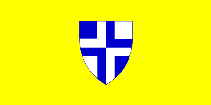
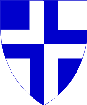
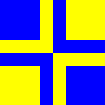
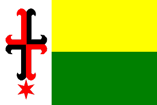
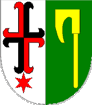
Flag and Arms of Zaprešić, Croatia (fotw); Flag of
Kreis Davos, Switzerland (fotw); Flag and Arms of
Tursko, Czechia (fotw)
Notes
a) A cross whose centre is obscured by a charge (as illustrated below) could be described as either a cross-counterchanged or a cross gyronny, however, the term ‘cross quartered’ has now come into use - see ‘cross quartered’.
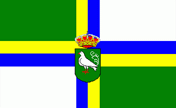
Flag of Palomares del Río, Spain (Klaus-Michael Schneider)
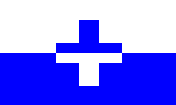
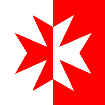
Flag of Zurrieq, Malta (fotw): Flag of
Villars-Sainte-Croix, Switzerland (fotw)
1) See ‘cross counter-changed’ in ‘appendix 8’.
2) The term that may also be used when the centre of a cross of this general
type is obscured as illustrated below.- see ‘cross gyronny’ in ‘appendix 8’.
Flag and Arms of Zaprešić, Croatia (fotw); Flag of Palomares del Río, Spain (Klaus-Michael Schneider)
A heraldic term sometimes used when a cross (either plain or decorated) does not extend to edges of a shield, banner of arms or flag (see also ‘couped 2)’ and ‘Greek cross’).

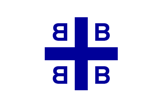
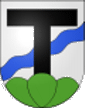
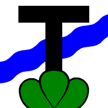
Example; Putative Flag of Constantine the Great c325AD (fotw);
Arms and Flag of Treiten, Switzerland (Wikipedia & fotw)
Please note that, unless referring to a plain cross, this term is always accompanied by a further description, for example a “cross tau couped” (as illustrated above), or “cross crosslet couped” as shown in the following definition.
The heraldic term for a cross which does not usually extend to the edges of a shield, flag canton or panel, but whose arms have a short transverse bar inserted (see also ‘cross 2)’).
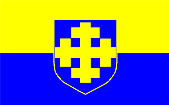
Example; Flag of Echt-Susteren, The Netherlands (fotw);
Arms and Flag of Slupca, Poland (fotw)
The heraldic term for a cross which does not usually extend to the edges of a shield, flag, canton or panel, and which may have plain or decorated ends, but whose vertical arm comes to a point at its base (see also ‘cross 2)’ and ‘cross of Santiago’).
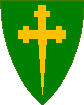
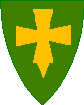
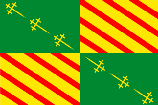
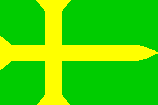
Flag of Bernissart, Belgium (fotw); Flag of Avinyó, Spain (fotw)
Please note that, unless referring to a plain cross, this term is always accompanied by a further description, for example a “cross crosslet fitchy”.
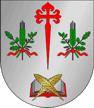
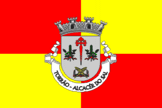
Arms and Flag of Torrão, Portugal (fotw)
The heraldic term for a cross which does not usually extend to the edges of a shield, flag, canton or panel, but whose ends are formed by fleur-de-lis – a fleur-de-lis or fleury cross, avis cross, or cross of calatrava (see also ‘avis cross’, ‘cross 2)’, ‘Dominican cross’, ‘cross of Calatrava’, ‘fleur-de-lis’ and ’fleury’)


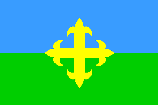
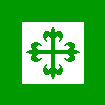
From left: Example; Suggested Flag of the Avis Order, Portugal (fotw); Flag of Almagro, Spain (fotw); Flag of
Guriezo, Spain (fotw); Flag of The Portuguese Legion c1928 – 1974 (fotw)
See ‘snakehead cross’.
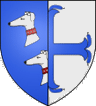
The heraldic term for a cross that may or may not extend to the edges of a shield, flag or panel, but is composed of two tinctures meeting at the centre point and alternating either side of the vertical and horizontal meridians (thus giving it a three-dimensional appearance) – a gyronny cross - see ‘gyronny’ and compare with ‘cross counterchanged’ in ‘appendix VIII’ (also ‘Dominican cross’, ‘faceted’ and ‘tincture’).
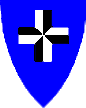
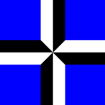
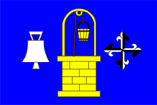
Example; Flag of Kreis Safien, Switzerland (fotw); Flag of Studnice, Czechia (fotw)
Notes
a) Unless describing a plain cross throughout, this term should always be
accompanied by a further description, for example a “cross fleury gyronny couped”.
b) A cross whose centre is obscured by a charge (as illustrated below) could be described as either a cross gyronny or a cross-counterchanged, however, the term ‘cross quartered’ has now come into use - see ‘cross quartered’.
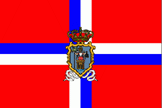
Flag of Santa Cruz de La Palma, Spain (Klaus-Michael Schneider)
1) The heraldic term used when two or more crosses are borne (couped) on the same coat – but see ‘cross-cantonée’ and ‘cross-crosslet’ in ‘Appendix VIII:’ (also ‘couped’).
2) A term also (incorrectly) used to describe a single small cross.
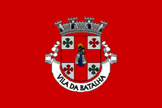
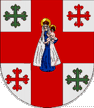
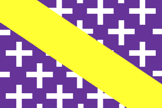
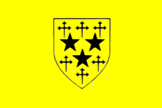
Flag and Arms of Batalha, Portugal (fotw); Flag of
Òdena, Spain (fotw); Flag of Somerville College Oxford, UK (fotw)
The heraldic term for a cross which does not usually extend to the edges of a shield, flag, canton or panel, but whose ends are split into two curved pieces – an anchor or moline cross (see also ‘cross 2)’ and ‘snakehead cross’).
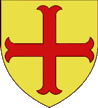
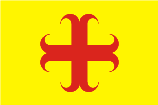
Example, Flag of Annœullin, France (fotw)
The heraldic term for a Latin cross that does not usually (although it may) extend to the edges of a shield, flag, panel or flag, but which is mounted on three steps steps – a cross of crucifixion, a calvary cross or calvary (see also ‘Latin cross’).
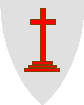
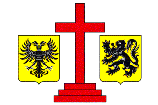
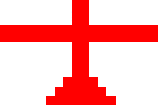
From left: Example; Flag of Geraardsbergen, Belgium (fotw); Flag of
Fulleda, Spain (fotw)
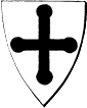
The heraldic term for a cross which does not usually extend to the edges of a shield, flag, canton or panel, but whose arms finish in a roundel (see also ‘cross 2)’, ‘pommeled’ and ‘roundel 3))’
![[Lagoa Portugal]](../images/v/vxt-d2597.gif)
![[Lagoa Portugal]](../images/v/vxt-d2599.gif)
![[Lagoa Portugal]](../images/v/vxt-d2598.gif)
Example (Parker); Flag of Lagoa, Portugal (Sérgio Horta); Arms and Flag of Santa Cruz, Portugal (Klaus-Michael Schneider)
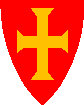
The heraldic term for a cross that may or may not extend to the outer edges of a shield, flag, canton or panel, whose arms are generally (but not exclusively) flat-ended but which is wider at its outer ends than it is in the centre. The arms can be straight-sided or curved throughout their length, or they can be straight-sided and parallel until being flared at their outer end – a cross formée, formé or formy, a pattée, patée, patty or Paty cross, a formée, formé or formy cross, or an iron, Hanseatic, Hansa, cavalier or cavalier’s cross – but see ‘Maltese cross’, ‘rounded cross’ (also ‘cross 2)’ and ‘Cross of the Order of the Knights of Christ’).
![[Wallis & Futuna]](../images/v/vxt-d592.gif)
![[Guernsey civil ensign]](../images/v/vxt-d592a.gif)
![[Cr. Jensen houseflag]](../images/v/vxt-d592b.gif)
From left: example; Flag of Wallis & Fortuna; Civil Ensign of Guernsey; House flag of Chr. Jensen, Denmark (fotw)
The heraldic term for a cross which does not usually extend to the edges of a shield, flag, canton or panel, but whose arms terminate in a transverse bar – a cross potence, or potent, or a crutch or Teutonic Cross (see also ‘cross 2)’ and ‘cross-cantonée’ and ‘potent 2)’).
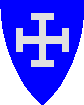
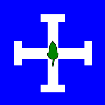
From left: Cross-Potent example; Flag of Goumoëns-la-Ville, Switzerland (fotw)
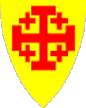
Example; Flag
and Arms of Niawier, The Netherlands
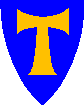
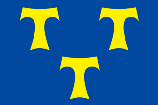
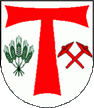
The heraldic term for a cross that may or may not extend to the edges of a shield, flag, canton or panel, but in which the vertical arm does not extend above the horizontal thus creating a letter ‘T’ - a tau cross, Cross of St Anthony or Saint Anthony's Cross, and in some Christian denominations, also an Advent Cross.

The heraldic term for a cross that may or may not reach the edges of a shield, banner of arms or flag and may be either closed or open-ended, but from which the centre is removed so that the field may be seen through it (see also ‘cross of athletics’ and ‘voided’)
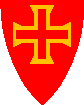
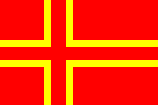
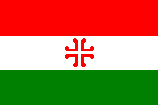
Notes
a) Unless referring to a plain cross, this term is always accompanied
by a further description, for example "a cross pattée voided".
b) This term is sometimes (incorrectly used to describe a
Cross of the Order of the Knights of Christ as illustrated below – see ‘Cross of the Order of the Knights of Christ’.
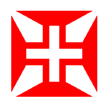
A banner of the Order of the Knights of Christ (fotw)
The heraldic term for a cross that does not usually extend to the edges of a shield, flag, panel or flag, but whose horizontal arm is shorter than its vertical and which is set above the centre line – a long cross (see also ‘Greek cross’ and ‘cross 2)’)

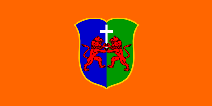
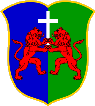
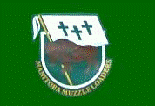
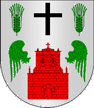
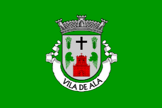
From left: example; Flag and Arms of Budinšcina, Croatia (Fame); Flag of the Muzzle Loaders of Manitoba, Canada;
Arms and Flag of Vila de Ala, Portugal (Antonio Martins)
Notes
1) Unless referring to a plain cross, this term should always
accompanied by a further description, for example a “Latin cross treflee” as
illustrated below.
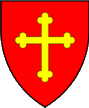
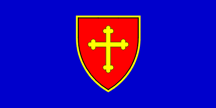
Arms and Flag of Negoslavci, Croatia (fotw)
2) In vexillological terms a Latin cross throughout becomes an off-centred cross – see ‘off-centred cross 2)’ (also ‘throughout’).
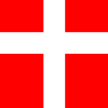
Flag of Thunstetten, Switzerland (fotw)
Introduction | Table of Contents | Index of Terms | Previous Page | Next Page