
Last modified: 2026-05-22 by rick wyatt
Keywords: united states | union army | wisconsin |
Links: FOTW homepage |
search |
disclaimer and copyright |
write us |
mirrors
See also:
In the June 2016
issue of
Isthmus was: “Wisconsin deserves a better flag:
Isthmus offers a few alternatives”, by Dylan Brogan. Vexillologist Ted
Kaye is quoted and five handsome flag designs, procured are offered. I was please to redraw them flatly
below.
António Martins-Tuválkin,
2 March 2026
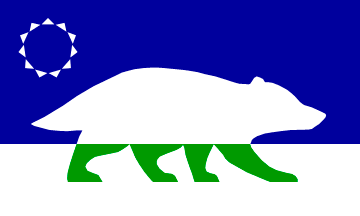 image by
António Martins-Tuválkin,
2 March 2026
image by
António Martins-Tuválkin,
2 March 2026
Based on https://isthmus.com/downloads/39157/download/Cover-WisconsinFlag-Distillery-06092016.jpg
Blue flag with white stripe at the bottom (California style) with a badger outline overall, white on blue and green on white, and at the upper hoist a negative space made of 11 obtuse triangles pointing outwards.
Brad Nellis, partner with Distillery Design, writes that his team drew "inspiration from the three pillars of Wisconsin: agriculture (green), recreation (blue) and industry (white).” These colors depict an abstract of the state's animal, a badger. The animal is shown in motion to embody the state's motto, "Forward." Nellis says the three-color palette also reflects the land and climate of the state. In the top-left corner of the flag is a sun with 11 points, which “pays homage to the Native American tribes present in Wisconsin."
António Martins-Tuválkin,
2 March 2026
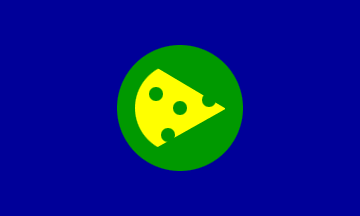 image by
António Martins-Tuválkin,
2 March 2026
image by
António Martins-Tuválkin,
2 March 2026
Based on https://isthmus.com/downloads/39158/download/Cover-WisconsinFlag-DMM-06092016.jpg
A plain blue flag (reminiscent of the current flag) with a green disc (diam. approx. half of the flag's height) centered on it containing a yellow stylized cheese wedge, with two full round holes and two partial ones, intersecting the straight edges. The wedge itself, although its curved side is an arc of a smaller, concentric ersatz yellow disc, is not constructed as a sector, as it is delimited not by radii of the disc but by two of its chords, effectively centering the wedge on the green disc: A clever optical illusion making for a much better looking and geometrically simple symbol than an actual sector would be.
Isthmus' own David Michael Miller points out that Wisconsin already has a symbol known around the world: the cheesehead hat. So he fashioned a Wisconsin flag after this iconic image, which he calls "Forward with Cheese." The green and gold seen in the flag are, fittingly, in honor of Wisconsin's beloved Packers. The iconic cheese wedge is centered on the flag in the likeness of the web symbol "play" suggesting "Forward," the state's motto. "For the sake of history and continuity," Miller says, "the field of Union Army blue is retained."
António Martins-Tuválkin, 2 March 2026
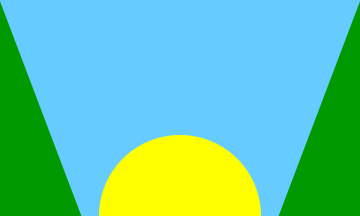 image by
António Martins-Tuválkin,
2 March 2026
image by
António Martins-Tuválkin,
2 March 2026
Based on https://isthmus.com/downloads/39159/download/Cover-WisconsinFlag-Hartley-06092016.jpg
Pale blue flag with a yellow half disc (diam. approx. 2/3rds of the flag's height) centered on the bottom edge and two green right triangles at hoist and fly, their square angles respectively at the lower hoist and lower fly corners of the flag, their long hypotenuses being the whole height of the flag and the short ones extending inwards on the lower edge of the flag to not reach the disc.
Richard Hartley was a design student at Madison College. When he began contemplating a new flag for Wisconsin, he started asking people what they like about the state. "It almost always was beer, football, cheese. Badgers. Over and over," Hartley says. So he asked a slightly different question: What do you like to do in Wisconsin? "A new yet consistent pattern emerged. Hiking. Swimming. Camping. Parks came up. Devil’s Lake. Governor Nelson. Bayshore Park. Whitefish Dunes, Egg Harbor. Potawatomi." So Hartley created a flag to reflect Wisconsinites' love of the outdoors. The natural beauty is represented with blue skies, green trees and sunshine, which form an outline of "the good old 'W.'"
António Martins-Tuválkin, 2 March 2026
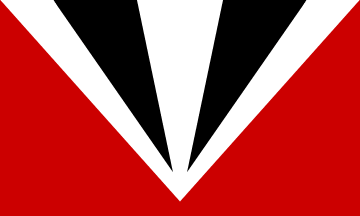 image by
António Martins-Tuválkin,
2 March 2026
image by
António Martins-Tuválkin,
2 March 2026
Based on https://isthmus.com/downloads/39161/download/Cover-WisconsinFlag-Lorbieki2-06092016.jpg
Red flag with a large white isosceles triangle whose base is the upper edge of the flag and apex almost reaching the midpoint of the lower edge; on this triangle two black obtuse triangles placed symmetrically with their shorter sides on the top edge of the flag and the other sides all roughly converging to the apex of the white triangle almost reaching it. The whole yields, besides the approximate shape of the letter "W", a very stylized iconic image of a top-view badger head.
Brian Lorbiecki is a graphic designer at Wisconsin Public Television. He was inspired by the chevrons used by color field painter Kenneth Noland. The shapes are set on a field of red to form the head of a badger. Lorbiecki is pleasantly surprised that the state’s animal is easily recognizable. He says the flags of New Mexico and Maryland are praised for their designs because of simplicity. "But simple is hard, as we say around here."
António Martins-Tuválkin, 2 March 2026
 image by
António Martins-Tuválkin,
2 March 2026
image by
António Martins-Tuválkin,
2 March 2026
Based on https://isthmus.com/downloads/39162/download/Cover-WisconsinFlag-Lorbieki-06092016.jpg
Unequal horizontal triband of pale blue over light yellowish green over blueish teal (approx. stripes's widths: 5+3+2).
The second design conceived by Lorbiecki is a tricolor flag that represents sky, land and water (hence the cool palette). The flag fits traditional vexillological aesthetics but is also influenced by the landscapes of minimalist artist Brice Marden. "There's more sky than the rest, to convey the horizon," says Lorbiecki. "The colors are not just symbolic. It's more of a literal depiction, even though it's extremely abstract."
António Martins-Tuválkin, 2 March 2026


