
Last modified: 2018-12-15 by rob raeside
Keywords: ashdod | iriyat ashdod | anchor (white) | text: hebrew (white) |
Links: FOTW homepage |
search |
disclaimer and copyright |
write us |
mirrors
![[Flag]](../images/i/il-ashdod.png)
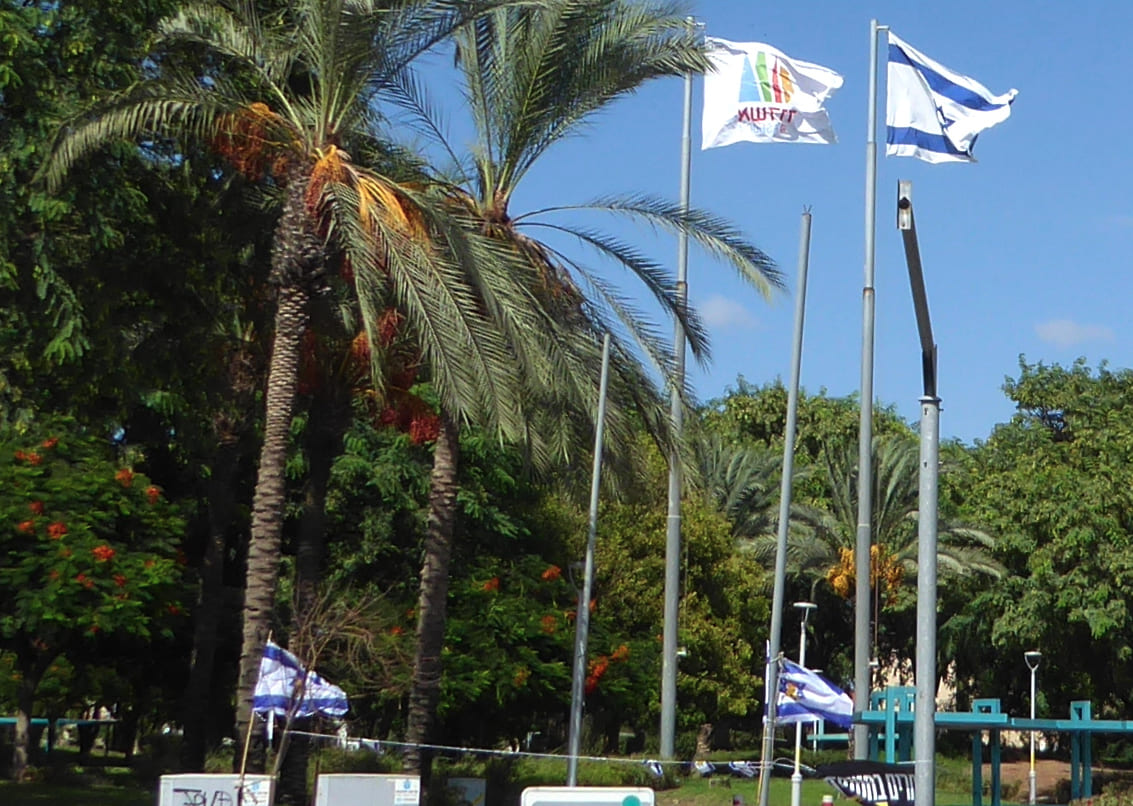
The Ashdod City Council currently uses a flag featuring the emblem of the sails and the lion's head in the centre on a white background. Until the new emblem was adopted in 2016, the city's official flag featured the anchor and lion emblem in white on a dark blue background.
See also:
![[Municipality of Ashdod (Israel)]](../images/i/il-asdod.gif) image by Dov Gutterman | 2:3    Emblem adopted 16th January 1969 |
♦ photo
Ashdod is situated on the sea shore, 27 km south to Tel Aviv
and is the main port of the area. Its name taken from the Bible
(Joshua 15:46 and
15:47). Founded in 1956
and got a big boost when the port was built. Pop. 150'000. The unofficial municipal flag is
blue with a white emblem. The municipal emblem was published in
the official gazette (Rashumot, Yalkut ha-Pirsumim), YP
1499, 16 January 1969, to replace that of the former Local
Council which had been published in YP 1001, 28 March 1963.
Sources: author's own observation, 29 September 2001
Dov Gutterman, 12 October 2001
The municipal website (http://www.ashdod.muni.il/Openning1.asp?Lang=1 [failed retrieval])
elaborates about its emblem:
"Meaning of the emblem: The emblem represents, in short lines, the ancient and renewed Ashdod.The emblem appeared on a stamp issued on 24 March 1965 (when Ashdod was still a local council).
The Lion head represents the Juda tribe, in whose part was the area where Ashdod is situated.
The line that goes on from the lion's head represents an ancient ship from the biblical era.
The Anchor represents the new port.
The aggression of the lion represents dynamism – the force which built and created Ashdod after the establishment of the state of Israel as well as the conquest of the sea for the benefit of the society.
The emblem was designed by the artist Yitzhak Bakhar."
Dov Gutterman, 9 April 2005
Ashdod through the ages
Ashdod's origins date back to the 17th century BC as a fortified Canaanite city, on the site of present-day Tel Ashdod. Following the raids by the Sea Peoples and the destruction of the city in the 14th century BC, the Philistines settled there and made it one of the five most important cities in their kingdom.
During the Israelite period, 600–1200 BC, Ashdod was part of the territory of the tribe of Judah, which failed to recapture it from the Philistines, and its name appears for the first time in the Bible in the Book of Joshua. Once built and fortified, the city became the magnificent capital of the Land of the Philistines until it was conquered by Uzziah at the beginning of the 8th century BC. During this period, the Tel Mor fortress was erected at the foot of the Lachish Stream estuary, and following Sargon II's conquest campaign, the city was captured and completely destroyed.
During the Babylonian and Persian periods, the city was rebuilt, and following the Return to Zion, in the days of Ezra and Nehemiah, a Jewish settlement was established there within the Kingdom of Judah.
At the beginning of the fourth century, the city surrendered to the conquests of Alexander the Great and was henceforth known as "Azotus".
Throughout the Hellenistic period, Ashdod passed from Greek rule to that of the Hasmonean Kingdom until the Roman conquest, which completely destroyed the city.
From this period until the conquest of the land by the Turks and the establishment of the Ottoman Empire, nothing is known about Ashdod. The Turks founded "Isdud", a large Arab village, and "Al-Sukhir", a settlement that served as a transit point for goods.
During the British Mandate, "Isdud" became an important port on the maritime route, and a railway station was built nearby to serve the Lod–Gaza–Egypt line.
During the struggle for independence and the declaration of statehood, the Egyptian army was repelled from Ashdod's southern border by the blowing up of the Ad-Halum Bridge, and the Arab settlement of "Isdud" was abandoned and destroyed.
This is how it began
Following the establishment of the State, on the eve of Operation Kadesh, the then Prime Minister, David Ben-Gurion, sent a letter to Oved Ben-Ami, who was at that time the mayor of Netanya, in which he wrote: "Do for the south what you did for the north."
The idea of establishing Ashdod encountered no small number of difficulties, and when Operation Kadesh came to an end, Ben-Ami's proposal – to build a port near a city with an established economic infrastructure – was accepted.
To this end, the Ashdod Development Company was established. In May 1956, the founders – the City Builders Group – received government approval for the plan, and a contract was signed between the State and the company, under which an area of 24'000 dunams was granted in exchange for a commitment to plan the city in every detail and carry out the development work.
From an immigrant town to a city
25 November 1956 marks Ashdod's birthday. It began with 22 immigrant families from Morocco who arrived in the dead of night, during a dark and cold winter, and continued with impressive growth in the city's population until, just a dozen years after its founding, Ashdod was declared a city. Ashdod was a town of new immigrants that has welcomed new arrivals throughout its history, and today its population numbers over a quarter of a million people, from 99 different communities speaking at least 20 languages. The city, built by immigrants, has succeeded in achieving the social integration typical of an Israeli city, whilst preserving its immigrants' original cultures and forging a new and unique identity rooted in the concept of Israeli identity.
(Translated with DeepL.com)
![[Logo]](../images/i/il-ashdod)2016.png)
♦ photo source (city hall, 2019)
From the municipal website (in Hebrew):
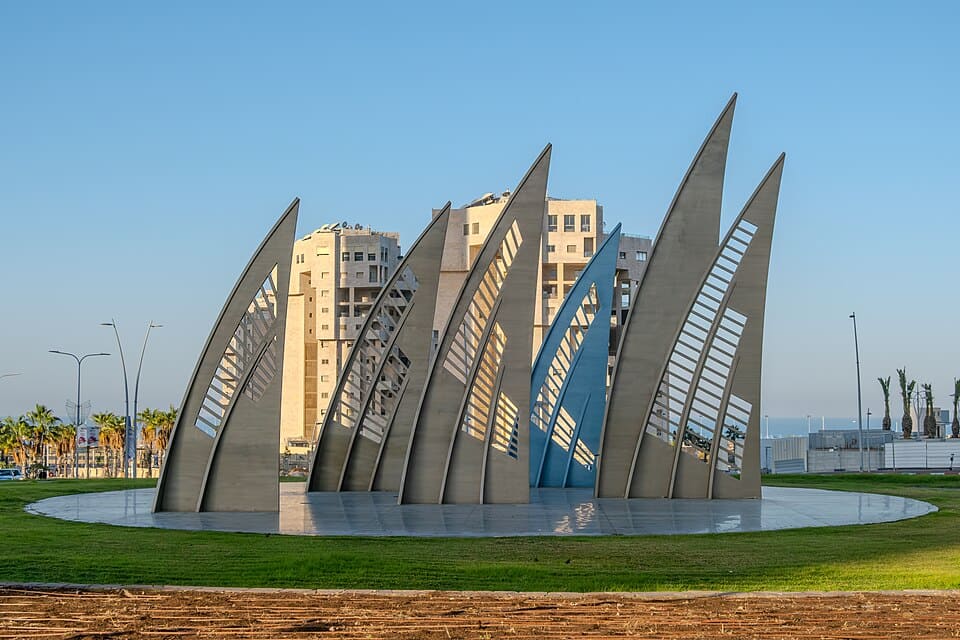
The colours of the sails symbolise Ashdod as a modern and dynamic city.
Blue – the sea Green – sustainability Orange – the energy and warmth that characterise the city's residents
The lion's head is coloured like the dunes and sands from which the city of Ashdod emerged 60 years ago [1956]. The winning logo was designed by Shmuel Yehuda Oish, from the "Kivun" branding agency in Ashdod. The logo reflects Ashdod's identity as a modern city, bridging the past – through the use of a lion's head, a link to the old emblem and the symbol of the Tribe of Judah that once inhabited the area – with its present and future, by incorporating the city's most prominent landmark: Sails Square [photo source].
At the bottom of the emblem, alongside the word "Ashdod" in Latin script, appears the city's original emblem.
(Translated with DeepL.com)
![[Logo]](../images/i/il-ashdod)1961.png)
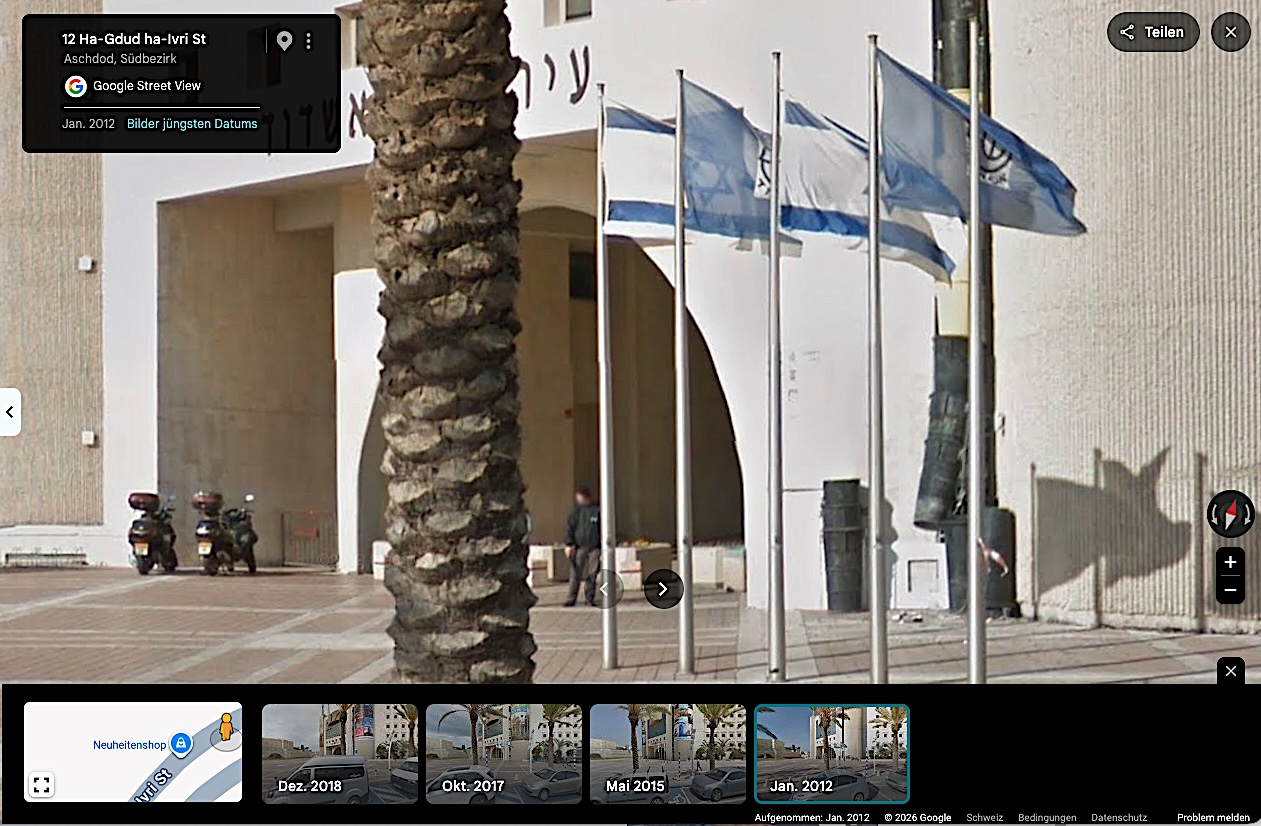
♦ photo (city hall, 2017)
♦ envelope designed for Ashdod's proclamation as a city (1968)* source
* Text on the left: quotation from 2 Chronicles 26:6
From Hebrew Wikipedia:
The emblem consists of a lion's head and an anchor, connected by a line symbolising an ancient biblical ship. The emblem was designed to incorporate elements of both ancient Ashdod and the revitalised Ashdod. The lion's head symbolises the vigour that characterised the establishment of Ashdod through great toil and labour following the founding of the State of Israel, as well as the tribe of Judah, within whose territory the city fell during the division of the land among the tribes (similar to the coat of arms of the city of Jerusalem, which features the Lion of Judah). The anchor symbolises the Port of Ashdod and the use of the sea for the social benefit of humankind.
Rabbi Moshe Cohen Shauli, a former city councillor and former Chief Rabbi of Iranian Jewry in Israel and the Diaspora, viewed Ashdod as a symbol of the country's development and a gateway to Jerusalem, given that it is the port city closest to Israel's capital. His description of the meaning of the city's coat of arms: "It is fitting that my city should wear upon its head a royal crown, the crown of the cities of Israel. For you symbolise the development of our homeland, its prosperity and its flourishing through God's mercy ... Engraved upon your coat of arms is the 'Lion', king of the beasts, a symbol of your strength and might. An anchor is also depicted on your coat of arms, for you are the gateway for the captives of Zion and the scattered exiles. Like an anchor, you have been a salvation to us, the long-established residents, and to our brothers, the new immigrants. In you, tribes and communities unite. Where else in the world is there a city that has done so much to realise the concept of 'the unity of the tribes of Israel'?"
(Translated with DeepL.com)

2.jpg)


3.jpg)
1968.jpg)
