Last modified: 2023-03-11 by rob raeside
Keywords: kent | horse (white) | canterbury cathedral |
Links: FOTW homepage |
search |
disclaimer and copyright |
write us |
mirrors
![[Kent banner of arms]](../images/g/gb-en-kt.gif) image by Jason Saber, 19 October 2017
image by Jason Saber, 19 October 2017
On this page:
![[Kent Shield]](../images/g/gb_kent-s.gif) The Kent White Horse Shield - image by Pete Loeser, 6 October 2020
The Kent White Horse Shield - image by Pete Loeser, 6 October 2020
There is an illustration of the flag of Kent on page 63 of Bartram (2004). The horse is very definitely upright, like a circus horse rearing, and is offset towards the hoist.
Graham Bartram, 10 June 2004
The White Horse flag is very definitely flown from County Hall in Maidstone. Until the new Logo was adopted (c1990s) the heraldic banner was the only flag used by the County Council and flew daily from County Hall. It does NOT have the "Invicta" motto beneath the Horse. The grant of arms was made to Kent County Council in the 1930's, and the first flag caused a little controversy due to its red colour. It was presented by a local Labour MP, who was suspected of making a Socialist statement.
The position of the horse on the arms, logo and flag is indeed "rampant" , that is, rearing on one hind leg - but this version dates only from the 1930's Grant of Arms. Earlier versions depict the Horse as forcen? i.e. rearing naturally on its hind legs) or occasionally courant (running). Some 19th century versions
show the background colour as blue, and there is sometimes a green strip of turf below.
The "Invicta" motto is associated with the story of the Treaty of Swanscombe in 1067: according to local legend, William the Bastard, having seized the English throne, was travelling to Dover when he was met by the Cantware (the People of Kent). They demanded from him their ancient laws and rights, in which case he would have their loyalty, or else "battle most deadly". William granted the request, and Kent acceded to his reign by treaty, hence getting the motto "Invicta" (unconquered). I have lived in Kent all my life, and can vouch for the fact that William is never styled "Conqueror" by anyone native to the County.
Karl Wittwer, 24 July 2004
As a Kentish Man I have just looked at your site re the flag and arms of Kent, and found as expected reference to Hengist and Horsa (though I've never heard it said before that they were one and the same person: brothers, the younger of whom, Horsa, was killed in battle). Hengist, whose banner may have been a white horse on a red ground went on to found the Kingdom of Kent which then included the Isle of Wight, given by a later King of Kent to Cerdic the first King of Wessex. My reason in writing to you is that Hengist and Horsa and their followers were not Saxons, but Jutes who had been exiled from their native land (Jutland). Of course the Saxons, Angles and Jutes were very closely related to each other, all coming from the area of Northern Germany around the Jutland peninsula, so much so that modern DNA testing cannot tell their remains apart.
Richard Kent, 15 June 2006
Flag Type: County Flag
Flag Date: C17th
Flag Designer: Unknown
Adoption
Route: Traditional
UK Design Code: UNKG7409
Aspect Ratio: 3:5
Pantone©
Colours: White, Red 186
Source:
https://www.flaginstitute.org
Valentin Poposki, 28 June 2020
![[Kent banner of arms]](../images/g/gb_en_kt.gif) image by Pete Loeser, 6 October 2020
image by Pete Loeser, 6 October 2020
It is uncertain if the white horse flag is actually used as such. If so,
it would be a banner of arms, and may contain the word "INVICTA" below it.
The Kent County Council uses the white horse on its logo. This logo certainly has the white horse of Kent, but I have a feeling that the Invicta flag is simply a banner of the county's arms, i.e., a white horse on dark red (certainly far darker than on the KCC logo!).
James Dignan, 10 June 2004
Kent County Council governs the county of Kent in England. There are, however, 12 smaller district councils, and around 300 town and parish councils. The Kent County Council does indeed use the White Horse on its banner, logos, website, and on documents.
Pete Loeser, 6 October 2020
![[alarming Kent logo progression]](../images/g/gb_kent-logo.gif) composite image by Pete Loeser, 6 October 2020
composite image by Pete Loeser, 6 October 2020
After almost 1,600 years, will the White Stallion of Kent, the famed stallion forcené argent, be put out to pasture? I've noticed an alarming logo progression on the Kent County Council website - will it end up with the historic White Stallion becoming the "Turquoise" Stallion?
Pete Loeser, 6 October 2020
![[Kent coat of arms]](../images/g/gb)kent.gif) image by James Francom, 13 October 2003 / modified by Pete Loeser, 6 October 2020
image by James Francom, 13 October 2003 / modified by Pete Loeser, 6 October 2020
The arms were granted on 17 October 1933 and re-confirmed in 1975. The white horse of Kent is supposedly the old symbol for the Saxon kingdom of Kent, dating from the 6 - 8th century.
The crest shows a mural crown, which symbolizes the many castles in the county, as well as the independent Saxon kingdom of Kent. The sails are symbols for the strong ties of the county with the sea and stand for the navy, the mercantile marine and fisheries. The sea lions are also a symbol for the strong ties with
the navy, the lion being the British lion. The sea lions also symbolize that Kent is the frontier of Britain with continental Europe. The left supporter wears the arms of the Cinque Ports, five harbour cities that had to provide
support for the English navy until modern times. Four of these cities are in Kent. The arms are three lions with ship hulls as tails. The right supporter wears a shield with the arms of the Archbishopric of Canterbury, founded in 597 by St. Augustine.
James Frankcom, 13 October 2003
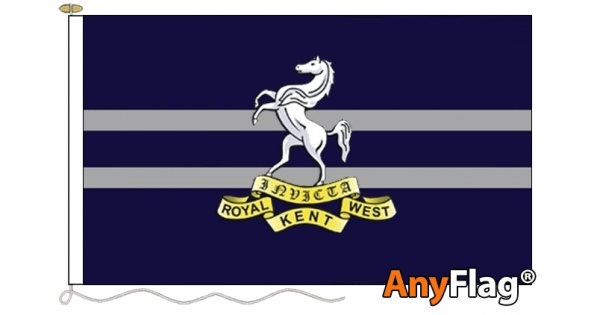
![[Kent coat of arms]](../images/g/gb_kent-rwk.gif) image located by Pete Loeser, 6 October 2020
image located by Pete Loeser, 6 October 2020
Royal West Kent Regiment Flag (commercial), not official Regiment colours (source)
The badges of some British regiments had a white horse that was not derived from the arms of Hanover:
When the elector of Hanover became king of England the white horse seems to have been given prominence in other iconography. This may have been because, as others have noted, it was already a German symbol well accepted in England. The white horse of Hanover seems to be associated with the motto Nec Aspera Terrent, and the white horse of Kent with the motto Invicta.
T.F. Mills, 3 June 1999
![[Kent Police Logo]](../images/g/gb_cant-kp.gif) image from Pete Loeser, 6 October 2020
image from Pete Loeser, 6 October 2020
The Kent Police are the territorial police force for Kent. They are one of the oldest and possibly largest police forces in England. They were founded in 1857. Kent County has an area of 1,433 square miles, almost a population of two million people. That requires a lot of police to cover the area.
Pete Loeser, 6 October 2020
![[Canterbury Cathedral]](../images/g/gb_cantc.gif) image by Rob Raeside
image by Rob Raeside
Outside Canterbury Cathedral there is a flagpole, which last Saturday was flying a blue flag with a white cross throughout, and in the centre, the letter I above the letter X, both in black. When I was there, it looked like there was something above the I but it was not clear. I remember spending a fair amount of time trying to see it clearly. I am still not 100% sure that it was there.
Jonathan Dixon, 2 April 2005
They are the arms of the Cathedral itself. From the cathedral's gift shop webpage - "Our logo is the Cathedral's coat of arms (a blue shield with IX, the Greek abbreviation for Jesus Christ)"
Ned Smith, 2 April 2005
The arms of Canterbury Cathedral are "Azure on a cross Argent the Greek letters I and X in pale Sable." See them at
www.cathedralshop.co.uk.
James Dignan, 22 December 2005
![[Archbishop of Canterbury]](../images/g/gb_arch_cant.gif) image by Todd Schneider, 9 July 2019
image by Todd Schneider, 9 July 2019
Image based on
https://cdn10.bigcommerce.com/
Todd Schneider, 9 July 2019
This not the Archbishop's "personal" flag but is, rather, the flag of his office as leader of the Church of England.
Christopher Southworth, 9 July 2019
Kent has a unique set of internal territorial divisions named "Lathes". The word lathe may derive from a Germanic root meaning "land" or "landed possession", possibly connected with the Greek word latron (payment). These unique divisions appear to have originated in the 6th century, during the Jutish
colonisation of the county. Today Kent has five lathes, that remain as traditional entities. The flags presented below are proposals presented in British County Flags website:
Source: British County Flags: Kent
Valentin Poposki, 28 June 2020
![[Lathe of Aylesford proposal]](../images/g/gb-eken_a.gif) image located by Valentin Poposki, 29 June 2020
image located by Valentin Poposki, 29 June 2020
The Lathe of Aylesford is home to "The Aylesford Bucket", believed to have held locally produced beer, mead, or fermented berry-juices, this particular example, discovered in 1886, containing several cremated human bones, is thought to have been used in a funeral ceremony. The bucket is noted for its ornamentation, featuring two elaborately crowned human heads rearing above the vessel's handles; and an extraordinary decorative frieze just below the rim which bears the singular image of two "pantomime horses" facing each other. The
artifact is identified with the Celtic Cantii people, after whom the county of Kent is named and dated to approximately 75 BC. The distinct decorative handle on the bucket, depicting a human face and named for the lathe in which it was discovered, is an ideal local symbol for deployment on a flag for the Lathe of Aylesford. The device is set against a grey coloured field, suggestive of the earth from which it was retrieved.
Source:
British County Flags: Kent
Valentin Poposki, 29 June 2020
![[Lathe of Aylesford proposal]](../images/g/gb-eken_sa.gif) image located by Valentin Poposki, 29 June 2020
image located by Valentin Poposki, 29 June 2020
The flag of the Lathe of Saint Augustine features the cross shaped staff finial associated with the saint, for whom the locality is named, Augustine, the first Archbishop of Canterbury, the main city in the lathe. This form of cross is known as "The Canterbury Cross" after a Saxon brooch, dating around 850, that
was found in Canterbury in 1867. Appropriately, a Canterbury Cross, is a decorative feature on the "Kent and Canterbury Hospital", in Canterbury! The cross features a small square in the centre, from which extend four arms, wider on the outside, so that the arms look like triangles, symbolising the Trinity. The tips of the arms are arcs of a single circle, giving the overall effect of a round wheel. A stone cross is located at Canterbury Cathedral and such crosses are sold at the souvenir shop there. The cross on the flag is black with some minimal grey detailing and is set against a bright yellow field, representative of the bright yellow fields of Oil Seed Rape often found in the area, which contrasts well with both the main charge and the red hoist panel.
Source:
British County Flags: Kent
Valentin Poposki, 29 June 2020
![[Lathe of Aylesford proposal]](../images/g/gb-eken_s.gif) image located by Valentin Poposki, 29 June 2020
image located by Valentin Poposki, 29 June 2020
The Lathe of Scray is a wide territory which embraces both the north and south Kent coasts and there is no single emblem that naturally represents this somewhat diverse division of the county. Scray was formed by the merger of
Milton and Wye however and each of these is associated with a distinct local emblem. The council of Sittingbourne and Milton was awarded arms in 1949 which included a green wyvern, this had been previously used by the council in Milton Regis and stood for the defence against Danish and later invaders, with an obvious reference to the emblem of Wessex, the bulwark in the struggle against Danish invasion. The town of Wye is overlooked by a chalk hill, into which the outline of a crown has been carved. The combination of these two devices, using a distinctive green and white colour scheme that reflects the colours of both original emblems, thus symbolises the combined localities that make the Lathe of Scray.
Source:
British County Flags: Kent
Valentin Poposki, 29 June 2020
![[Lathe of Aylesford proposal]](../images/g/gb-eken_sh.gif) image located by Valentin Poposki, 29 June 2020
image located by Valentin Poposki, 29 June 2020
The territory of this lathe includes the Cinque Port towns of Hythe, Folkestone, Lydd and New Romney. A confederation of coastal towns in Kent and Sussex, formed for military and trade purposes, the Cinque Ports originally comprised Hastings, New Romney, Hythe, Dover and Sandwich, with Rye replacing New Romney when storm damage led to it being silted up. A number of other towns, having varying degrees of connection to the ancient Liberties of the Cinque Ports, are known as Limbs of the Cinque Ports towns, with Folkestone and Lydd included in their number. The distinctive heraldic emblem of the Cinque Ports features a lion joined to a ship, also seen in the arms of Hastings and Sandwich, and this same theme was included in the arms awarded to the council of the modern district of Shepway, whose style also recalls the civic arms of Folkestone, the major town in the Lathe. Thus the flag of the Lathe of Shepway features a golden Cinque Ports ship. This both recalls the heritage of the local
confederation and also emphasises the strong association of the locality with the sea, whose colour forms the background against which the ship is placed. The blue is a lighter shade to enhance the contrast with the red of Kent in the hoist panel.
Source:
British County Flags: Kent
Valentin Poposki, 29 June 2020
![[Lathe of Aylesford proposal]](../images/g/gb-eken_su.gif) image located by Valentin Poposki, 29 June 2020
image located by Valentin Poposki, 29 June 2020
The Lathe of Sutton-at-Hone bears a flag with a white Jerusalem cross against a black background. The symbol is associated with this locality because of the presence of St. John's Jerusalem Preceptory there. This was established in 1199 as a Commandry of the Knights Hospitaller of the Order of Saint John of Jerusalem. The building was given to the nation in 1943 by Sir Stephen Tallents, and was open to the public twice a week in the 1950's. The emblem of the order of Saint John and the Knights Hospitaller, known as a Maltese cross because the headquarters of the order is located on the island and it is commonly seen there, is a white eight-pointed cross having the form of four "V"-shaped elements, each joining the others at its "vertex", leaving the other two tips spread outward symmetrically. Consequently organisations in the Lathe of Sutton-at-Hone make use of the cross, including for example a local parish council and the local football club. The cross is also present on the civic arms of Dartford, on the necks of the two supporters bearing the shield, where it is white against a red and black field. A white cross against a red background, as seen in the above image, remains the specific colour scheme used by the order of Saint John but another common realisation for this device places the white cross against a black background and this is the colour scheme utilised for the lathe flag, which is seen as particularly dramatic
and distinctive.
Source:
British County Flags: Kent
Valentin Poposki, 29 June 2020
![[Admiral of the Humber]](../images/g/gb~admh.gif) image by Martin Grieve, based on a photograph by Donald Edwards
image by Martin Grieve, based on a photograph by Donald Edwards
Admiral of the Humber (source)
In 1930 the Town Clerk of Rochester informed the Admiralty that the Mayor of Rochester was, by the terms of various Charters granted between 1189 and 1692, Admiral of the Medway, and entitled to fly the flag of an admiral when on the river between Sheerness (where the river Medway flows into the Thames Estuary) and Hawkwood (near Maidstone). He enclosed the drawing of a flag, a St George's flag defaced in the centre with the arms of Rochester, which he suggested should be approved by the Admiralty, to obviate confusion between an Admiral of the
Royal Navy, and the Admiral of the Medway.
The Admiralty replied that the title Admiral of the Medway did not confer the right to the proposed flag, which would contravene the Order in Council of 9 July 1864, that abolished Royal Navy Squadron Colours, and established the design of the flags of naval admirals. The Town Clerk then asked if the Mayor could continue to fly a plain St George's flag, something he had done for many years. At that time Chatham, which is along the river adjacent to
Rochester, was a major naval dockyard port, so, not unsurprisingly, the Admiralty refused this request. [National Archives (PRO) ADM 1/8744/138]
See Admiral of the Humber.
David Prothero, 13 June 2003