
Last modified: 2026-10-31 by rob raeside
Keywords: bolivar | colombia | cartagena | cartagena de indias | nueva granada | barranquilla |
Links: FOTW homepage |
search |
disclaimer and copyright |
write us |
mirrors
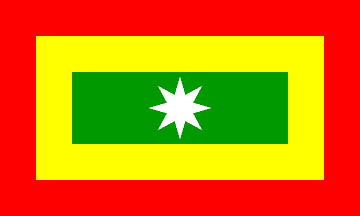 image by Carlos Thompson, 8 May 2003
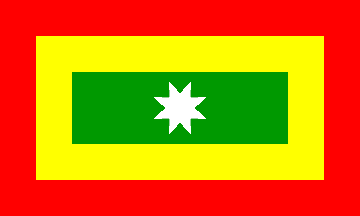 image by Carlos Thompson, 10 November 2004
See also:
This was the Cartagena State flag
(1811-14) and the United Provinces of Nueva Granada
provisional flag (1814). The star is eighpointed
Jaume Ollé, 8 September 1996
Above is the flag according the constitution provisions. Same
image is feautured in the arms. The 8 pointed yellow star is the
supposed original flag of the republic of Cartagena was described
only after that the provincial flag was already adopted. When the
provincial flag was adopted the Cartagena republic flag was
reconstructed as the above and was adopted as such.
Jaume Ollé , 15 May 2000
I live in Barranquilla, Atlantico, Colombia. A green,
red-white-fringed, five-point star flag is the flag of the city
of Barranquilla, and the 8 Points
Star Version is one is the Cartagena's. Cartagena is the capital
of the Bolivar department.
Carlos A. Leiva, 18 July 2000
At the official site www.alcaldiadecartagena.com
, one can see the municipal symbols. Note the shape of the star
and the respective proportions of the rectanglesas as opposed to
the Previously Reported Flag.
Translated from that site:
"FLAG CUADRILONGA - With the independence and the
formation of the Sovereign State of Cartagena, in 1812, along
with the republican shield, a republican flag was adopted
composed of three rectangles or longos squares (for that reason
it is called cuadrilonga ), of colors red, yellow and green and
in its center a white tienuna stars of eight points. It had been
speculated on the meaning of the three rectangles; on the three
used colors and the mentioned star. Nevertheless, it was not been
possible to find no document that indicates such meaning with
exactitude . Until now the version that seems best guessed right
is that the eight ends of the star correspond to the eight
provinces that originally formed the Sovereign State of
Cartagena. In any case, the Cuadrilonga Flag had an outstanding
figuration as the one to be taken as standard by Bolivar when in
1812 he undertook the so-called Admirable Campaign from Cartagena
which culminated with the liberation of Caracas, to which the
liberator arrived with the flag of Cartagena in his hands. It is
the same flag of Barranquilla, being the Flag of the State (old
Province) of Cartagena, of which that city was part."
Dov Gutterman, 21 January and 22 Febuary 2002
The flag I remember have seen flying is more alike the Previously Reported Flag, than the newly reported
one. I have a photo that I took last time I was in Cartagena
(last year), and it seems to agree with the proportions of the
previusly reported flag, and the shade of green is similar to the
one from Barranquilla or the historical flag of Cartagena.
I have found two sites: www.cartagena.com.co
and www.cartagenacaribe.com,
each with a different version of the flag. I am pretty sure that
the cuadrilonga's vertical and horizontal strips are the same
width.
Carlos Thompson, 17 March 2003 and 8 May 2003
Most flags displayed in Cartagena do show a diference of Barranquilla and historical
Cartagena flag.: non of the points in the star points to the top. as shown
in www.cartagenacaribe.com
. I do not know, however, if there is an official
difference.
Carlos Thompson, 10 November 2004
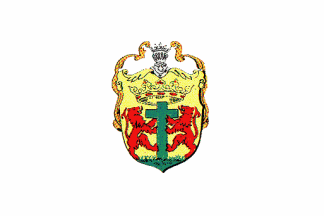 image by Eugene Ipavec, 31 December 2009
On December 11 I visited Cartagena , and saw the Consejo
(Council), the Legislative body in a Municipality in Colombia
(each Municipality in the country has one). Outside of their
offices I saw a flag which was a rectangular white background
with the Colonial Coat of Armsin the middle. The flag has the
Coat of Arms on the obverse as well as the reverse.
E.R.., 31 December 2009
"Colonial" CoAbo-cg.gif) located by Dov Gutterman, 21 January 2002
image from www.alcaldiadecartagena.com
bo-cg1a.jpg)
bo-cg1b.jpg) images located by Esteban Rivera, 23 February 2026
Sources:
http://www.librosdeheraldica.com, and
the book "Heráldica colombiana" (1952) by Enrique Ortega Ricaurte
"Republican" seal
bo_cg.jpg) located by Carlos Thompson, 17 March 2003
image from www.cartagena.com.co
Note: Cartagena City changed its Coat of Arms. This
one is probably the previous arms.
Felipe Carrillo, 13 Febuary 2003
Recently there have been a debate about changing the coat of arms of
Cartagena. The one above has been the arms since 1574, with a few
interruptions. The mayor wants to change the arms for the one used by the
independentists in 1812. While the first one (also known as "colonial") is
the most known, some historians agree that both the "colonial" and the
"republican" are current coats of arms of Cartagena. See also www.cartagena.com.co
and www.cartagenacaribe.com.
Carlos Thompson, 17 March 2003
See also image Colonial
Coat of Arms from: GARCÍA, Julio Cesar. "Himnos y Símbolos
de Nuestra Colombia". Camer Editores. 2000, and image of Republican Coat of
Arms and the flasg from a book by Evangelista Quintana Rentería.
Esteban Rivera, 22 March 2004
"Republican" Arms
bo_cg2.jpg) located by Esteban Rivera, 01 February 2013
image from Bulletin
No. 88 of the Fundación Numismáticos de Colombia
The "Republican" Coat of Arms of Cartagena was originally intended to be used
as the Seal for official documents and charge a Postal Tax on all documents
sealed with it, a measure adopted in the rest of the newly independent States as a way for colecting taxes (public income for the State to cover its own
expenses). The first mention of this Seal was on , and later this same Seal was
replicated onto coins, the latter being mentioned first on the Gazeta 14
(Gazette 14) of July 16, 1812, not having the same detail though, as seen in the
following pages of the document.
Source: Bulletin No. 88 of the Fundación Numismáticos de
Colombia ISSN-0122-1345, Numismatics of Colombia, firs semester of 2010
Foundation, found here.
Esteban Rivera, 01 February 2013
A somewhat technical and historical description of it is as follows (original
in Spanish):
"On the first page of the 'Constitution of the State of
Cartagena de Indias (https://www.suin-juriscol.gov.co/viewDocument.asp),
sanctioned on June 14, 1812, the second year of its independence,' there is a
circular shield depicting a richly adorned indigenous woman, wearing a headdress
and feathered skirt, with a quiver and arrows on her back, reclining against a
palm tree. In her right hand, she holds a pomegranate from which a bird is
feeding. In her left hand, she holds broken chains.
In the background,
two hills with buildings can be seen; the one on the right has been identified
as La Popa hill. (Rey Márquez, 2005, p. 2). The coins minted by the state of
Cartagena de Indias in 1812 depict the Indian woman with her attributes holding
the pomegranate and broken chains. The background landscape changes; the hills
are replaced by palm trees.
Sources:
http://sedboyaca.gov.co/wp-content/uploads/2019/02/coleccion-bicentenario-arte.pdf
and
https://revistas.unicartagena.edu.co/index.php/eltallerdelahistoria/article/download/3421/2890
Esteban Rivera, 23 February 2026
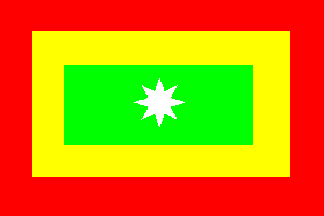 image by Petr Exner and Ivan Sache, 22 Febuary
2002
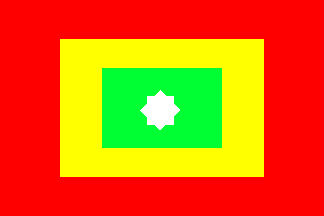 image by Ivan Sache, 22 Febuary 2002
bocg1.jpg)
bocg2.jpg)