Last modified: 2026-04-25 by rick wyatt
Keywords: south carolina | united states | eutaw |
Links: FOTW homepage |
search |
disclaimer and copyright |
write us |
mirrors
See also:
![[South Carolina 2nd Regiment flag]](../images/u/us-sc^2r2.gif) image located by Esteban Rivera, 16 February 2026
image located by Esteban Rivera, 16 February 2026
The Flag of the Second South Carolina Regiment, Continental Line." The colors are listed as "Blue field, yellow letters, green wreath, red ribbon, red and blue flags within." The motto in the center reads "VITA POTIOR LIBERTAS," with the year "1775" just above the ribbon.
"This flag with the motto 'Liberty rather than life,' was carried by men who meant it. Sgt. Jasper, who had saved the Crescent Flag at Sullivan's Island, fell carrying this at Savannah. Col. Moultrie first led this regiment, and Francis Marion, the 'Swamp Fox,' commanded it at Savannah."Randy Young, 23 February 2001
![[Eutaw Standard]](../images/u/us^eutaw.gif) image by Randy Young, 27 February 2001
image by Randy Young, 27 February 2001
"Colonel Washington spent an hour with the fair Jane Elliott before the campaign through Eutaw and the Cowpens. She [said she] would await news of the triumph of his flag. 'But I have no flag,' he said. 'Then I'll give you one!' she replied, and cut a square of brocade from a curtain. It later flew at their wedding."Randy Young, 27 February 2001
![[South Carolina Navy]](../images/u/us-sc^nv.gif) image by Randy Young, 2 August 2001
image by Randy Young, 2 August 2001
Source: "The Stars and the Stripes: The American Flag as Art and as History from the Birth of the Republic to the Present."
This flag is listed as "The flag of the South Carolina navy" during the American Revolution. The flag is essentially the same as the Continental Naval jack, but with the motto "DONT TREAD ON ME" appearing on the second red stripe from the top, and "joining stripes of Scotland's blue and England's red."
Randy Young, 2 August 2001
The flag is mentioned in the October 9, 1778 letter from Benjamin Franklin and John Adams to the "Ambassador of the King of the Two Sicilies", which describes several American flags. One sentence reads, "For example, the vessels
of war of the State of Massachusetts Bay have sometimes a pine tree; and those of South Carolina a rattlesnake, in the middle of the 13 stripes."
The Franklin/Adams letter does not indicate the color of the stripes. "Standards and Colors of the American Revolution" indicates that the red and blue colours are illustrated in Preble's book (to which I am sad to say I do not have access), but that Preble does not give his source. The earlier text of the Franklin/Adams letter indicated that the stripes on the flag of the American Congress had red, white AND blue stripes, as was often the case with American naval vessels in European waters.
Devereaux Cannon, 16 September 2002
I have the Admiral Preble books and while the SC Navy flag is illustrated on a color plate between pages 192 - 3 in Volume One, there does not seem to be any text concerning this flag. The flag as illustrated has seven red and six blue
stripes and the rattlesnake is oriented generally the same as on the First Navy Jack. The most notable difference would be that the "DONT TREAD ON ME" slogan appears in the stripe third from the top, above the rattlesnake.
John Evosevic, 16 September 2002
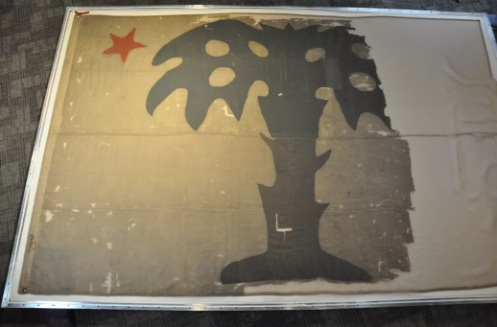
![[Palmetto Guard]](../images/u/us-sc^pg2.jpg) image located by Esteban Rivera, 16 February 2026
image located by Esteban Rivera, 16 February 2026
Source:
https://ultimateflags.com/products/palmetto-guard-cotton-flag-3-x-5-ft
The following is the information on this flag. Since the main source
basically covers all information regarding this subject, I will quote most of
the article for reference purposes, including citations.
"The Palmetto
Guard flag was the first Confederate-aligned flag to fly over Fort Sumter. It
bears a symbol that has been associated with South Carolina since the American
Revolution – and was flown as a symbol of secession. To understand the flag,
we'll have to explore what it originally represented, and consider how its
meaning may have changed over time.
A Revolutionary Symbol
The primary symbol on the Palmetto Guard flag was not new at the time of
the Civil War. Instead, it springs from South Carolina's fight for
independence against the British during the American Revolution.
In 1776,
Patriots under Colonel William Moultrie successfully defended a fort on
Sullivan's Island, at the mouth of Charleston Harbor. The fort, later renamed Fort Moultrie (https://srvirginia.org), was made of palmetto tree logs – a building material found in large
quantities on the South Carolina coastline. During the battle, British cannon
fire failed to do significant damage to the fort, in part because the logs
were flexible and resilient against incoming fire. [1]
The Patriot
victory made the palmetto tree an enduring symbol
of South Carolina’s resilience against the British. It became associated with
a state holiday known today as "Carolina Day", numerous civic organizations,
and a militia unit – the Palmetto Guard. [2]
Flags and Militiamen
The Palmetto Guard was one of many militia units in pre-Civil War
Charleston, appearing in local newspaper advertisements as early as 1851. [3]
When South Carolina announced its secession from the United States on
December 20, 1860, the militia units would be the state's first organized
military.
TThroughout the secession crisis, the Palmetto tree took on a
new meaning. South Carolina politicians looked back to the Revolutionary
symbol and linked it with their current attempt at "independence". In January
1861, South Carolina's legislature adopted a new official state flag, bearing
a white palmetto tree in the center, a crescent in the upper left corner, and
a dark blue field behind it. With a few small modifications, this remains the
state flag today. [4]
The Palmetto Guard flag was slightly different. The flag consisted of a
white field, a dark brown and green palmetto tree in the center, and a red
star in the upper left corner. The "single star" stood for "state
sovereignty" or independence. [5]
"The Palmetto Guard was divided into
the Palmetto Guard Volunteers and the Palmetto Guard Artillery. Half of the
Palmetto Guard volunteered for Confederate service in 1861" (https://ultimateflags.com).
First Shots, First Flag
Throughout the secession crisis, South
Carolina militia units like the Palmetto Guard were engaged in a tense
standoff with the US garrison at Fort Sumter, a centrally placed harbor fort.
By early April 1861, the Palmetto Guard was stationed on Morris Island,
within firing range of Fort Sumter and the US soldiers.
On the early
morning of April 12, the Confederate positions around the harbor began
shelling Fort Sumter with artillery fire. Captain G.B. Cuthbert of the
Palmetto Guard described his regiment's activity:
"At the dawn of day the
Iron Battery commenced its work of demolition. The first shell from columbiad
No. 1, fired by the venerable Edmund Ruffin, of Virginia, burst directly upon
the parapet of the Southwest angle of the fort..." [7]
After about 34
hours of bombardment, the US forces at Fort Sumter agreed to evacuate the
fort, and the fort was physically taken by the Confederates on April 14th.
Ruffin carried the flag into the fort, and another Confederate soldier raised
it over Fort Sumter. The fort was in Confederate hands – as it would be until
February 1865. [8]
The Flag's Legacy
The Palmetto Guard soon
became part of the 2nd South Carolina Infantry Regiment
(which was known as the 2nd Palmetto Regiment and fought in many of the major campaigns of the war,
mostly with the Army of Northern Virginia.
The South Carolina
state flag still bears the palmetto tree symbol. However, the tree is still
mostly remembered for its successful Revolutionary War defense of Charleston
Harbor. Due to the Confederacy's defeat, the flag's association with the
secession movement has become less well known.
The flag was eventually
kept in the possession of John Styles Bird, Jr., a veteran of the Palmetto
Guard who was present during the attack on Fort Sumter. A descendant of Pvt.
Bird gave the flag to Fort Sumter and Fort Moultrie National Historical Park in 1979. [9] Its colors are now faded, with the formerly white background
now bearing a beige appearance. The fragile flag
(source) was kept on display from
1985 until 2023. It is now in the park's museum resting the artifact from
light exposure.
Citations:
[1]: "Sullivan's Island". American
Battlefield Trust.
https://www.battlefields.org/learn/revolutionary-war/battles/sullivans-island-south-carolina
[2]: Butler, Nic. "The Story of Carolina Day". Charleston County Public
Library, 2018 June 22.
https://www.ccpl.org/charleston-time-machine/story-carolina-day
[3]:
"Palmetto Guard" The Charleston Daily Courier, 1851 July 19.
https://www.newspapers.com/image/604528878/
[4]: The
Flag of South Carolina. The Charleston Mercury, 1861 Feb.
https://www.newspapers.com/image/605450849/
[5]:
"What
Shall Be the Flag?" The Charleston Mercury, 1860 Nov. 20.
https://www.newspapers.com/image/605447985/
[6]:
"The
Palmetto Guard". Richmond Dispatch, 1861 May 13.
https://www.newspapers.com/image/80617469/
[7]: The War of the Rebellion:
A Compilation of the Official Records of the Union and Confederate Armies.
Series I – Volume I. P. 54.
[8]: Ringold, May Spencer, and W.G. Young.
"William Gourdin Young and the Wigfall Mission – Fort Sumter, April 13,
1861". The South Carolina Historical Magazine, Jan. 1972, pp. 27-36.
https://www.jstor.org/stable/27567098?seq=1
[9]:
Burton, Beatrice, et al. Fort Sumter and Fort Moultrie National Historical Park
Administrative History. Nov. 2020, p. 127.
https://npshistory.com/publications/fosu/adhi.pdf
Source:
https://www.nps.gov/articles/000/the-palmetto-guard-flag.htm
Esteban Rivera, 16 February 2026
I am not sure if the Palmetto Guards flag is the same as the Palmetto Regiment (https://www.scencyclopedia.org/sce/entries/palmetto-regiment and https://en.wikipedia.org/wiki/Palmetto_Regiment), since the Palmeto Guards appear as early as a 1851 and a monument was built in 1853 and installed in 1854 (https://www.historiccolumbia.org/tour-locations/1200-gervais-street-9). AI (Gemini) mentions the following: "the Palmetto Regiment and the Palmetto Guard are not the same; they are distinct South Carolina military entities from different, though overlapping, periods. The Palmetto Regiment was a 10-company unit formed for the Mexican War (1846), while the Palmetto Guard was a pre-Civil War Charleston militia company"
Source: https://www.nps.gov/articles/000/the-palmetto-guard-flag.htm
Esteban Rivera, 2 March 2026