Last modified: 2026-01-02 by daniel rentería
Keywords: venezuela | uncategorized | government |
Links: FOTW homepage |
search |
disclaimer and copyright |
write us |
mirrors
See also:
 image by Zoltan Horvath, 22 February 2014
The IAIM (Instituto Aeropuerto Internacional de Maiquetía, Maiquetia
International Airport Institute) is the operator of the
"Aeropuerto Internacional de Maiquetía Simón Bolívar" in Maiquetía,
Estado Vargas.
Source:
http://es.wikipedia.org/wiki/Instituto_Nacional_de_Aeron%C3%A1utica_Civil
The flag is a white horizontal flag with the
logo
in the middle.
The flag is seen
here
and
here.
(Sources:
http://www.gentedehoy.com/site/2013/08/designado-gb-luis-gustavo-graterol-caraballo-como-presidente-de-conviasa/
and http://www.aporrea.org/actualidad/n234125.html )
For additional information go to:
IAIM (official website):
Aeropuerto Internacional de Maiquetía "Simón Bolívar" (official website)
Esteban Rivera, 22 February 2014
 image by Zachary Harden, 20 December 2004
Based on <www.lacasadelasbanderas.com>.
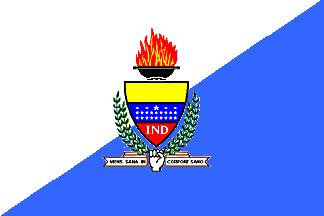 image by Ivan Sache, 27 May 2004
ind.gif) image by Raul Orta, 28 April 2004
image by Raul Orta, 28 April 2004
Flag at <www.lacasadelasbanderas.com>.
Logo at <www.ind.gov.ve>.
Dov Gutterman and Marc Pasquin, 13 April 2004
Instituto Nacional de Deportes (National Institute of Sports)
- Official organization which centralizes all the sport activity
in our country.
The Flag - Attributes and Semiology: Consists in a field with
approximated ratio 2:3; this is, square and half of length,
diagonally divided from the superior corner of the fly to
the inferior corner of the hoist in two triangular stripes:
white (superior) and blue (inferior). Completes the design the
Coat of Arms of the Institute on the center. Although at the time
of the redaction of this file is not available official data
about the semiology of this flag, according to the consulted
sources, the generally attributed meaning to these colors is the
follows: white remembers Integrity, Virtue and Peace whereas blue
alludes to High Ideals, Elevation of Sights, Justice, Loyalty and
Perseverance, values all totally adapt with the aims and
objectives of the Organism. This piece is considered too
the Venezuelan Sport Flag.
Historical Synthesis: Until the moment of the redaction of this
file is not available data about the origin and official adoption
of this flag.
Coat of Arms - Attributes: Consists of a French contour tierced
in fess. The Quarter of the Chief, is plenty in Or (yellow). The
Central Quarter, enameled in Azure (blue) charges twenty-three
five-pointed stars in Argent (white) disposed five, nine and
nine, being of greater dimension the central one in the set of
five. The Quarter of the Base, enameled in Gules (red) loads the
abbreviations "I", "N" and "D" in
Roman capital letters of Argent (white). As external ornaments,
the blazon shows a censer in Sable (black) flamed (with flames)
in Or (yellow) and Gules (red) as crest and as supports, a laurel
crown in its colors and a pennant in Argent (white) charging the
motto 2MENS SANA IN CORPORE SANO" (Healthy Mind in
Healthy Body) in gothic capital letters in Sable (black), both
subjects by a human dexter in Argent (white) filleted
(delineated) in Sable (black).
Semiology: Although at the time of the redaction of this file is
not available official data about the matter, according to the
consulted sources is possible to be inferred that the enamels in
the quarters allude to the National Flag of Venezuela: Or
(yellow) remembers Authority, Magnanimity and Constance; Azure
(blue) alludes to High Ideals, Elevation of Sights, Justice,
Loyalty and Perseverance, while Gules (red) represents Courage,
Sacrifice and Valor, all of them virtues totally adapted with the
aims and objectives of the Organism. The stars represent the
twenty-three geopolitical entities of the Republic, whereas the
abbreviations allude naturally to the Institute. The flamed
censer remembers the Sports Spirit; the laurel crown symbolizes
the imperishable triumph fruit of the maintained effort; the
closed hand symbolizes strength and victory, whereas the motto,
take from the well-known phrase of the Latin poet Juvenal,
rebounds the same essence and fundamental object of the Organism.
Historical Synthesis: Until the moment of the redaction of this
file is not available data about the origin and official adoption
of this Coat of Arms.
Sources: Material and information provided by Mr.
Konstantin Jemetz, Functionary in Charge of Documentation of
Literature Room and Superior University Technician Richard
Idrogo, Graphical Designer of Department of Press of
National Institute of Sports. Caracas, April 21st, 2004.
Raul Orta, 28 April 2004
The Latin poet Juvenal (Decimus Junius Juvenalis, c.
60-c. 130) came from Apulia to Rome under the reign of emperor
Domitian (Titus Flavius Domitianus, 51-96, emperor in
81). He spent a harsh life, always searching for rich protectors.
Embittered by his setbacks, he wrote in the beginning of the IInd
century sixteen Satires, in which he violently denounced
the moral corruption of the Roman society. Juvenal venerated the
traditional moral and social values and accusated the foreigners
and the emancipated slaves to contribute to the degeneracy of
these values. Juvenal is considered as one of the founders of the
satire, characterized by the lack of nuance and deliberately
exaggerated indignation. Among those who acknowledged his
influence are the French satirists Nicolas Boileau (1636-1711)
and Victor Hugo (1802-1885).
Mens sana in corpore sano appears in Satire X
(356), dedicated to the wishes. Originally, Juvenal meant that,
as a wise man, he asked to the God only a healthy mind and a
healthy body. The modern meaning of the maxima is rather that a
healthy body is required to have a healthy mind. Therefore, it is
not surprising that Juvenal's maxima is used as a mantra by sport
federations. I believe the use of supposed wise Latin mottos by
the sport federations is extremely ironical knowing the level of
mind and body corruption attained in modern sport.
Ivan Sache, 27 May 2004

 images by Ivan Sache, 16 May 2021
Instituto Nacional de Parques (INPARQUES, National Park
Institute) - The INPARQUES logo, with the letters MARNR (Ministry
of Environment and Renewable Natural Resources). The logo is a
black deer passant (modernly stylised) on a tree leaf .
Now, the names and initials of many ministries (including this)
have changed, but no flag has done any changes.
Guillermo T. Aveledo, 1 March 2000
INPARQUES, established on 3 October 1973, has for duty "the direction of
public policy oriented to protection and management of the Venezuela Park
System, composed of 43 national parks, 36 natural monuments and 65 leisure
parks. Parks and monuments account for 16% of the national territory and include
90% of the sources of freshwater.
http://www.inparques.gob.ve/, INPARQUES website
The flag is used
either with a white or a green field.
Photos
White field
https://www.facebook.com/InparquesGobVe
https://www.facebook.com/InparquesGobVe
Green field
http://www.inparques.gob.ve
https://www.facebook.com/InparquesGobVe/
https://www.facebook.com/secretariadeeducacionydeporte/
Ivan Sache, 16 May
2021
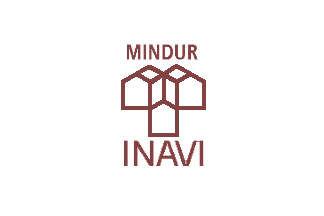 image by Guillermo T. Aveledo, 1 March 2000
Instituto Nacional de la Vivienda (INAVI, National Housing
Institute) - The INAVI logo (three crossed gibblings which look
like houses), and the letters MINDUR above it (Ministry of Urban
Development), in brown.
Now, the names and initials of many ministries (including this)
have changed, but no flag has done any changes
Guillermo T. Aveledo, 1 March 2000
 image by Zoltan Horvath, 25 March 2011
The SUDEBAN (Superintendencia de Bancos), Banking Superintendency is the
Venezuelan government organization in charge of regulating Banks practices.
Source:
http://sudeban.gob.ve/webgui/inicio/quienes
Its flag is a white horizontal flag with the
logo in the middle.
Image of flag at:
http://www.abrebrecha.com/110735_Norma-para-enfrentar-ciberdelitos-prepara-Sudeban.html
For additional information please see:
SUDEBAN (official
website)
Esteban Rivera, 25 March 2011
Anything below this line was not added by the editor of this page.