Last modified: 2026-10-17 by rick wyatt
Keywords: united states | anti-slavery almanac |
Links: FOTW homepage |
search |
disclaimer and copyright |
write us |
mirrors
![[Anti-Slavery Almanac flag]](../images/u/us!nstar.gif) image by António Martins-Tuválkin,
30 September 2026
image by António Martins-Tuválkin,
30 September 2026
On this page:
See also:At
https://encyclopediavirginia.org/12956-fe8903ae1905339 the back cover of
William Wells Brown's Illustrated Edition of the Life and Escape of Wm.
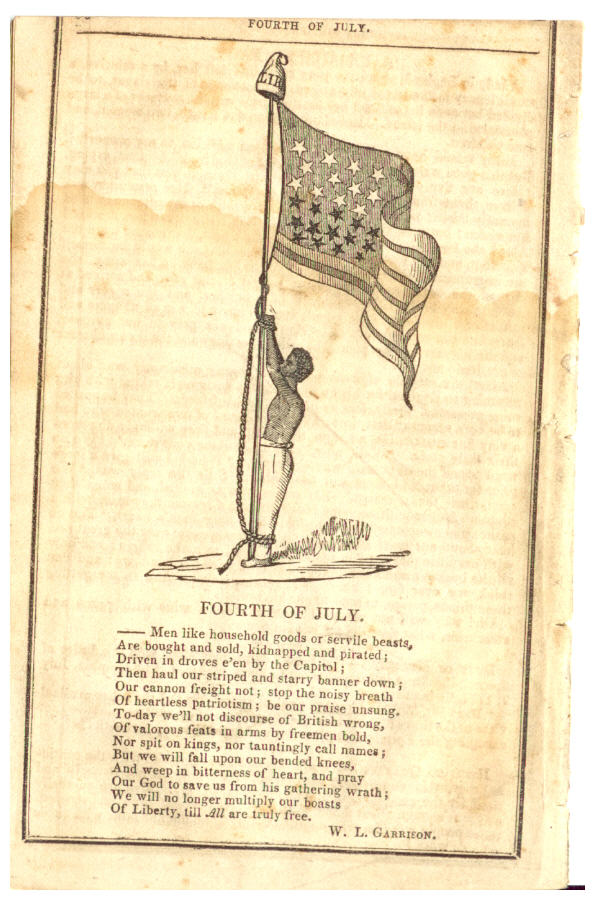
Wells Brown (London, 1851) with a flag-related woodcut by Patrick Reason
illustrating a poem by William Lloyd Garrison. It depicts an unusual U.S. flag,
altered in metaphor, hoisted on a flag pole set on the ground, its rope also
bounding a dark skin male human figure, tied to the pole at his wrists and
ankles. (Same image also seen elsewhere —
https://blogs.shu.edu/americanhistory/project/the-fourth-of-july,
e.g., where it is on p.36 of some other publication; I'd presume Brown's 1851
edition is the first of many reuses of this artwork.)
The flag design is
not the 30-star or 31-star flag expected for this
date, but a meaningful alteration showing on the canton 15 white stars above
(north) and 14 black stars below (south), these standing for each state's
position concerning the enslavement of blacks.
The stripes pattern is swapped to start and end with a white stripe, and
there are only eleven in total: 6 white stripes alternating with 5 red
stripes; furthermore the white stripes are also doubly wide and this latter
departure from the actual flag design is likely anotther part of the
metaphor about inherent white supremacism, not just mere careless
draughtsmanship.
It is from the 1844 American Anti-Slavery Almanac, available in the Zaricor
Flag Collection website:
https://www.flagcollection.com/itemdetails.php
https://bowerbird-mediastore.s3.amazonaws.com
António Martins-Tuválkin, 30 September 2026