
Last modified: 2026-10-17 by  klaus-michael schneider
Keywords: princely states | ternate | goheba madopolo romdidi |
Links: FOTW homepage |
search |
disclaimer and copyright |
write us |
mirrors
![[Ternate National Flag]](../images/i/id_tern3.gif) image by Klaus-Michael Schneider, 7 Oct 2026
image by Klaus-Michael Schneider, 7 Oct 2026
See also:
Acc. to Dirk Rühl the inscription on the white disc of a yellow flag is red. But we have evidence in our archives of a car flag with white fringes, where the inscription is black.
Source:
Rühl 1952, p.143
Klaus-Michael Schneider, 7 Oct 2026
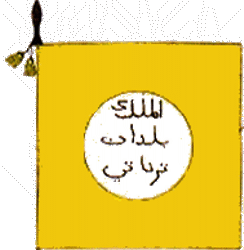 image by John McMeekin, 25 Feb 2015
BENDERA KOMPANI (or Battalion Flag), in the central disc is "Al Molok Buldan Tarnate" (The Moluccas are Ternate Territory).
John McMeekin, 25 Feb 2015
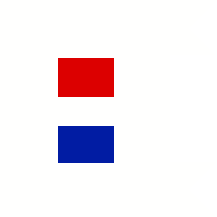 by JJaume Ollé
Ratio c. 1:1.
Jaume Ollé
This appears to be the Sultan's Car Flag, note white frill in
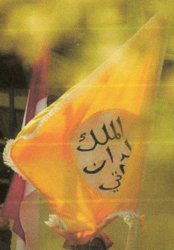 this photo.
John McMeekin, 4 Dec 2010
![[Ternate state flag]](../images/i/id_ternate-s.jpg) image by Rob Raeside, 6 June 2010, based on a sketch by John McMeekin
image by Rob Raeside, 6 June 2010, based on a sketch by John McMeekin
![[Ternate personal standard]](../images/i/id_ternate-pstd.gif) image by John McMeekin, 4 Dec 2010, based on a car flag.
image by John McMeekin, 4 Dec 2010, based on a car flag.
The Sultanate Motto is "MOLOKU KIE RAHA"
The Sultan's Motto is "LIMAU GAPI"
John McMeekin, 4 Dec 2010
![[Ternate Goheba Madopolo Romdidi #1]](../images/i/id_ternate.gif) image by Rob Raeside, 8 June 2010, based on sketch by John McMeekin |
![[Ternate Goheba Madopolo Romdidi #2]](../images/i/id-tern-gmr.gif) 3:5, image by Klaus-Michael Schneider, |
For centuries, the sultanates of Tidore and Ternate were rivals for dominance over the Moluccas.
Their core territories consisted of two tiny, adjacent volcanic islands west of Halmahera.
Tidore was Ternate´s southern neighbour. Ternate controlled the greater part of the Moluccas until 1652, when the VOC forced it to sign a treaty.
Tidore maintained its hegemony over neighboring Halmahera, the Bird´s Head Peninsula on New Guinea, and the intervening islands until the 19th century.
Both remained sultanates associated with the Dutch until 1946.
Ther is a yellow flag featuring three red borders and a silver mythical creature (Ternatean: Goheba Madopolo Romdidi).
This is a two-headed bird with a single body and a single heart.
It is a traditional heraldic symbol of Ternate, though the name also refers to the flag as a whole.
The symbol holds deep cultural and philosophical significance.
It represents the inseparable unity between the Sultan and his people, as well as the principle that all people must work together to achieve common goals.
The two heads signify different opinions, yet a single shared heart beats within the breast.
Sources:
Marcel van Westerhoven: "The Flags of Princely States of the Dutch East Indies", in "Proceeedings of the ICV25", Rotterdam 2013, p.14/9
this webpage
Klaus-Michael Schneider, 7 Oct 2026
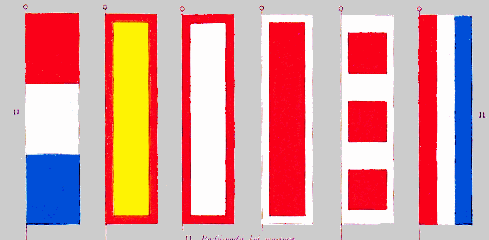 image by John McMeekin, 25 Feb 2015
PANJI-PANJI KOI MA-RAU 1/2 m wide x 2 m long (flags like banana leaves) flown on the Sultan's boat.
John McMeekin, 25 Feb 2015

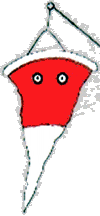 images by John McMeekin, 25 February 2015
PANIKI & NJON (streamers like a bat & ray).
John McMeekin, 25 February 2015
AMRAL (Great Pennant) - Flown from the top of the mast of the Sultan's boat,
Princes are allowed to fly this flag, but Sengaji's (a kind of Governor) are not
allowed to fly them.
John McMeekin, 25 Feb 2015
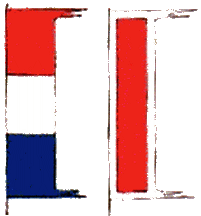 images by John McMeekin, 25 Feb 2015
DAJALU (KOI MA-RAU). Half as big as the Sultan's flags and can be flown by Sengaji's.
John McMeekin, 25 Feb 2015
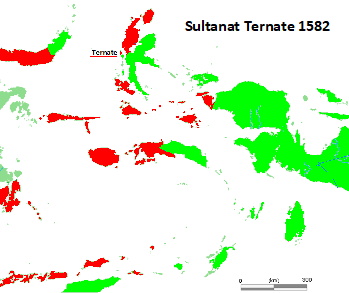
The territory of the Sultanate in 1582 is painted red.
back Indonesia Princely States index page click here