Last modified: 2026-10-17 by  klaus-michael schneider
Keywords: princely states | sakabuano | saparua | siak | siantan | surakarta | sumatra |
Links: FOTW homepage |
search |
disclaimer and copyright |
write us |
mirrors
![[National flag of Indonesia]](../images/i/id.gif) 2:3
2:3
![[ National Flag and Ensign ]](../misc/oooooo.gif) image by Željko Heimer, 2 Jan 1996
image by Željko Heimer, 2 Jan 1996
See also:
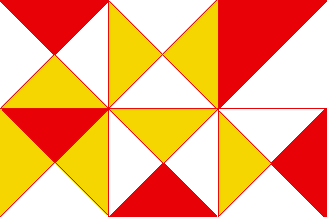 by Jaume Ollé
Ratio 2:3.
 image by Rob Raeside, 6 June 2010
based on sketch by John McMeekin
Bendera Sultan Sambaliung
image by Rob Raeside, 1 June 2010
based on sketch by John McMeekin
![[Sameth, Oma and Rohomoni ]](../images/i/id_sameth-oma.gif) image by Klaus-Michael Schneider,
image by Klaus-Michael Schneider,
Sameth, Oma and Rohomoni are located on the southern and western shores of the tiny Haruku Island.
They all share the same flag, red with a white disc with three black ellipses forming an armillary sphere. Emerging from disc are four golden cross beams slightly shifted.
The 4th village in this confederation is Ihamahu, having a simple red flag.
The three black ellipses on the white disc are interpreted as an armillary sphere, suggesting that the flags were influenced by the Portuguese, whose flag also features an armillary sphere.
The two tiny islands of Haruku and Saparua lie south of Seram and west of Ambon, the centre of the short-lived Republic of South Maluku.
Source: Rühl 1952,, p.145
Klaus-Michael Schneider, 7 Oct 2026
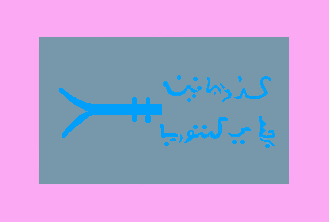 by Jaume Ollé
Ratio 2:3.
Adopted: ? .
Abolished: ? .
Note: Reverse.
 by Jaume Ollé
Ratio 2:3.
Adopted: ?.
Abolished: ?.
Sampit state in Dutch East India has two flags or ensigns. The images above are from D. Ruhl, and variations below are from a plate in Flagmaster 99.
![[Sampit Sultanate]](../images/i/id-sam1a.gif) by Jaume Ollé
by Jaume Ollé
![[Sampit Sultanate]](../images/i/id-sam2a.gif) by Jaume Ollé
by Jaume Ollé
Sampit is a settlement along the Sampit river in south central Kalimantan. It was one of several Muslim sultanates in Dutch Borneo that were used as buffer states between inland Dayaks and sea-faring peoples like the Buginese and Sulu-peoples. They were described as 'weak states', although there were fierce rebellions in the 19th century, which threatened the Dutch presence in the whole archipelago.
Jarig Bakker, 24 January 2001
Note that all of these flags show the zulfikar, one of the most ancient of
Islamic symbols. More information about this symbol can be found in on our page
about zulfikar on Ottoman Empire flags.
Jaume Ollé
![[Samudra Pasai]](../images/i/id_samudra).jpg) image provided by John McMeekin, 5 February 2015
image provided by John McMeekin, 5 February 2015
 photo from Janis Lasmanis, 25 April 2020
Royal flag
 image by Rob Raeside, 8 June 2010
based on a sketch by John
McMeekin
 image by Klaus-Michael Schneider, 5 Oct 2026
The red flag shows in on a red shield with white edges the arms of the Netherlands in white.
The shield is supported by two crowned lions rampant as supporters, based on a white wing, the shield is surmounted by a white royal crown.
Source: Wereldmuseum (department Leiden) filing card archive no.RV 370-2077
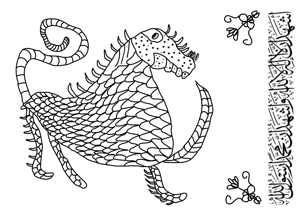 image from Ben Cahoon, 4 May 2022
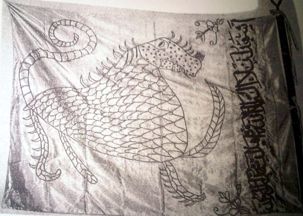 image provided by John McMeekin, 8 Nov 2011
Sawitto is in The Celebes (now Sulawesi).
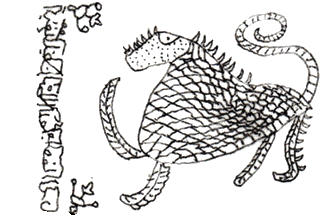
Sawitto State Flag (until 1957): A white flag with the image of an animal
(drawn in black), near the hoist in black, is a vertical "Jawi" inscription (line
drawing only).
John McMeekin, 8 Nov 2011
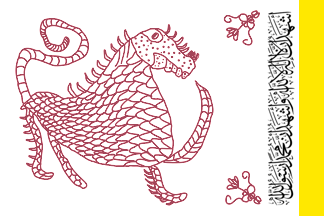 image by Olivier Touzeau, 12 Nov 2022
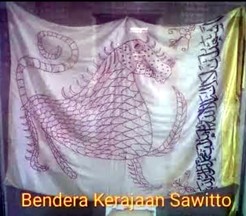 image provided by John Duncan McMeekin, 13 Oct 2022
The SAWITTO Flag has a yellow vertical stripe on the hoist, (between the hoist & the inscription), as wide as the inscription.
I found this on Google images. "BENDERA KERAJAAN SAWITTO" The drawing of the animal is in RED, the inscription is BLACK.
John Duncan McMeekin, 13 Oct 2022
 modern flag;
photo from Janis Lasmanis, 25 April 2020
modern flag;
photo from Janis Lasmanis, 25 April 2020
![[Seram ceremonialflag ]](../images/i/id_seram.jpg) approx. 3:5, image by Klaus-Michael Schneider, 5 Oct 2026
approx. 3:5, image by Klaus-Michael Schneider, 5 Oct 2026
Very unusual is a ceremonial "flag" of Seram, shaped like a human figureand made of cotton and wood.
Its greatest length is just under one meter, and its greatest width is about half that.
The flag was raised during the Poreka festival. This festival has animistic origins and served to summon spirits and venerate ancestors.
It is made of red, white, and black cotton with black wooden buttons, for example, for the eyes and mouth,
a wooden nose covered with white cotton, a red crescent moon on the chest, a black one over the genitals, and a black banner across the belly.
Source: Wereldmuseum (department Leiden) filing card with archive no. RV-1121-4
Klaus-Michael Schneider, 5 Oct 2026
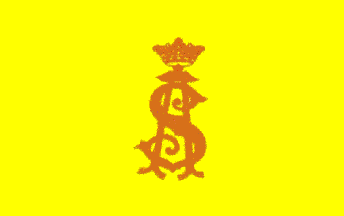 image by John McMeekin, 6 December 2010
Serdang State Flag. Serdang is in north-central Sumatra.
John McMeekin, 6 Dec 2010
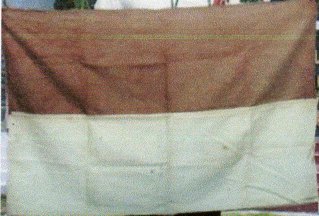 image by John McMeekin, 4 December 2010
The old red over white flag of Siau Kingdom (Sangihe & Talaud Islands, off
the northeast tip of The Celebes) [an Indonesian flag in the same image is noticeably
more red (RGB = 180,80,80) and white, making this flag look decidedly brown -
may be age?]
John McMeekin, 4 December 2010
 image by Ben Cahoon, 8 September 2020
Siau flag photo (by Janis Lasmanis) and flag image (white - red)
SIAU island in North Sulawesi, whose capital is Hulu Siau, state was founded c.1510
Ben Cahoon, 8 September 2020
 by Jaume Ollé
Ratio 2:3.
Adopted: ?.
Abolished: ?.
Note: The flag is the same for all three entities.
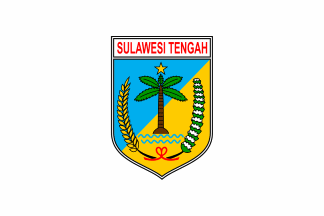 by Jaume Ollé
Ratio 2:3.
Adopted: ?.
Abolished: ?.
Details from Donald Tick: Sidenreng had a King called THE ADDATUANG, the present
King is Yang Mulia Paduka (Y.M.P. -or- H.M.) Haji Andi Patiroi Pawiccangi
who was crowned 22nd December, 2012, (born in 1927), grandson of
Addatuang, La Cibu, reigned 1906-1942 & 1945-1949 (d.1949)
John McMeekin, 9 August 2014
![[Panembahang Sultanate]](../images/i/id_panembahan.gif) image by Rob Raeside, 4 June 2010
image by Rob Raeside, 4 June 2010
based on a sketch by John McMeekin
The Sirisori villages are located on Saparua Island half way between Saparua city and Ouw.
![[Sirisori-Islam ]](../images/i/id_sirisori-i.gif) image by Klaus-Michael Schneider, 11 Oct 2026
image by Klaus-Michael Schneider, 11 Oct 2026
![[Sirisori-Saran]](../images/i/id_sirisori-s.jpg) image by Klaus-Michael Schneider, 11 Oct 2026
image by Klaus-Michael Schneider, 11 Oct 2026
Source: Wereldmuseum (department Leiden) filing card archive no. RV-370-2099
Klaus-Michael Schneider, 11 Oct 2026
 by Jaume Ollé
Ratio 2:3.
Adopted: ?.
Abolished: ? .
Note: The flag is the same for both entities
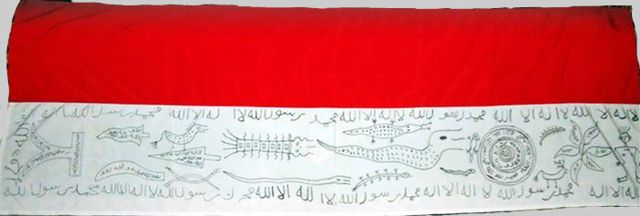 image provided by John McMeekin, 8 November 2011
Soppeng is in The Celebes (now Sulawesi).
John McMeekin, 8 November 2011
Royal flag
 image by Rob Raeside, 8 June 2010
based on a sketch by John
McMeekin
 by Jaume Ollé
Ratio c. 2:3.
Adopted: ?.
Abolished: ? .
Sumbawa Sultanate State Flag
![[Sumbaya]](../images/i/id_sunbawa.gif) image provided by Ben Cahoon, 04 May 2022
image provided by Ben Cahoon, 04 May 2022
War Flag
![[Sumbaya]](../images/i/id_sumbaya.jpg) image located by John D McMeekin, 11 December 2013
image located by John D McMeekin, 11 December 2013
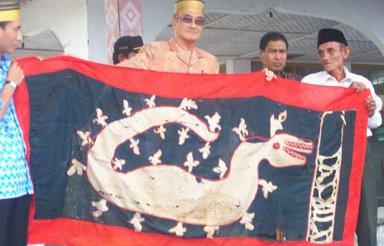
Sumbawa Sultan's Flag also had a flag which was dark-blue with a broad red edge with a 4 legged beast on it in white, as seen on this photograph of the original flag.
The long black flag with the white beast is the War Flag
John McMeekin, 29 September 2014
The core territory of Sumenep was located on the eastern part of the island of Madura and extended to the islands lying to the east.
![[Sumenep battalion colour]](../images/i/id_^sump1.gif) image by Klaus-Michael Schneider, 7 Oct 2026
image by Klaus-Michael Schneider, 7 Oct 2026
There is a battalion colour belonging to the colonial auxiliary troops of Sumenep, which were incorporated into the Royal Netherlands East Indies Army, manufactured between 1812 and 1825 during the reign of the local ruler Natakasumo II.
His title had been "Panembahan". The battalion participated, among other conflicts, in the Padri War of 1837.
The flag is made of yellow silk and features the ruler´s coat of arms embroidered in flannel.
Regarding the battalion colour, Dirk Rühl adds that it is a "very old flag of the Sultan of Madura"
The subsequent text clarifies that this must refer to Sumenep.
Due to minor differences, we must assume that the flag in question was merely one very similar to the battalion flag.
The flag was made of yellow silk and featured a coat of arms consisting of a blue shield with a narrow gold border, overlaid with a gold saltire (diagonal cross) of the same width as the border.
In the upper quadrant, there was a crescent moon lying horizontally with its points facing upward, flanked by three saltires, all in gold.
The heraldic left quadrant displayed several small gold houses, while the lower quadrant showed a green tree.
The entire design was overlaid with a suit of steel armour from which an arm emerged, holding a sword upright in the right hand; all elements were gold.
The shield was surmounted by a princely crown.
The shield supporters consisted of a winged and crowned serpent (Naga) on the right and a silver winged horse (Pegasus) on the left. The supporters rested upon a red ribbon tied into a bow.
Flowers were arranged between the base of the shield and the bow, and palm fronds encircled the shield.
The battalion colour differed in several details. Specifically, the shield was parted per saltire into red and yellow quarters.
The houses were red; the border and saltire were blue. The Pegasus was green; the serpent was red.
The bow was blue with a golden inscription: "Z:H: DE/ SUMANAP/PANEMBAHAN / NOTOKOESOEMO".
Blue conches with gold ornamentation appeared at both upper edges of the shield.
Explaining the coat of arms, Dirk Rühl writes:
"The moon, accompanied by seven small saltires representing seven stars, symbolises Sumenep, while the stars represent the seven rulers of the same lineage who governed the land.
The buildings represent the palace, and the tree is a fig tree (Indonesian: waringin).
The blue steel-armour on the battalion colour is a symbol of strength. The saber is pointed at the face of the serpent. The crown symbolises princely dignity.
According to legend, the Pegasus served as the mount of the fabled ruler Djobo Tolè of Sumenep, also known as Kyai Kudhe Panulè.
He is said to have ridden this creature in the war against Dempo Awang, a prince from India, who possessed a flying ship as his mount.
Kyai Kudhe Panulè emerged victorious from this conflict. The winged serpent is actually a winged iguana.
Here, the horse represents the worker, who obeys the orders of his superiors, while the iguana embodies the defender, who bites and carries venom in its mouth.
Sources:
1. Rühl 1952, pp.139-140
2. Wereldmuseum (department Leiden) filing card archive no.370-796
3. photo shot in Leiden August 2013 by Klaus-Michael Schneider
4. Klaus-Michael Schneider: "Flaggen über dem Archipel - Fahnen und Wimpel indonesischer Regionen und autonome Staaten vor dessen Unabhängigkeit"
Klaus-Michael Schneider, 7 Oct 2026
![[Sumenep district chief]](../images/i/id_sump2.gif) image by Klaus-Michael Schneider, 7 Oct 2026
The white flag with a blue border belonged to a district chief (Dutch: districtshoofd/i>).
It depicts a phoenix, or possibly a Garuda, sinister facing, perched on a thorny branch beneath an inscription in a darker colour.
image by Klaus-Michael Schneider, 7 Oct 2026
The white flag with a blue border belonged to a district chief (Dutch: districtshoofd/i>).
It depicts a phoenix, or possibly a Garuda, sinister facing, perched on a thorny branch beneath an inscription in a darker colour.
![[Sumenep islamic cleric]](../images/i/id_sump3.gif) image by Klaus-Michael Schneider, 7 Oct 2026
image by Klaus-Michael Schneider, 7 Oct 2026
Made of red cotton, it is covered with white magical prayer symbols. It belonged to an Islamic cleric.
Arranged from the hoist outwards these are:
a hexagram representing the Seal of King Solomon
an Arabic "M"
a rectangle
and the Arabic letters "H" and "W"
This seal is frequently used in Arabic magic and mysticism. The flag was in use before 1883
Sources:
1. Wereldmuseum (department Leiden) filing card archive no.370-803
2. photo shot in Leiden August 2013 by Klaus-Michael Schneider
Klaus-Michael Schneider, 7 Oct 2026
![[Surakarta Sultanate]](../images/i/id_surakarta-state.gif) 3:5, image by Rob Raeside, 4 June 2010 based on a sketch by John McMeekin |
![[Surakarta Sultanate #2]](../images/i/id-solo2.gif) 4:5, image by Jaume Ollé |
Present state flag.
John McMeekin, 4 June 2010
![[Surakarta Sultanate old]](../images/i/id_surakarta-old.gif) 3:5, image by Rob Raeside, 4 June 2010 based on a sketch by John McMeekin |
![[Surakarta Sultanate old #2]](../images/i/id-solo1.gif) 4:5, image by Jaume Ollé |
back Indonesia Princely States index page click here