Last modified: 2026-09-26 by tomislav todorovic
Keywords: forest finns | norway | sweden | finland | scandinavia | cross: scandinavian | scandinavian cross |
Links: FOTW homepage |
search |
disclaimer and copyright |
write us |
mirrors
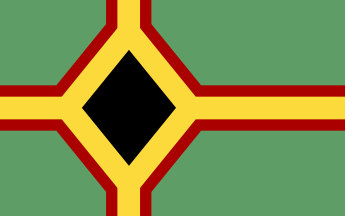 image by Tomislav Todorovic, 13 May 2023; derived from the SVG image of the flag from
Wikimedia Commons
image by Tomislav Todorovic, 13 May 2023; derived from the SVG image of the flag from
Wikimedia Commons
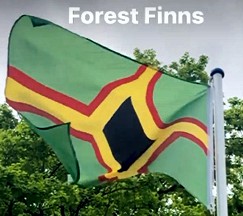
These images (1, 2) were posted on one of the Facebook flag pages. [...] The flag apparently represents "Forest Finns" of Sweden and Norway. No further information on whom this designation refers to precisely or how "official" it is, i.e. under what authority it was created and is used - particularly if it is recognised in both adjoining countries.
Jason Saber, 11 May 2023
There was a few posts on Reddit (1, 2) about this. [The latter post] was linked to [this article].
Masao Okazaki, 11 May 2023
This flag was adopted in late 2022 following a design competition arranged by a number of cultural associations for the Forest Finns. The winning design was created by Frédéric M. Lindboe and Bettina Gukhagen.
The flag is not officially adopted by any government agency in Sweden, but by these private associations. It seems to have been immediately embraced by most people concerned.
Green is for the forest, yellow for the rye cultivated by the Forest Finns through slash-and-burn agriculture, red for fire and the holy tree of rowan, black for the soot of the hut walls and the slash-and-burn agriculture. Black and red are also used in the flags of Savolax and Tavastia, the areas in Finland from where most of the Forest Finns hailed. The rhombus is also an old fertility symbol. Overall, the flag of course has a Scandinavian cross.
Finland was an integral part of Sweden from the 12th Century until 1809 (when it was conquered by Russia following the war of 1808-1809). During the 16th and 17th Centuries, people from Savolax and Tavastia were persuaded to resettle in other parts of Sweden, mostly in Värmland, Dalecarlia and Närke, to establish a population in areas which so far had been virtually uninhabited forest lands. They became known as Forest Finns. They spoke Finnish, and this language was still spoken in the areas well into the 20th Century.
Elias Granqvist, 11 May 2023
"The cultural flag of the Forest Finns was adopted on 29 December
2022 and designed by the Norwegian coupleFrédéric M. Lindboe
and Bettina Gullhagen. The flag was designed as part of a flag design competition
to adopt an official cultural flag for the Forest Finns. The competition was held
during the summer of 2021 and received hundreds of proposals."
(source)
"When the original draft of the current flag was chosen, it lacked
the red fimbriation between the yellow and green, which was later added by
the flag committee before adoption."
(source)
"The flag is a yellow Nordic cross design on a green canvas with
red fimbriation. The centre of the cross is deformed with a black rhombus shape
derived from a traditional Forest Finn symbol for fertility, which is found on old
Forest Finn settlements. The proportions and placement of the cross is the same
as the Flag of Sweden. The relative thickness of the red and yellow on the cross
is 1:2 and matches the Flag of Norway. Representing the Forest Finns in both
Norway and Sweden.
The green represents the importance of the forest for the Forest Finns
Slash-and-burn culture, the red represents fire and the holy Rowan tree,
the yellow represents the rye from slash-and-burn farming and the black
represents the soot of slash-and-burn. The color scheme is also meant to
match the flags of the Finnish regions of Savonia and Tavastia, of which
the Forest Finns originate from."
(source)
"The flag was officially for the first time hoisted at a governmental
flag pole on 4 May 2023, at the Oslo City Hall. Marking the 200 year anniversary
of the Tolvmannamarsjen (English: Twelve man march) in April 1823,
when six Swedish and six Norwegian Forest Finns traveled to the capital Stockholm
and brought a petition with 600 signatures demanding their own common church
congregation (Kirkesogn) with a Finnish speaking priest right on the
Norway-Sweden border. The twelve men were given an audience before King
Charles XIV John on 4 May."
(source)
(source)
Additional information here, here and here.
Esteban Rivera, 11 May 2023
Another source:
Museum for Forest Finn Culture in Norway
Tomislav Todorovic, 13 May 2023
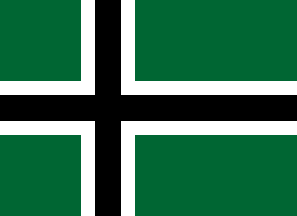 image by Tomislav Todorovic, 7 July 2023
An earlier design, which seems not to have been used officially, combines the design of the national flag of Norway and the colors of the flag of the Republic of Finnskogen. A photo (or a very well made image which looks like one) which displays it as being hoisted with the national flag of Norway and those of other minorities living in the country, can be found here.
While the flag was sometimes indeed presented online as the flag of Forest Finns, it was not eventually adopted as such. A reason might be that it is nearly identical with the flag of Vinnland, which has been increasingly used by the neo-Nazis in recent years, although its creator, Peter Steele of the Type O Negative rock group, seems not to have shared their political attitudes.
Tomislav Todorovic, 7 July 2023