
This page is part of © FOTW Flags Of The World website
Stein am Rhein commune (Schaffhausen canton, Switzerland)
Last modified: 2026-02-06 by martin karner
Keywords: stein am rhein | st. george | dragon | horse (white) |
Links: FOTW homepage |
search |
disclaimer and copyright |
write us |
mirrors
See also:
Stein am Rhein
![[Flag of Stein am Rhein]](../images/c/ch-sh030a.gif) image
by Pascal Gross
image
by Pascal Gross
Gules St George Proper harnysed Azure nimbed
Or on a horse Argent holding in dexter an escutcheon of
this Last bearing a cross of the First and in sinister a lance Or slaying a dragon Vert.
Christopher Southworth
The flag was changed to its mirror image in 2003 so that the figures face the
hoist.
Sources:
– City home page with current coat of arms:
https://www.steinamrhein.ch/portraet/zahlen-fakten.html/27
– German Wikipedia article about the change of the coat of arms:
https://de.wikipedia.org/wiki/Stein_am_Rhein#%C3%84nderung_des_Wappens
Trivia: Our city's custom manhole covers with the local coat of arms were
manufactured before 2003 and are therefore probably the only "illegal" manhole
covers in the world ;-)
Marcel Waldvogel, 28 February 2022
![[Flag of Stein am Rhein]](../images/c/ch-sh030.gif) image
by Pascal Gross
image
by Pascal Gross
Miscellaneous Pictures
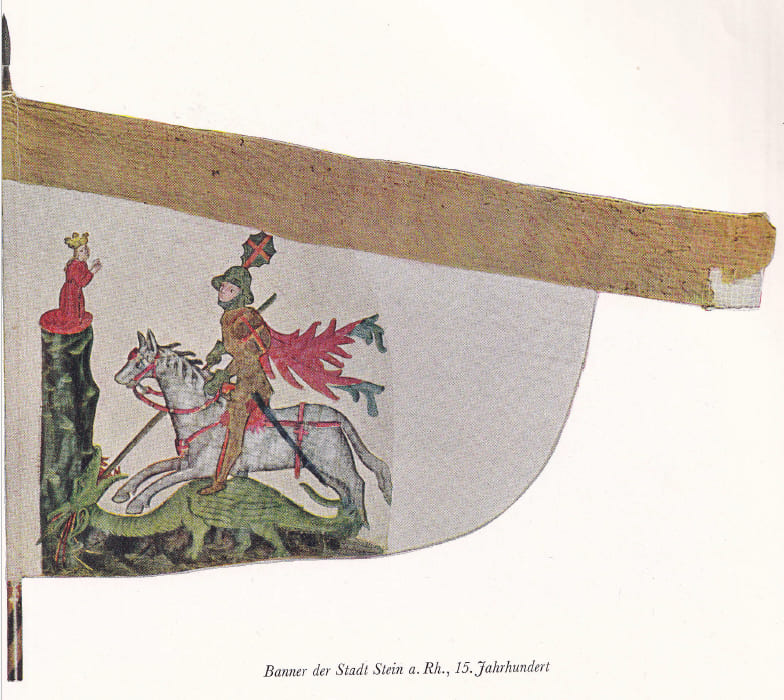
Banner of Stein am Rhein (15th c.) (source: [b7b42]).
Stained glass plate made by Hans Wilhelm Wolf, Zurich (probably
1679), 58x50 cm. Location: town hall, Stein am Rhein (source).
The two shields between the city and the imperial arms are so-called Stadtfarben ("city
colours"), bearing the colours blue and red from the coat of arms. Those city colours come from the
Venli, the city's troop flag for partial drafts (since 15th century). These flags were used
frequently, so they were well known to the people and thus became the "simple" or "everyday"
coat of arms of the city (Later, in the 17th century, the city militia used flags in blue and red with a
continuous white cross). With the end of the Ancien Régime (1798), the use of such flags ended.
So we have an official, ceremonial city coat of arms, the riding Holy Dragon Slayer, going back to the
seal; a popular, everyday city coat of arms, split between blue and red, going back to the Venli;
and the imperial arms. (Information: Emil Dreyer)
.jpg)