Last modified: 2023-06-03 by  zachary harden
Keywords: fédération internationale de football association | international federation of association football | fifa | football | international sports organization | sport | soccer | ball | world cup |
Links: FOTW homepage |
search |
disclaimer and copyright |
write us |
mirrors
![[FIFA Football for hope logo]](../images/i/int@fifa18.gif) image by Zachary Harden, 25 January 2022
image by Zachary Harden, 25 January 2022
The Fédération Internationale de Football Association (FIFA) was founded in Paris on 21 May 1904, by the Union des Sociétés Françaises de Sports Athlètiques (USFSA), the Union Belge des Sociétés de Sports (UBSSA), the Dansk Boldspil Union (DBU), the Nederlandsche Voetbal Bond (NVB), the Madrid Football Club, the Svenska Bollspells Förbundet (SBF), and the Association Suisse de Football (ASF).
One of its main goals, beside the standarisation of the "Laws of the Game", has always been the organization of international competition, and a way to accomplish this was through the organization of the Olympic Soccer tournament at the London Olympic Games of 1908. Since then the FIFA has, with the exception of the Games of 1932, organized Soccer tournaments for all Olympic Games.
The Great War caused as set-back for the ideal of uniting nations through sport, but after the war the FIFA started to grow quickly. In 1921 only 30 members were left, while by 1954 the count had risen to 85 members. In 1930, though suffering under the world-wide depression, the FIFA organized its first World Championship, which took place in Uruguay.
Nowadays, as per mid-2000, the FIFA has 204 members. It has organized
16 world-championships, and it forms the international organisation
for approximately two hundred million active players.
Fédération Internationale de Football Association Website, September 2001
![[The flag of FIFA.]](../images/i/int@fifa09.gif) 2009-2018 flag; mage by Juan Manuel Gabino Villascán, 9 March 2011
2009-2018 flag; mage by Juan Manuel Gabino Villascán, 9 March 2011
Accoding the "The history of the FIFA corporate mark" (Edition 2, Jun 2nd 2011)
(pdf file from www.fifa.com): "In 2009 FIFA
adopted a more modern look, accentuating the wordmark. The new FIFA design was a
crucial decision in terms of harmonising FIFA's brand architecture. It relies on
the FIFA wordmark and the Claim. This re-launch facilitated a consistent brand
identity across all FIFA communication platforms".
Juan Manuel Gabino Villascán, 9 March 2011
It seems that the tagline was removed from the current FIFA flag, but I am not certain when this change occurred.
Zachary Harden, 25 January 2022
![[FIFA vertical-hanging flag.]](../images/i/int@fifa09v.gif) image
by Juan Manuel Gabino Villascán, 9 March 2011
image
by Juan Manuel Gabino Villascán, 9 March 2011
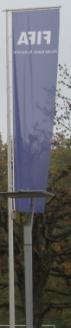
The vertical variant
of the current FIFA
flag - picture were taken on November 11, 2011 at the FIFA main office in
Zürich, Switzerland.
Esteban Rivera, 15 November 2012
Circular no. 610, which was sent to the FIFA member national associations on 24 March, is a reminder as to the criteria for flying flags at international matches.
- For matches involving A-category national teams, the FIFA flag, the flag of the country of team A and team B are raised as well as that of the country, region or city in which the match is being played.
- For international matches organised by the confederations, whether involving national or club teams, the flag of the relevant confederation is also flown.
- The representatives of FIFA, the referee and assistant referees are identified as such by the FIFA flag. The national flags of their respective countries are consequently not raised.
FIFA Newsletter, May 1997
The protocol manual for the
London 2012 Olympics (Flags and Anthems Manual
London 2012 [loc12]) provides recommendations
for flag designs. Each international
federation and international paralympics federation was sent an image of the flag,
including the PMS shades, for their approval by LOCOG. Once this was obtained, LOCOG
produced a 60 x 90 cm version of the flag for further approval. So, while these
specs may not be the official version of each flag, they are certainly what the international
federation and international paralympics federation believed the flag to be.
For FIFA: PMS 654 blue. The vertical
flag is simply the horizontal version in 5:3, with the logo entirely in the
top half of the flag.
Ian Sumner, 10 October 2012
![[The flag of FIFA.]](../images/i/int@fifa07.gif) image
by Juan Manuel Gabino Villascán, 7 March 2011
image
by Juan Manuel Gabino Villascán, 7 March 2011
![[FIFA vertical-hanging flag.]](../images/i/int@fifa07v.gif) image
by Juan Manuel Gabino Villascán, 7 March 2011
image
by Juan Manuel Gabino Villascán, 7 March 2011
This is a set of FIFA flags
(horizontal and vertical variants) used from 2007 to 2009.
Juan Manuel Gabino Villascán, 7 March 2011
![[The flag of FIFA.]](../images/i/int@fifa.gif) image by Juan Manuel Gabino Villascán
image by Juan Manuel Gabino Villascán
![[FIFA vertical-hanging flag.]](../images/i/i@fifa_v.gif) image
by Juan Manuel Gabino Villascán
image
by Juan Manuel Gabino Villascán
The image of the flag of the FIFA shows it to be blue, with on it two footballs, their height about a third of the flag's height, drawn in white, side by side, the dexter slightly obscuring the sinister. Through the colouring of their surfaces, the balls together form a map of the world in shades of blue, yellow and brown, with Africa dexter and America sinister. Below the balls are the letters FIFA in white, approximately a fifth of the flag in height. Below this is the text "For the Good of the Game" in white, in a pseudo hand-written script, approximately one eighth of the flag in height.
The current flag was most likely adopted during 1998.
Juan Manuel Gabino Villascán, 30 June 2001
Mark Sensen, 30 June 2001
![[FIFA: old flag.]](../images/i/i@fifa_o.gif) image
by Juan Manuel Gabino Villascán
image
by Juan Manuel Gabino Villascán
The image of the previous flag of the FIFA shows it to have been blue, with on it two footballs, their height about half of the flags height, drawn in white with mostly black details, side by side, the dexter slightly obscuring the sinister. Through the pattern on their surfaces the balls together form a map of the world, with Africa dexter and America sinister. Below the balls are the letters FIFA in yellow, with a white fringe, approximately a seventh of the flag in height.
The last reported use of this flag was during the 1998 World
Championship in France. It's currently unknown when this flag was
adopted, and whether it was the first flag used by the FIFA.
Juan Manuel Gabino Villascán, 30 June 2001
Mark Sensen, 30 June 2001
![[The Centenial flag of FIFA.]](../images/i/i@fifac1.gif) image by Juan Manuel Gabino Villascán, October 13, 2004
image by Juan Manuel Gabino Villascán, October 13, 2004
![[The Centenial emblem of FIFA.]](../images/i/i@fifac).gif) image by Juan Manuel Gabino Villascán, October 13, 2004
image by Juan Manuel Gabino Villascán, October 13, 2004
![[The Centenial flag of FIFA - variant 1.]](../images/i/i@fifac2.gif)
![[The Centenial flag of FIFA - variant 2.]](../images/i/i@fifac3.gif)
![[The Centenial flag of FIFA - variant 3.]](../images/i/i@fifac4.gif)
All images by Juan Manuel Gabino Villascán, October 13, 2004.
![[Current FIFA Fair Play flag variant # 1]](../images/i/int@fp07.gif) image
by Juan Manuel Gabino Villascán,
9 March 2011
image
by Juan Manuel Gabino Villascán,
9 March 2011
 image
by Juan Manuel Gabino Villascán,
9 March 2011
image
by Juan Manuel Gabino Villascán,
9 March 2011
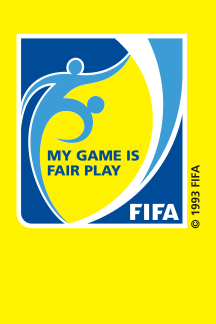
FIFA Fair Play flag in both vertical and horizontal versions. Adopted
about 2007.
Juan Manuel Gabino Villascán,
9 March 2011
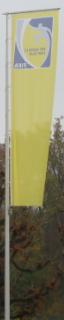
The vertical variant of the
current Fair Play flag - picture were taken on November 11, 2011 at the FIFA
main office in Zürich, Switzerland.
Esteban Rivera, 15 November 2012
![[FIFA Fair Play flag as used in the FIFA WC Germany 2006]](../images/i/i@f_fp.gif) image
by Juan Manuel Gabino Villascán,
June 2006
image
by Juan Manuel Gabino Villascán,
June 2006
![[FIFA Fair Play flag variant # 1]](../images/i/i@f_fp1.gif) image
by Juan Manuel Gabino Villascán,
June 2006
image
by Juan Manuel Gabino Villascán,
June 2006
![[FIFA Fair Play flag variant # 2]](../images/i/i@f_fp2.gif) image
by Juan Manuel Gabino Villascán,
June 2006
image
by Juan Manuel Gabino Villascán,
June 2006
![[FIFA Football for hope flag]](../images/i/int@fifaffh.gif) image by Zoltan Horvath, 14 November 2012
image by Zoltan Horvath, 14 November 2012
"Football for hope" is FIFA's Social Responsibility program. It "supports
programmes all over the world that combine football and social development. This
includes funding and equipment, as well as projects that offer training,
capacity building and know-how exchange on topics such as monitoring and
evaluation, curriculum development and communication. Each year, Football for
Hope supports many new programmes that specifically address social challenges in
local communities. Since its inception, Football for Hope has supported more
than 100 programmes in over 50 countries.
Eligibility criteria Football for Hope supports programmes which are:
- Run by legally registered entities with non-governmental status (e.g. NGO,
CBO, charity)
- Politically and religiously independent and not-for-profit
- Non-discriminatory in any way (e.g. social, ethnic, racial, religious,
gender-based)
- Using football to address social issues and promote social development;
- On-going and target children and young people
- Financially sustainable and have a long-term approach
Source:
http://www.fifa.com/aboutfifa/socialresponsibility/footballforhope/programmes/index.html
This program first started in 2010, and the first eight "Football for Hope
Centres" (which consist of facilities dedicated to education and public health
as well as an artificial turf football pitch) were built during the South
Africa's 2010 FIFA World Cup in Ghana, Kenya, Lesotho, Mali, Namibia, Rwanda,
and South Africa".
Source:
http://www.fifa.com/mm/document/afsocial/footballforhope/01/44/09/71/20centres-leaflet_e.pdf
FFH (Footbal for hope) also organizes its own FIFA sponsored tournament, and
awards the FIFA Football for hope Cup, as seen in this
article.
The program origins started back in 2005, when a "FIFA-sponsored football match
played between the Ronaldinho XI team and the Shevchenko XI team on 15 February
2005 at the Camp Nou in Barcelona in support of the relief effort after the 2004
Indian Ocean tsunami disaster". (FIFA's Football for Hope logo was designed back
in 2005 for this event, and the same logo is used today).
Source: http://en.wikipedia.org/wiki/Football_for_hope
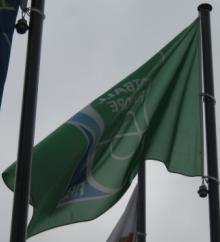
The flag is a green background flag with the logo in the middle.(Picture
taken at FIFA's main office in Zürich,
Switzerland on November 1, 2011)
![[FIFA Football for hope logo]](../images/i/int@fifaffh2.jpg) image located by Esteban Rivera, 12 July 2012
image located by Esteban Rivera, 12 July 2012
Football for hope logo, cropped image taken from:
http://www.sitesofchange.org/vap/supporters/futbol-for-hope/
For additional information go to:
Football for hope (official website):
Esteban Rivera, 12 July 2012
![[FIFA Football for hope logo]](../images/i/int@lfbl.gif) image by Zachary Harden, 25 January 2022
image by Zachary Harden, 25 January 2022
"Living Football" is FIFA's official theme by Hans Zimmer. Also, all players
taking part in official matches wear the patch on their uniforms, as seen here:
https://media.gettyimages.com (source:
https://www.gettyimages.com/event/group-a-2018). There is also a flag that
is presented before every official match.
Sources:
https://www.fifa.com/worldcup/videos/2018-fifa-world-cup-russiatm-official-tv-opening
and
https://www.youtube.com/watch?v=vnYxTRXHDnU
The flag is a blue horizontal flag displaying the logo (image on the right:
https://4.bp.blogspot.com) in the middle.
For additional information
go to Hans Zimmer (official website, entry on "Living Football"):
http://www.hans-zimmer.com/index.php?rub=disco&id=1642
Esteban
Rivera, 21 June 2018
FIFA will also implement from this tournament on its campaign "Handshake for
peace" protocol.
"The Handshake for Peace campaign is a joint initiative between FIFA and the Nobel Peace Center in Norway and will feature at all the matches in
the Club World Cup. Opposing captains and referees will meet next to the centre
circle to take part in the Handshake for Peace. The formal handshake will
feature at all future tournaments, including the 2014 FIFA World Cup Brazil.
FIFA said "the handshake will form an integral part of FIFA events, giving a
strong platform for this positive gesture of respect, friendship and fair play.
The joint initiative was announced by the two organisations at the 2012 FIFA
Congress in Budapest. The FIFA Club World Cup in Morocco is the first time it
has been formalised at an event"
Source:
http://www.insideworldfootball.com/fifa/13775-handshake-for-peace-protocol-debuts-in-morocco-at-club-world-cup
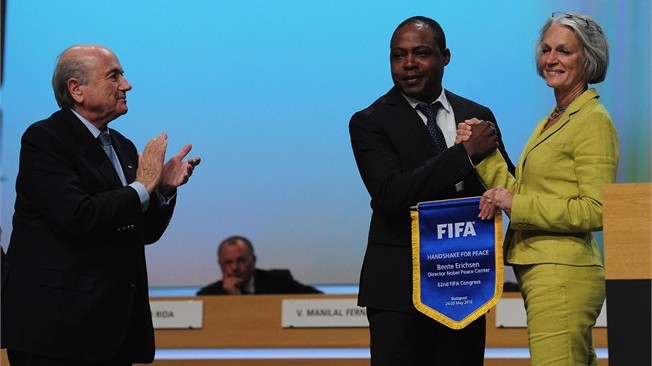
This new FIFA campaign has its own pennants as well:
-
Pennant announcing the new campaign, during the FIFA
2012 Congress in Budapest
-
Pennant displaying the
Handhsake for peace logo
Additional sources:
Official Facebook profile
-
http://www.fifa.com/aboutfifa/organisation/bodies/congress/news/newsid=1639712/index.html
- http://www.fifa.com/clubworldcup/photo/photolist.html#2249060 (official FIFA
website news report on the new protocol)
Esteban Rivera, 04 January 2014
In this current edition (2015) of the FIFA Club World Cup tournament, the
logo and flag of the Handshake for peace has changed a little bit. Here's the
new logo (seen here as an armband to be featured by each team's captain on
the football pitch) and
flag.
"The Nobel Peace Center and the
Norwegian Football Association are the
lawful owners of the Handshake for Peace "mark.
Source:
http://www.fifa.com/mm/document/afsocial/fairplay/02/24/23/42/factsheet_en_neutral.pdf
(official document with the information on this campaign).
Here's the new pennant.
Esteban Rivera, 19 December 2015
"Football for health" is another Social Responsibility program by FIFA. It
means "playing football, protect yourself from injuries and learn how to live a
healthy life". It portrays 11 steps (or sessions) to carry out this leisure
activity as a health enhancing practice:
Session 1: Play Football
Session 2: Respect Girls and Women
Session 3: Protect Yourself from HIV
Session 4: Avoid Drugs and Alcohol
Session 5: Use Treated Bed Nets
Session 6: Wash your Hands
Session 7: Drink Clean Water
Session 8: Eat a Balanced Diet
Session 9: Vaccinate Yourself and Your Family
Session 10: Take Your Prescribed Medications
Session 11: Fair Play
Source:
http://www.fifa.com/development/medical/football-for-health/11sessions/index.html
The flag is a blue background flag with the logo in the middle as seen
here: (first flag from right to left, on the bottom, before the "Handshake
for peace").
Source:
http://www.gettyimages.ae/detail/news-photo/and-uefa-flags-hang-prior-to-the-65th-fifa-congress-at-the-news-photo/475055456
For additional information go to:
Football for health (official website)
Esteban Rivera, 28 December 2015
![[FIFA assistant referee flag]](../images/i/int@fref.gif) image by James Dignan, 31 July 2010
image by James Dignan, 31 July 2010
Various flag signals used by assistant referees (i.e., what used to be
called linesmen) in football (soccer). The rules governing the use of these
flags can be found at
http://www.sidelinesoccer.com/assistant-referee-signals.
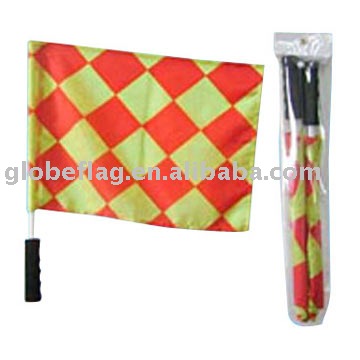
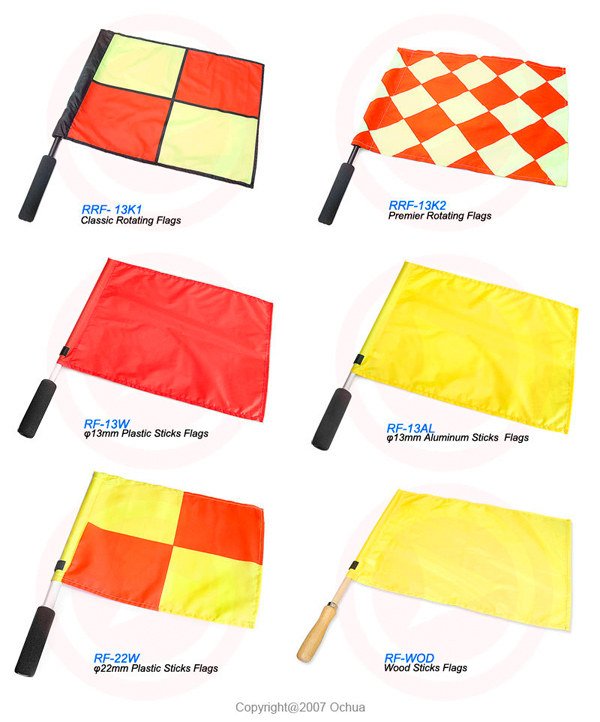
FIFA-approved
flags come in a wide variety of different colours, but are usually
approximately 3:4 in ratio. The colours are always high-visibility, and tend
to be chosen so as not to clash with the colours of the participating teams.
Plain flags, quartered flags, and diamond-patterned flags are all common,
though perhaps the most commonly seen is quartered in bright orange and yellow.
James Dignan, 31 July 2010
In Spanish, the term for the assistant referee is Juez de Línea (which would
translate as Lineman). The assistant referees were called linesmen but in 1996
FIFA changed the soccer rules and came up with a new name to better reflect the
modern role of these officials. Still, many people like to referee to them as
"referee's assistants" or the "linesmen" (Source:
http://en.wikipedia.org/wiki/Assistant_referee_(association_football) based
on Rule No. 6 of the official "Laws of the Game",
http://en.wikipedia.org/wiki/Laws_of_the_Game_(association_football) and
http://www.fifa.com/worldfootball/lawsofthegame.html). The FIFA body in
charge of soccer rules is called the IFAB (International Football Association
Board), commonly known as the "International Board" (Source:
http://en.wikipedia.org/wiki/International_Football_Association_Board). The
IFAB is made up of representatives from each of the United Kingdom's pioneering
football associations: The FA (England), SFA (Scotland), FAW (Wales), IFA
(Northern Ireland), and the FIFA.
There are several variants of this flag, and some even have sponsors logo's
on them, such as this picture of Würth (a German worldwide wholesaler of
fasteners, screws and screw accessories, dowels, chemicals, furniture and
construction fittings, tools, machines, installation material, automotive
hardware, inventory management, storage and retrieval systems) on the flag of a
Spanish Lineman during a "La Liga" (official top tier Spanish Professional
Soccer Club Championship):
http://es.wikipedia.org/wiki/Archivo:Assistant_referee_15abr2007.jpg
However I do recall that these flags were first plain red (for one side) and
plain yellow for the other side of the soccer field, like this picture shows:
http://es.fifa.com/mm/photo/worldfootball/general/000_par1280239_39595_sq_medium.jpg
(yellow flag),
http://www.corbisimages.com/Enlargement/42-15142489.html (red flag). I think
they were changed from plain flags to combined flags (yellow/red) flags in order
not confuse them with yellow and red cards (I mean, not that they are the same
size, but simply the color of the cards mean something and the flags mean
something else. It's a wild guess). Sometimes the "yellow flag" was even a
bright yellow/green fluorescent color, like this image shows:
http://uk.eurosport.yahoo.com/28032010/8/photo/stephen-child-assistant-referee.html.
The most common variant, is the diagonally checkered flag seen here:
http://www.shahbazfc.com/images/soccer-rules-assistant-referee.jpg,
http://img.alibaba.com/photo/51165180/Linesman_Flag_referee_flag_football_match_flag.jpg.
In brief, the more commonly used flags are these ones:
http://img.alibaba.com/photo/11675244/Soccer_Referee_Set_Lineman_Flag.jpg.
Esteban Rivera, 1 August 2010
I played amateur youth soccer in the 70-s, where the team coaches would be
the assistant referees. Each coach would bring a club-provided flag, which in
our case was in the team colours, blue and white. I think most such flags were
in the team colours. They weren't chosen to have colours different from those of
the players, I guess, but maybe the colours helped the referee in determining
whether a particular signal might be biased in favour or against the flagged
player.
On the home field, we also had corner flags, and their staffs in club colours.
(I think they were only used on the main pitch, though.)
Peter Hans van den Muijzenberg, 07 April 2011
Football world governing body FIFA in its
official website has replaced the page "Netherlands
Antilles" for that of
"Curaçao"
In the link "Associations" of the same site in English, the name
"Netherlands Antilles" used to appear between "Netherlands" and "New
Caledonia"; right now it appears no more. Insted, the name "Curaçao" has
been placed between "Cuba" and "Cyprus".
A month ago, the International Olympic Committee
ruled that all athletes
from the former Netherlands Antilles would participate in the 2011 Pan
American Games and 2012 Olympic Games under the Olympic Flag as independent
Athletes; after that all of them shall compete under the Dutch flag. At the
same time IAAF (World Athletics Federation) witdrew its recognition towards
the non-existent Netherlands Antilles stating that Athletes from the former
territory shall compete for the Netherlands from now on.
Though lacking of official statements, it seems that FIFA decided to keep
recognition to Curaçao as the legal successor of the Netherlands Antilles.
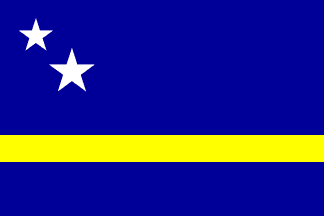
The flag shown for Curaçao in the
FIFA site is this
one, the code in use is : CUW (the same used by ISO-3166)
Juan Manuel Gabino Villascán, 6 March 2011