
Last modified: 2025-08-23 by bruce berry
Keywords: gabon | equator | tricolour | okoumã© tree | ship | panthers |
Links: FOTW homepage |
search |
disclaimer and copyright |
write us |
mirrors
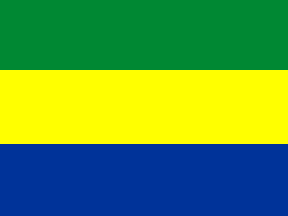 image by Zoltan Horvath, 4 June 2024
|
Proportions: 3:4 |
Location: Central Africa |
Neighboring Countries:
See also:
The country's present name originates
from "Gabão", or Portuguese for "cloak", which is roughly the shape of
the estuary of the Komo River by Libreville. The French explorer Pierre
Savorgnan de Brazza led his first mission to the Gabon-Congo
area in 1875 and France officially occupied the area in
1885. In 1910 Gabon became one of the four territories of French
Equatorial Africa (Afrique-Equatoriale-française or AEF) which existed
until 1958 as the federation of the four colonies of Gabon, Moyen-Congo (now the
Republic of Congo), Oubangui-Chari (now the
Central African Republic) and Chad.
Martin Grieve, 8 December 2010
At independence on 17 August 1960 Gabon adopted a horizontal tricolour
consisting of blue, yellow and green stripes in the somewhat unusual ratio
of 3:4 (although some sources quote 2:3). The design of the flag was
inspired by the geographical location of Gabon with the green stripe
representing the country’s forests and blue for the Atlantic Ocean being
separated by the yellow stripe, which stands for the Equator and the ever present sun.
Martin Grieve, 8 December 2010
The national constitution in law N.54/60 of August 1960 says
that the flag of the Republic of Gabon is composed of three equal horizontal
bands which are hereby determined:
Upper band of "clear Irish green" of a length equal to 4 times the height of the
first band
Middle band of "golden yellow" of the same length
The lower band of "royal blue" of the same length.
Franck Makosso, 10 April 2013
I have a copy of Law No. 54/60 of 9 August 1960 and can
confirm that the ratio of the flag of Gabon is 3:4 (although whether it is
actually used in practice remains open to debate).
Christopher Southworth, 11 April 2013
Looking at the description, and
seeing that for the size it doesn't refer to the top stripe, but to the "first
stripe, I wondered whether there used to be an extra stripe, vertical stripe at
the hoist, as that would give a 3:5 ratio?
Looking for a previous flag that might have looked like that, however, I refer
to the flag used in 1959. Since this has
a French flag in canton, taking up the hoist part of the top stripe, a full
description would require specifying the lengths of each of the horizontal
stripes separately, which makes what is quoted in the description of the 1960
flag unnecessary. The French flag would also provide a separate "first stripe",
and this design does have a horizontal stripe equal to it. Finally, this
flag is also 3:4. In my opinion, that description of the current flag derives
from a formal description of the 1959 flag, and the current flag has inherited
the ratio of that 1959 flag.
That leads to the conclusion for the ratio of 3:4 in the 1959 flag.
Well, the French flag, at 2:3, would normally only make that design 3:4 if the
equator stripe was half as wide as what it became in the adopted flag. It
would seem an original more narrow yellow stripe was widened to the same width
as the stripes of the French flag (indeed a better design), but to avoid the 5:6
this would normally result in, the extra width was taken from the other stripes,
thus keeping the 3:4 ratio, though squeezing the French flag.
To make the design with an equator equal to the French stripes, yet make
Gabonese flag and the French flag in it 2:3, one would have had to make the
French flag less than half the upper stripe in depth. That would have given it
less space than the Union Jack has in the British colonial flags. It may well be
that, before independence, such a solution was regarded as unacceptable by the
French.
Speculation – The design may have started out as a 2:3 flag, with no equator
stripe at all. That would give the motherland flag the expected quarter of the
flag. It's the (narrow) equator stripe that would have given the design that 3:4
ratio.
Peter Hans van den Muijzenberg, 16 April 2013
According to Eve Devereux (1994) [dev94], the colours
of the Gabonese symbolise respectively the forest (green), the equator – which crosses the country
(yellow) and the sea (blue).
Antonio Martins, 30 May 1997
Concerning the shade of the colours, the green and yellow seems to be rather
straightforward but the blue is problematic as usual. The Pantone approximation
given in the Album des Pavillons (2000) [pay00] is 285c (CMYK 90,45,0,0).
The colours used on two pages in the
Album are quite different (certainly an
effect of printing process), but it seems that a light grayish blue is
appropriate. However, most of other sources that I referred to show the blue
as being rather dark – almost like navy blue.
Željko Heimer, 2 October 2001
Article One of Law No.54/60 dated 9 August
1960 which established the flag gives the
colours as: 'light Irish green', 'golden yellow' and 'royal blue'
Christopher Southworth, 21 January 2003
The Constitution of the Republic of Gabon was adopted on 14 March 1991 (law 3/91, 26 March 1991) and amended on 22 April 1997, with the following provisions:
Title 1The Republic and Sovereignty
Article 2
(...)
The national emblem is the tricolor flag, green, yellow, blue in three horizontal bands of equal dimension.
(...)
The motto of the Republic is "Union – Work – Justice".
The seal of the Republic is a "Nursing Maternity".
Source: Constitutions – What they tell us about national flags and coat of arms, published by SAVA (2000) Pascal Vagnat & Jos Poels [vap00].
Ivan Sache, 21 January 2003
The protocol manual for the London 2012 Olympics
(Flags and Anthems Manual, London, 2012 [loc12])
provides recommendations for national flag designs. Each National Olympic
Committee was sent an image of their flag, including the PMS shades, by the
London Organising Committee of the Olympic Games (LOCOG) for their approval.
Once this was obtained, the LOCOG produced a 60 × 90 cm version of the flag for
further approval. So, while these specifications may not be the official,
government, version of each flag, they are certainly what the National Olympic
Committee believed their flag to be.
For Gabon : PMS 355 green, 109 yellow, 293 blue. The vertical flag is simply the
horizontal version in 5:3.
Ian Sumner, 10 October 2012
The Special Constitution of Gabon (Law Nº 3/91, 26 March 1991) with modifications also defines the national flag:
https://www.assemblee-nationale.ga/object.getObject.do?id=1422
"L'emblème national est le drapeau tricolore, 'vert, jaune, bleu', à trois bandes horizontales, d'égale dimension."
But there is no any regulation about correct colors and ratio of flag.
The Presidency website shows a picture of the flag, and there is a flag-like illustration, but it's a long one, it only shows
the colors: https://presidence.ga/symboles-nationaux
More pictures of the Gabonese flag:
 image
by António Martins-Tuválkin/Messer Woland, 27 December 2016
image
by António Martins-Tuválkin/Messer Woland, 27 December 2016
In the context of the celebration of the Flag National Day, scheduled for 9 August 2011,
"counterfeiters" of the Gabonese national flag have been severely warned in a communiqué released on 7 August 2011
by Jean-François Ndongou, the Minister of the Interior, Public Security, Immigration and Decentralization.
"For slightly more than 48 hours, hawkers have been peddling table flags ["drapelets"]
charged in the middle with the arms of the Gabonese Republic.
The Minister of the Interior, Public Security, Immigration and Decentralization
wishes to remind everyone that the flag of a country is a national heritage with
precise specifications that nobody should altered. While tracing the
network of manufacturing of these counterfeit flags to punish the culprits, the Minister of the Interior orders the immediate
withdrawal of these table flags from the market. Everyone caught in the art of
selling such a product, with effect with the publication of this communiqué,
will be taken in for questioning and will be accountable at the competent
jurisdiction. The defense and security forces [the army and the police,
respectively] have been given instructions accordingly.
At the beginning of the celebration of the Flag Day, we recall to all that the
flag of the Gabonese Republic is made of three stripes of equal dimensions
placed horizontally, with vert green [vert sinople]
at the top followed by golden yellow [jaune or] and, at the bottom, azure blue
[azure blue]. The width of a stripe shall be equal to thrice
its length.* The national flag should not be charged with any writing or motif.
Similarly, the stripes, when placed vertically, have nothing to do with the flag
of the Gabonese Republic. The Minister of the Interior calls, once and for
all, everyone's patriotic sense for the respect of these rules, which are a
token of the national sovereignty." [Source:
Gabonews, 9 August 2011]
* The original French text says: "La largeur d'une bande doit être égale à trois
fois sa longueur." Assuming that "largeur" and "longueur" means here "horizontal
dimension" and "vertical dimension" (usual sense would mean the reverse), the
flag obtained following the recommendation of the Minister would be square!
The issue of the "table flags/flaglets" was first raised by Pierre Mamboundou,
Executive Secretary of the main opposition party, UPG (Union du Peuple gabonais
– Gabonese People's Union). During a meeting held on 6 August 2011 in
Libreville. Mamboundou expressed his concerns again that copies of the national
flags charged with the national arms. Such defaced flags are illegal according
to Article 2 of the Constitution and to Law No.
54 of 15 August 1960.
Ivan Sache, 15 August 2011
 image
by Zoltan Horvath
image
by Zoltan Horvath
Photos:
Zoltan Horvath, 4 June 2024
.gif) image
by Messer Woland, 26 December 2016
image
by Messer Woland, 26 December 2016
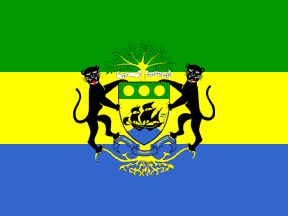
The shield of the Arms of Gabon is supported by two black panthers and an
okoumé tree symbolizing the timber trade. The ship represents Gabon moving towards a
brighter future. The coat of arms is unusual in having two ribbons with mottos
in two different languages. The ribbon below the shield has the motto in
French 'UNION, TRAVAIL, JUSTICE' ('Union, Work, Justice'). The second ribbon
is placed beneath the branches of the okoumé tree and has the motto in Latin
'UNITI PROGREDIEMUR' ('Let us go forward united').
Source: Dorling-Kindersley Flag Pocket Book (1997) [rya97]
(note this source incorrectly states the motto as UNITE PROGREDIAMUR
– "We go forward united").
The coat of arms was designed by the Swiss heraldist and vexillologist
Louis Mühlemann, one of the founding members of FIAV and also designer of
the former coat of arms of the Republic of Congo. The panthers symbolize
the vigilance and courage of the president who protects the nation. The
bezants (golden discs) in chief of the shield symbolize the mineral wealth of
the country.
Source: Flags Through the Ages
and Across the World (1975) by Whitney Smith [sme75b].
Ivan Sache, 4 October 2001
The official blazon of the shield: "Or a ship Sable, masts of the same, with the flag of Gabon,
tierced fess Vert, Or and Azure, sailing upon a sea Azure, a chief Vert charged with three bezants."
Christopher Southworth, 2 October 2024
seal.gif) image
by Zoltan Horvath
image
by Zoltan Horvath
The seal of the Gabonese Republic is a "Maternité Allaitante", that is to say a mother who breastfeeds her child.
The mother represents the Republic, the Gabonese State which feeds its children, protects them, cares for them, educates
them and constantly watches over their happiness. The child represents each of the people, a member of a family, the Gabonese
nation to whom they owe respect, obedience and love (source).
Zoltan Horvath, 4 June 2024
![[FIS Code]](../misc/fissumry.gif)
