- MIDDLE ARMS
- See under ‘arms’.
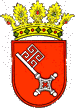
Middle Arms of Bremen, Germany (fotw)
- MILITARY BANNER
- See ‘banner 6)’ (also
‘sovereign’s banner’).
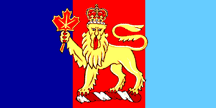
Commander in Chief banner, Canada (fotw)
- MILITARY COLOURS (or COLORS)
- See ‘colour 2)’ and
‘colours 2)’.
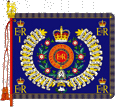
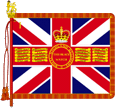
Regimental Colour and Queen’s colour, 1st Battalion of The Black Watch (Graham Bartram)
- MILITARY CREST
- In largely US usage, the term for that emblem which is displayed by units of the National Guard,
and usually taken from symbols contained within the flags, seals and/or coats of arms of the relevant
state – a state military crest (see also
‘badge 3)’,
‘coat of arms’,
‘crest 1)’,
‘emblem, military and governmental/departmental’,
‘seal’ and
‘state flag 2)’
and ‘wreath 2))’).
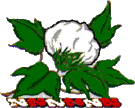
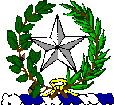
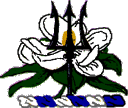
Military Crests of Alabama,
Texas and Mississippi, US (fotw)
- MILITARY EMBLEM
- See ‘emblem, military and governmental/departmental’ under ‘emblem’.
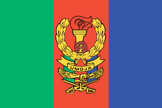
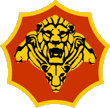
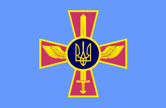
Flag/Emblem, People's Defence Force, Tanzania (fotw);
Army Badge, RSA (fotw);
Flag/Emblem, Air Force, Ukraine (fotw)
- MILITARY FLAGS
- The general heading under which all the various flags, banners, pennants and colours
relating to the military establishment of any particular country, countries or entity are
listed – see ‘colour 2)’.
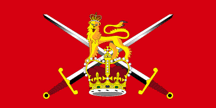
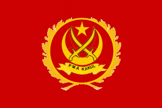
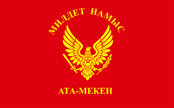
Army Flag, UK (fotw); Flag of the
Military Academy, Pakistan (fotw);
Armed Forces flag, Kyrgyzstan (fotw)
- MILLRIND (MILLRINE, MILL-INK or MILL-IRONS)
- The alternative heraldic terms for a charge usually (but not invariably) in the form of a curved or wavy X, and meant to
represent a mill bearing – a fer de moline, millrine, mill-ink or mill-irons (see also ‘millstone’).
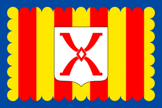
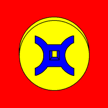
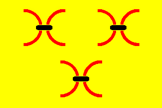
Flag of
Ham-sur-Heure, Belgium (fotw); Former Flag of
Courtion, Switzerland (fotw); Flag of
Orthen, Netherlands (fotw)
- MILLSTONE (or MILL-STONE)
- The term for a representation of the large circular stone used
for the grinding of wheat or other cereal by water- or windmill, and usually (but not invariably) shown with a
square or notched hole in its centre and sometimes radiating ridges – a mill-stone, grind-wheel,
grindwheel or
grindstone - see ‘waterwheel’
(also ‘millrind’ and
‘windmill’).
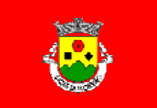
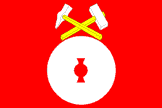
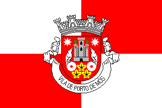
Flag of Sazes do Lorvão, Portugal (fotw);
Flag of Choltice, Czechia (fotw);
Flag of Porto de Mós,
Portugal (fotw);
- MILLWHEEL (or MILL-WHEEL)
- See ‘waterwheel’.
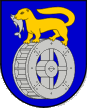
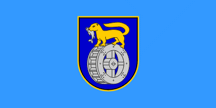
Arms and Flag of Veliki Grđevac,
Croatia (fotw)
- MIRROR IMAGE
- The term used when the reverse of a flag is a reflected duplication of the obverse
(as seen as in a mirror), and the default assumption in most cases - but see
‘double-sided 1)’ and
‘two-sided 1)’
(also ‘obverse’ and
‘reverse’).
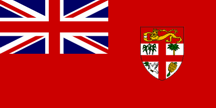
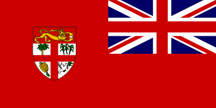
Obverse and Reverse of the Civil Ensign of Fiji
(fotw)
- MITRE
- In some Christian usage the ceremonial head covering of a prelate (see also ‘crozier’ and ‘stringed’).
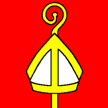
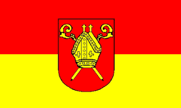
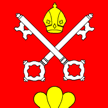
Flag of Bennau, Switzerland (fotw);
Flag Bützow, Germany (fotw);
Flag of La Rippe, Switzerland (fotw)
- MIXED TINCTURES
- In heraldry there are two mixed tinctures, they are brunatre (brown) and tenne
(orange) – auxiliary colours – see ‘tinctures’.


Brunatre and Tenne
- MIZZEN (or MIZZEN MAST)
- The aftermost mast in a sailing vessel with three masts (and on a two masted vessel dependent upon the rig) from which the gaff is rigged
– but see ‘mizzen, at the’ (see also ‘foremast’,
‘gaff’, ‘mainmast’, ‘mast’ and
‘masthead’).
- MIZZEN, AT THE
- (adv) The phrase used when a flag is flown from the ruck of the aftermost mast of a
three masted sailing warship – see ‘mizzen’. (also ‘masthead’ and ‘truck’).
![[at the fore example]](../images/v/vxt-d3595.gif)
Flag of a Rear-Admiral 1864 - 1898, UK (fotw)
Please note that in the sailing/steam-assisted navy, the command flag of a
rear-admiral was formerly flown in this position (also ‘balls of difference’,
‘flag of command’ and ‘flagship’)
