Last modified: 2023-12-09 by martin karner
Keywords: switzerland | sea merchant flags | naval flags | naval | rectangular flag |
Links: FOTW homepage |
search |
disclaimer and copyright |
write us |
mirrors
![[Swiss flag at sea]](../images/c/ch~.gif) image
by António Martins
image
by António Martins
See also:
During WWII a Swiss Naval Ensign was adopted with the proportions 2:3.
The National Flag of Switzerland is square.
Nick Artimovich, 12 February 1996
It is used only by the Swiss
commercial fleet outside Switzerland. On the lakes the usual square flag
is used.
Harald Müller, 12 February 1996
This may have been the intention, but I have visited two of the Swiss lakes
and (bearing in mind that it was over twenty years ago) the flags flown by the
commercial vessels which plied those lakes were definitely 2:3.
Christopher Southworth, 21 March 2009
This seems to be correct for at least some of the vessels – see
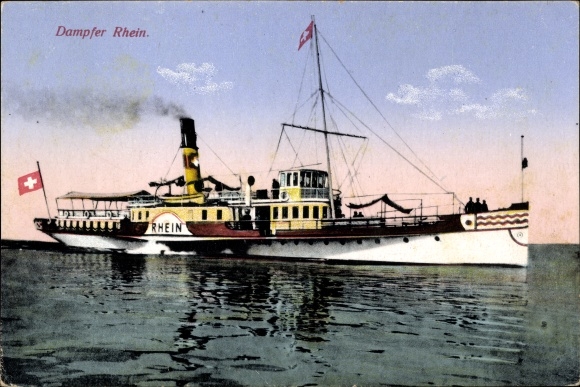
here [postcard from early 20th century, Lake Constance, see Emil Dreyer's comment below]
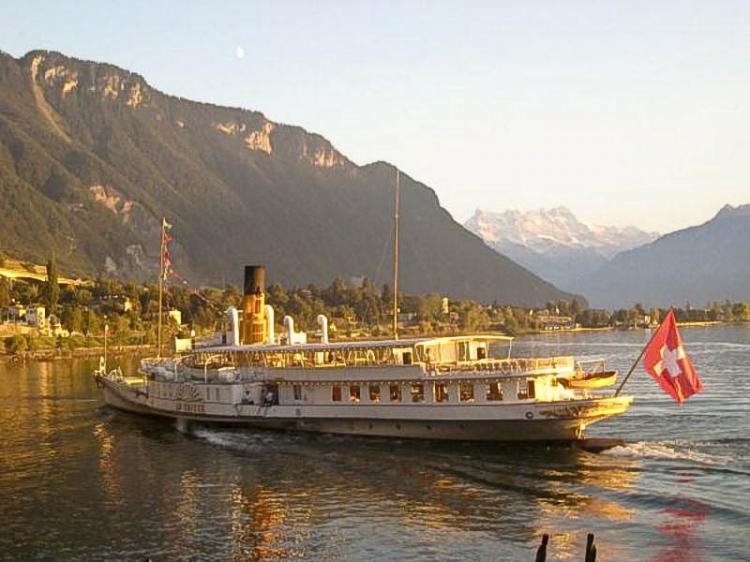
and here
– but not all of them – see here [expired].
Joe McMillan, 21 March 2009
See possibly Meylan (1974). I seem to
remember that the situation is a bit difficult, and somewhat different from lake
to lake, so there is no simple rule, and definitely no straightforward
legislation, but only some custom.
M. Schmöger, 30 March 2009
As we all know, Swiss sea-going ships are entitled by the law of 9 April 1941
(effective as of 17 April 1941) to use the rectangular national flag. Swiss
ships on the lake of Constance had used a rectangular flag of 2:3 as early as
1911 (Lake Constance steamship company regulations of 15 January 1911; see postcard
from early 20th c., steamship "Rhein" on Lake Constance), but they
were the only Swiss ships to use such a flag shape until 1941.
The law of
1941 was passed because during WWII it was necessary to distinguish the few
Swiss ships carrying supplies home, not to be seized or torpedoed by war-faring
powers. The internationally recognised ratio of 2:3, estimated to be the usual
maritime type of flag, was chosen. Those ships not only wore the rectangular
Swiss flag, but had large square (sic!) Swiss flags painted at the sides and on
top of the ships.
In fact, the construction sheet of this rectangular
Swiss flag is the only official drawing of a Swiss national flag so far. This
specific flag is officially denominated "national flag at sea" (Schweizerflagge
zur See), whereas the square national flag has no official name at all, it is
indifferently called the "federal flag" (Bundesfahne), the "confederate flag"
(eidgenössische Fahne), the "national flag" (Nationalfahne) or the "flag of the
country" (Landesfahne).
The first and only official mention of a Swiss
national flag is to be found in the constitution of 1848 (article 20, point 5),
where it simply says that "all troops in confederate service fly the confederate flag"
(Alle Truppenabteilungen im eidgenössischen Dienste führen die eidgenössische
Fahne). Only in 1851 is this flag described in a military regulation about
uniforms and equipment (regulation of 27 August 1851), in article 62 it says: "... each infantry batallion has a flag with the colours of the confederation,
the white cross on red field ...".
That's all what ever was regulated about
the Swiss national flag during the last 158 years. The actual Swiss constitution
has no mention to a national flag, there is obviously no need to mention what
has always been. There is no regulation as to the shape of the flag (of course
it is square, but this is said nowhere), as to the size of the cross in respect
to the field, nor as to the shade of red or white.
Only the proportion of the
cross has been regulated on 12 December 1889, to amend the regulation of 14 July
1815, whereby "... the red field should contain a freely standing upright white
cross, its arms being each one sixth longer than broad". So it has remained
until today.
Now back to the rectangular Swiss national flag. As I said,
ships on Lake Constance wear this rectangular flag 2:3 since 1911, sea-going
Swiss ships wear it since 1941. A regulation of 15 March 1971 introduced the use
of emblems to be placed on the rectangular Swiss flag "as long as it does
not be mistaken with any other foreign flag". Nothing is said about where such
emblems should be placed and how big these should be, etc. Usually such emblems
are placed in the upper hoist corner, following the example of the Cruising Club
of Switzerland, which had adopted its flag as early as 1956 (but which was not
allowed to use it as a national flag until 1971).
There are no official
government regulations for the use of rectangular flags on Swiss lakes and
rivers, usually though yachts and boat owners use the rectangular flags. I say
usually, because square flags are seen quite often too. Swiss ships on lake
Geneva, on lake Lugano and on lake Maggiore (lakes having a boundary to France
and Italy respectively) started using rectangular flags very early, but after
1941. Somewhat later followed the ships on lake Neuchâtel. I do not know the
exact dates of adoption of the use of rectangular flags by the steamship or
motorboat companies on those lakes. I have this research on my mind since 30
years ...
Each person or company is entitled to use the flag of individual
preference. Swiss flags on ships cruising on little lakes (like those of Zurich,
Hallwyl, Sempach, Zug, the Walensee, Ägeri, Thun, Biel, Murten, Brienz) are usually
square, as are those on the Lake of Lucerne. It seems as those regions in the
interior are more conservative and of course they have less maritime traditions
than when you live at those lake shores where you can see foreign ships.
The lack of clear regulations on the Swiss flag is on one side an expression
of liberty of the individual citizen. The Swiss identity is immediately
recognised, whatever shape the flag should have, and you can't show it upside
down. So there's no need for regulations, the flag has always been a white cross
on red, that's it. There is no government pursuit of offenses to the flag,
either by burning or soiling, or flying a square or rectangular or dark red or
bright red flag, the flag is the flag of every citizen, it has no political,
religious, cultural or ethnic burden.
Only the military have a strict
regulation to the use of the flag (i.e. colour). Government should have a
serious use of the flag too, but sometimes even officials use rectangular flags
instead of the square one (like it used to be flown on government cars until I
insisted in the new flag regulation of 2008 that only square flags had to be
used).
On the other hand, lack of regulation drives vexillologists crazy
:-)
Emil Dreyer, 30 March 2009
In the Dutch harbour of Sneek pleasure craft ships had hoisted rectangular Swiss ensigns.
Sneek is an inland harbour, and at least one of the craft flew a Basel flag
(as a hoist; should have been the jack). In all, that tells us that they could have reached us inland,
suggesting the Swiss rectangular ensigns are not necessarily limited to sea-going vessels or local Swiss
water ways only.
Peter Hans van den Muijzenberg, 18 May 2023
RS 747.30. Maritime Traffic Law (23 September 1953). Article 3: Swiss ensign
(Source:
Website of the Swiss government, German /
French / Italian)
![[Swiss ensign, construction sheet]](../images/c/ch~'.gif) image by Ivan Sache, based on figure that accompanied the 1953 law
image by Ivan Sache, based on figure that accompanied the 1953 law
The flag is a 2:3 rectangle, with A (length) = 1.5B (height). The central element of the cross is a square of side b. The square is placed in the geometrical center of the flag. Each horizontal arm of the cross has a height of b and a length of b+(1/6)b (the cross has the same specifications as in the coat of arms). There is a length of 0.5A between the cross edges and the left and right edges of the flag. Similarly, each vertical arm of the cross has a height of b+(1/6)b and a length of b. There is a height of b between the cross and the upper and lower edges of the flag.
Ivan Sache, 2 March 2002
RS 747.321.7. Regulation concerning Swiss yachts at sea (15 March 1971). Article 1, Paragraph 3
(Source: Website of the Swiss government, German / French / Italian)
One of three extracts from a memorandum sent to the Marine Department of the Board of
Trade in connection with revisions to the pages of national ensigns in the International
Code List published in 1879. [Public Record Office MT 9/183]
Switzerland.
Proposal of the Government of Switzerland to establish a Swiss maritime flag.
1864. "Switzerland has no distinctive maritime flag. Her Majesty's Minister in Berne
observed to the President of the Confederation that in the case where the merchant marine
would not have the protection of a military one, the measure might lead to political
complications in that while the position of Switzerland and her guaranteed neutrality
induced all Foreign Powers under existing circumstances to extend to her citizens
protection and goodwill, yet the use of the flag afloat might bring them into altercations
with belligerent Powers."
The question was referred to Admiral Harris who replied that "HM Government could only
view with satisfaction on the ocean, and in the ports of the British Empire the flag of an
industrious and friendly power, and that in time of peace no question were likely to arise
which would not admit of easy adjustment. However graver questions might arise in time of
war in consequence of Switzerland possessing no port of her own, and from the ships
bearing her flag hailing from ports of a belligerent. Neutrality guaranteed to the
territory of Switzerland could not be held to afford exceptional privileges to the
merchant vessels of Swiss citizens, and the power proposed to be given to Swiss consuls to
register vessels provisionally was considered likely to give rise to grave international
difficulties. The question of enforcement of Swiss municipal law on board such vessels,
and the manner in which respect to the Swiss Flag could be ensured were matters for the
Swiss Government."
Law Officers' Opinion. "The proposal is novel and though Swiss Marine must necessarily be
dependent upon the use of ports of other countries, there is no principle in International
Law which ought to lead other countries to refuse to recognise the flag of an inland
state, when used either by public ships of that state, or by the ships of its subjects
under the authority of its Government upon the high seas."
Proposal adjourned by Swiss Legislature to the following session, and abandoned in 1866.
David Prothero, 17 April 2001
It would seem peculiarly British to suppose that a state needed a distinctive
ensign – different from the national flag – for display at
sea, since most other countries even then used the same flag for both purposes.
The more relevant point is that subsequent treaties including the UN Convention on the Law of the Sea
explicitly recognize the right of landlocked states to use the high seas under their own flags.
Joe McMillan, 17 April 2001